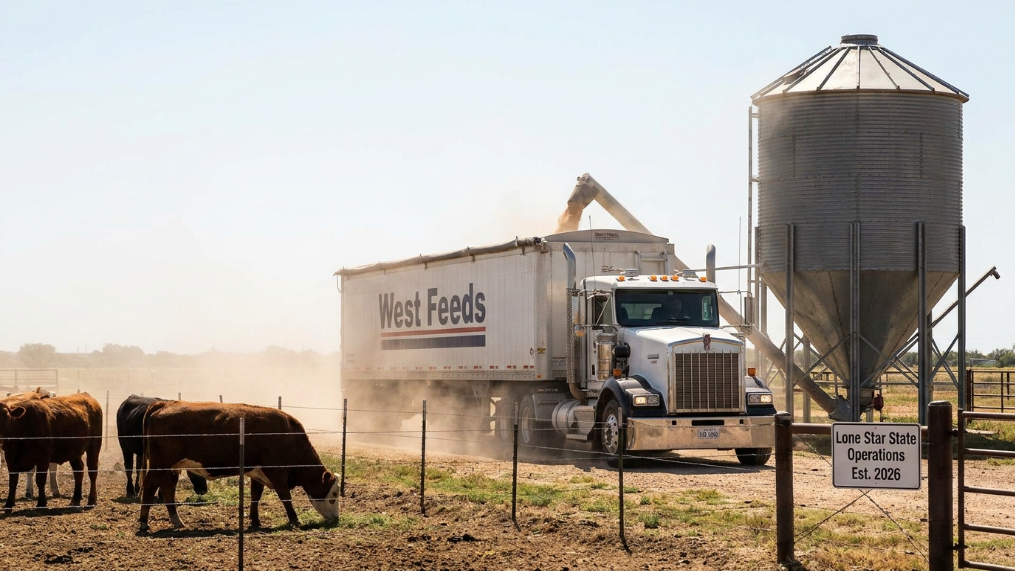
Buying bulk cattle feed in Texas is one of the fastest, most proven ways to cut feed costs by 20–40%—and with dozens of regional suppliers stocking everything from 20% protein cubes to liquid molasses, Lone Star ranchers have never had more options. This guide ranks the top 15 Texas bulk feed suppliers, breaks down 2026 prices by region, and gives you every tool—tables, checklists, FAQs, and a buyer’s guide—to make the smartest purchase for your herd.
Why Bulk Cattle Feed Saves Texas Ranchers 20–40%
Buying bagged feed is convenient—but it’s costing you real money at scale. A single 1,600 lb bag from a Central Texas supplier runs roughly $345, which works out to approximately $431/ton. Compare that to bulk truckload pricing, where 14% beef pellets can drop to $230–$289/ton, and the math speaks for itself.
Bag vs. Bulk: Cost-Per-Ton Comparison
| Feed Type | Bagged (50 lb bags) | Bulk (Truckload) | Savings/Ton |
|---|---|---|---|
| 14% Beef Pellets | ~$476/ton ($11.90/bag) | $230–$289/ton | $187–$246 |
| 15% Stocker Pellet | ~$484/ton ($12.10/bag) | $295–$425/ton | $59–$189 |
| 17% Stocker Pellet | ~$500/ton ($12.50/bag) | $445–$490/ton | $10–$55 |
| 12% Steer Fattener | ~$535/ton ($13.39/bag) | $440–$457/ton | $78–$95 |
| 20% Range Cubes | ~$550/ton ($13.75/bag) | $380–$460/ton | $90–$170 |
Sources: Valley Feed price list; J&J Cattle Co.; unanswered.io bulk pricing
Protein Requirements for Texas Herds
Texas beef cattle typically require rations with 12–18% crude protein, depending on life stage:
- Cow-calf pairs: 12–14% CP with adequate energy
- Stocker/growing cattle: 14–17% CP for efficient gain
- Finishing/fattening: 12–14% CP, high energy (corn-based)
- Lactating cows: 14–16% CP to maintain milk production
Texas ranks among the nation’s top five feed ingredient-consuming states, primarily for beef cattle. With over 12 million head of cattle statewide, securing reliable bulk supply is critical to profitability.
Top 15 Bulk Cattle Feed Suppliers in Texas
📌 Need bulk feed fast? Get a Free Quote From a Texas Supplier Near You →
Texas Bulk Feed Supplier Rankings (2026)
| # | Supplier | Headquarters | Key Products | Delivery Radius | Est. Price/Ton | Contact |
|---|---|---|---|---|---|---|
| 1 | West Feeds, Inc. | West, TX (McLennan Co.) | Cubes, pellets, meals, textured | Statewide via dealer network | $230–$380 | westfeeds.com |
| 2 | Producers Cooperative Assoc. | Bryan, TX | Bulk cubes, custom rations, range feed | Central/East TX statewide | $250–$400 | producerscooperative.com |
| 3 | Carmine Feed & Fertilizer | Carmine, TX / Giddings, TX | Bulk feed, molasses delivery | Central TX, Hill Country | Call for quote | carminefeed.com |
| 4 | Thomas Moore Feed | Navasota, TX | 20% All Natural Cubes, bulk feed | Central TX | $350–$460 | thomasmoorefeed.com |
| 5 | Producers Co-Op (South TX) | New Braunfels / Seguin, TX | Range cubes, stocker feed, show feed | South/Central TX | $260–$420 | producerstx.com |
| 6 | J&J Cattle Co. | Temple, TX | 12.5% Grower, 25% Pasture Supplement | Central TX, delivery avail. | $380/ton (~$190/bag) | jjcattleco.com |
| 7 | Speer Ag, LLC | Uvalde, TX | Cattle, horse, wildlife bulk feed | South TX, delivery w/ bobtail | Call for quote | speerag.com |
| 8 | Valley Feed | Rio Grande Valley | 14% Economy Pellets, 17% Stocker | South TX / RGV | $420–$490/ton | valleyfeed.com |
| 9 | Riverside Feed & Seed | Central TX | Range cubes, soy hulls, all-stock | Central/East TX | $288–$550/cwt basis | riversidefeed.com |
| 10 | Rib-Arc Cattle Co. | Temple, TX | 12% Self-Feed, 18% Supplement | Heart of TX, 10-ton+ delivery | $345/1,600 lb bag | ribearcattle.com |
| 11 | Big State Feeds | Pasadena, TX | Bulk commodity feeds | Houston Metro | 832-699-1679 | — |
| 12 | D&D Feed & Supply | Tomball, TX | Custom bulk, range cubes | Greater Houston | 281-351-7144 | — |
| 13 | HF&C | Lubbock, TX | Bulk grains, commodity feeds | Panhandle/West TX | 806-866-9801 | — |
| 14 | Innovative Farm & Ranch | Harlingen, TX | Bulk livestock, custom blends | Rio Grande Valley | 956-440-0806 | — |
| 15 | Haskell Feeds | Haskell, TX | Bulk range cubes, supplement | West TX / Rolling Plains | 940-864-2614 | — |
Supplier data compiled from: West Feeds; Producers Cooperative; Carmine Feed; Thomas Moore Feed; Producers Co-Op dealers; J&J Cattle; Speer Ag; Valley Feed
West Feeds, Inc. — Editor’s Pick
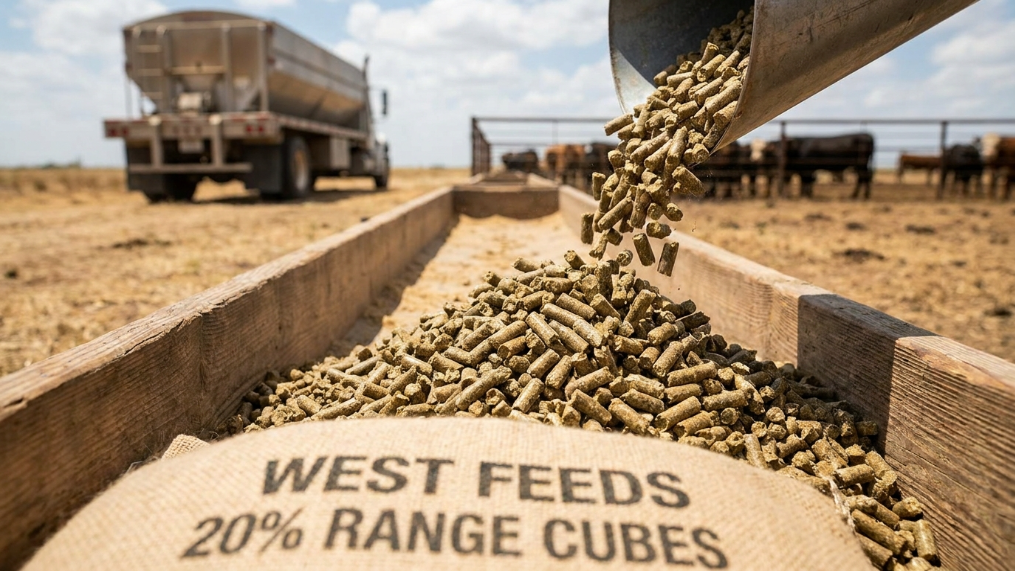
West Feeds is a family-owned Texas manufacturer headquartered in West, TX, offering a complete line of cattle feed—meals, cubes, pellets, and textured blends—distributed through an interactive statewide dealer network. Their dealer locator map makes finding local pickup easy across all 254 Texas counties.
Carmine Feed & Fertilizer — Best Molasses Delivery
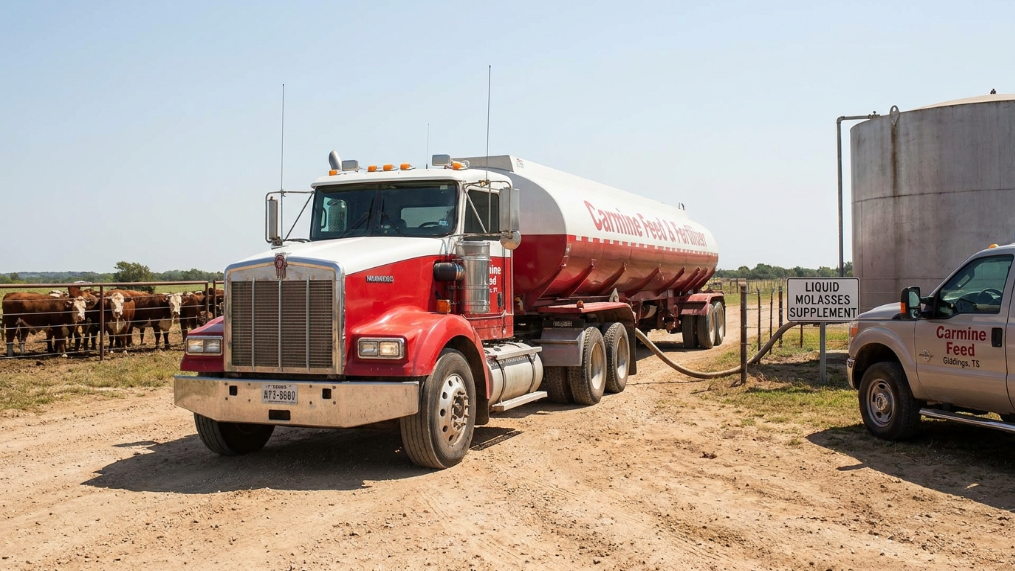
Carmine Feed operates two locations (Carmine and Giddings, TX) and delivers bulk feed in 3-ton increments, minimum 6 tons. Their trucks load directly from the supplier facility and drop feed wherever you point them—silos, bunks, or pads. They also offer same-day molasses feeder setup and fill service, making them the go-to for liquid supplement delivery in Central Texas.
Producers Cooperative Association — Best Coverage
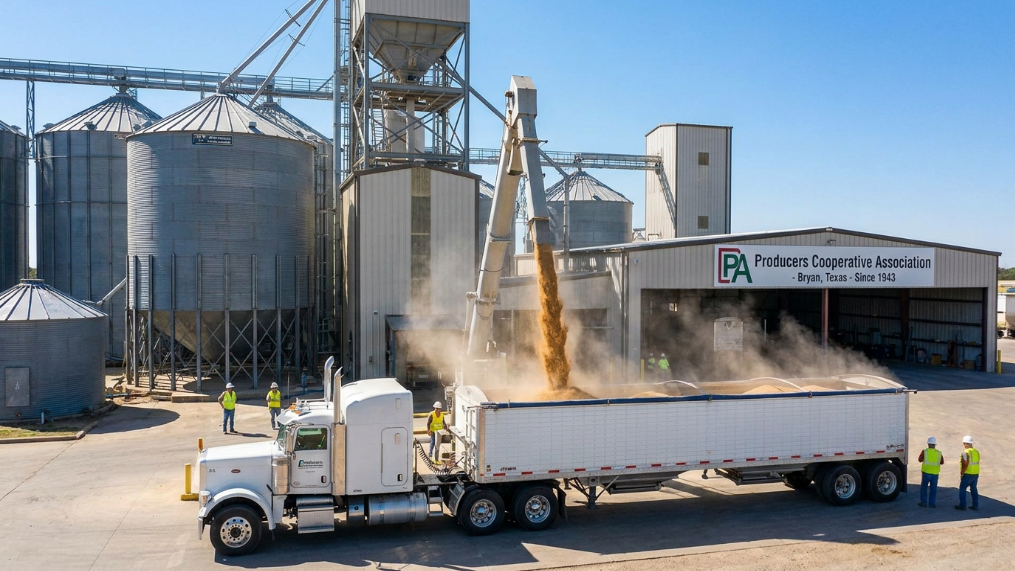
With locations in Bryan, Hillsboro, and Heidenheimer, Producers Cooperative has served Texas since 1943. They offer feed delivery via textline (979-272-6933) and a dealer network spanning all four quadrants of the state—from Lubbock to Harlingen.
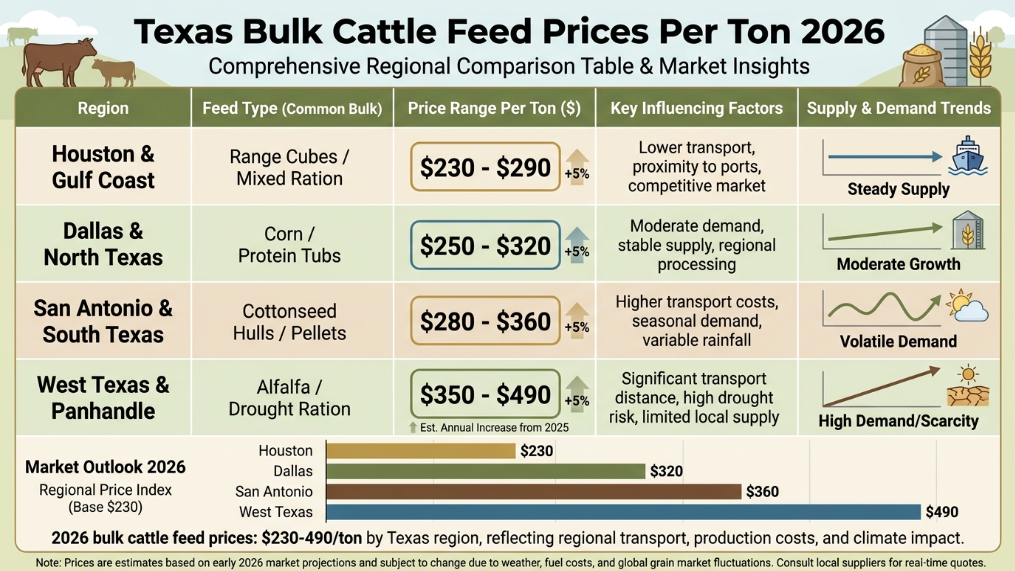
2026 Bulk Cattle Feed Prices by Texas Region
Feed prices vary significantly by region—proximity to rail, corn belt inputs, and local demand all drive differences of $50–$100/ton between West Texas and the Gulf Coast.
📌 Request Current Pricing From Suppliers Near You →
Regional Price Table: Bulk Cattle Feed (2026)
| Feed Type | Houston Area | Dallas/DFW | San Antonio | West TX / Panhandle | Rio Grande Valley |
|---|---|---|---|---|---|
| 14% Beef Pellets (bulk/ton) | $270–$310 | $250–$289 | $260–$300 | $230–$270 | $280–$320 |
| 15% Stocker Pellet | $300–$340 | $295–$330 | $310–$345 | $280–$315 | $320–$360 |
| 17% Stocker Pellet | $360–$420 | $350–$400 | $365–$415 | $340–$390 | $375–$440 |
| 20% Range Cubes | $380–$440 | $370–$420 | $375–$430 | $350–$400 | $390–$460 |
| Cottonseed Cubes (extruded) | $420–$460 | $410–$455 | $415–$460 | $395–$445 | $430–$480 |
| Liquid Molasses (bulk) | $180–$240 | $175–$230 | $180–$235 | $160–$210 | $190–$250 |
| DDGs (Distillers Grains) | $160–$201 | $160–$195 | $165–$200 | $155–$190 | $170–$210 |
Based on 2026 pricing data from Valley Feed, J&J Cattle, Rib-Arc Cattle, unanswered.io bulk survey
Key Price Factors in 2026
- Protein %: Every 1% increase in crude protein adds $15–$30/ton to cost
- Corn inputs: Corn and corn-related ingredients make up ~70% of non-forage livestock feed nationally
- Freight/delivery surcharges: Add $50–$150/ton depending on distance and truck type
- Minimum order: Typically 3–6 tons for bulk delivery; truckload (24 tons) unlocks best pricing
- Organic premium: Organic 16% maintenance feed adds 40–80% over conventional
Types of Bulk Cattle Feed for Texas Herds
Choosing the right feed form matters as much as choosing the right protein level. Here’s what Texas suppliers stock—and what works best for different herd types.
Feed Types at a Glance
| Feed Form | Best For | Pros | Cons | Typical Protein |
|---|---|---|---|---|
| Range Cubes | Cow-calf, range supplementation | Easy to broadcast, palatable | More expensive than pellets | 20–32% |
| Pellets | Stocker, finishing, dairy | Precise nutrition, low waste | Dusty if over-handled | 12–17% |
| Textured Feed | Calves, show cattle | High palatability, visible | Higher cost/ton | 12–14% |
| Liquid Feed/Molasses | Free-choice lick, mineral carrier | Encourages forage intake | Requires tanks/feeders | 10–32% (w/ urea) |
| DDGs (Distillers Grain) | Finishing, energy supplement | Cheap energy + protein | Phosphorus-heavy, ration math needed | 25–28% |
| Mineral Tubs | Pasture supplementation | Low labor, weatherproof | High cost per lb | 20–38% |
| TMR/Custom Blend | Feedlot, intensive dairy | Precise ration control | Requires TMR mixer | Varies |
Cheapest Way to Fatten Cattle: The Texas Ration
The most cost-effective cattle fattening approach combines cheap forage with a targeted supplement:
- Base: Bermuda hay or silage ($60–$120/ton, self-grown or local)
- Energy: DDGs at $160–$201/ton (cheapest protein/energy source nationally)
- Protein top-dress: 20% range cubes fed at 1–2 lbs/head/day
- Minerals: Free-choice loose mineral or lick tub
Estimated cost to gain 1 lb: $0.65–$0.90/lb liveweight with this combination, versus $1.10–$1.40/lb on all-in commercial feed.
Thomas Moore Feed — Natural Cube Specialist
Thomas Moore Feed (Navasota, TX) offers 20% All Natural Cubes specifically designed for beef cattle on pasture—¾” form for easy consumption, with no artificial additives. Their product line supports forage-based programs common across East and Central Texas.
Delivery & Logistics: Bulk Trucks, Silo Filling & MOQs
📌 Schedule a Bulk Feed Delivery in Your Area →
Understanding delivery logistics prevents costly mistakes—wrong truck type, undersized silos, or missed minimums.
Delivery Methods Used by Texas Suppliers
Delivery Cost Estimates
- Local (within 50 miles): $50–$75/ton
- Regional (50–150 miles): $75–$110/ton
- Long-haul (150+ miles): $110–$150/ton or flat truck rate
- Carmine Feed MOQ: 6 tons minimum (3-ton increments)
- Rib-Arc Cattle delivery: 10 tons minimum, call for rate
Silo & Storage Checklist
Before scheduling your delivery, confirm:
- Silo/bunker capacity ≥ your order size + 10% buffer
- Access road supports 80,000 lb GVW (loaded semi)
- Drop-point is within 50 ft of truck reach
- Feed is covered/sealed to prevent moisture and mold
- Pest control in place (rodents destroy 5–10% of stored feed)
Nutrition Guide: Best Feeds for Texas Cattle
Texas cattle diets are shaped by the state’s dominant forages—Bermuda grass, coastal hay, and native rangeland—which vary dramatically in protein (5–12% CP) and energy seasonally.
Forage vs. Supplement: What Texas Grass Provides
| Forage Type | Crude Protein | TDN (Energy) | Limiting Factor |
|---|---|---|---|
| Bermudagrass hay (good) | 10–14% | 55–60% | Energy in winter |
| Bermudagrass hay (poor) | 5–8% | 45–52% | Both protein + energy |
| Coastal hay | 8–12% | 52–58% | Energy supplement needed |
| Native rangeland (summer) | 8–12% | 50–56% | Protein in drought |
| Native rangeland (winter) | 4–7% | 40–48% | Both—critical gap |
| Silage (corn) | 7–9% | 68–72% | Protein top-dress needed |
Rule of thumb: When your forage drops below 7% CP, cattle cannot maintain body condition without a protein supplement—even if they’re eating all day. Range cubes (20–32% CP) fed at 1–2 lbs/head/day bridge this gap at minimal cost.
SAFE Technology & Rumen Health
- Slow-release non-protein nitrogen (NPN): Products using SAFE (Starea/Alltech) tech allow urea to safely contribute protein equivalent in liquid feeds—boosting cost efficiency by 30–40% vs. natural protein only
- Ionophores (Rumensin/Bovatec): Added to many commercial pellets to improve feed efficiency by 8–10%; check label if feeding to horses (toxic to equines)
- Bypass protein: Heat-treated or expeller-processed soybean meal; valuable for high-producing dairy or show cattle
How to Choose & Buy Bulk Feed: 10-Step Buyer Checklist
Step-by-Step Bulk Feed Buying Guide
- Calculate your daily requirement — Average cow needs 2–2.5% of bodyweight in dry matter/day. A 1,200 lb cow = 24–30 lbs/day DM.
- Assess your forage quality — Get a hay test ($15–$25 at Texas A&M AgriLife) before buying supplements. Don’t guess.
- Identify protein gap — If forage CP < 7%, add a 20% range cube at 1–2 lbs/head/day.
- Match feed form to your setup — Cubes for broadcast feeding; pellets for bunks; liquid for free-choice.
- Get 3 competitive quotes — Call West Feeds, Carmine, and your local Producers Co-Op dealer. Prices vary $50–$100/ton.
- Verify protein %, TDN, and additive tag — Request a guaranteed analysis sheet before ordering.
- Confirm delivery minimums and access — Most bulk trucks require 6–10 ton MOQ and paved/gravel road access.
- Negotiate truckload pricing — Ordering 24+ tons unlocks the best per-ton rates.
- Inspect first delivery — Check for mold, off-smell, clumping, or foreign material. Reject non-conforming loads.
- Track cost-per-gain — Weigh cattle monthly. If cost/lb gain exceeds $1.20, re-evaluate ration.
🚩 Red Flags — Avoid These Bulk Feed Mistakes
- Protein below label spec (ask for COA from every lot)
- No ingredient list or guaranteed analysis on delivery ticket
- Moisture content > 12% (mold risk in storage)
- Supplier who can’t confirm delivery date/truck type in writing
- “All-natural” claims without AAFCO-compliant labeling
- Pricing that seems too low—dilution with fillers (rice hulls, dirt) is a real issue
Regional Supplier Finder: Bulk Cattle Feed by Texas City
Use this as your quick-reference guide before calling. Each entry links to a child page for full dealer listings.
By Region
Houston Metro (Harris, Fort Bend, Montgomery, Brazoria Counties)
- Big State Feeds — Pasadena, TX (932-699-1679)
- D&D Feed & Supply — Tomball, TX (281-351-7144)
- Texas Feed Stop — Mont Belvieu, TX (281-385-6068)
- Katy Feed & Tack — Katy, TX (281-391-3333)
- Spring Creek Feed — Magnolia, TX (281-252-5400)See full Houston bulk cattle feed dealers map →
Dallas / DFW Metroplex
- Joshua Feed — Joshua, TX (817-558-3444)
- Peacocks Feed — Weatherford, TX (817-594-5424)
- Farmersville Grain & Hardware — Farmersville, TX (972-784-7261)
- Pilot Point Feed — Pilot Point, TX (940-686-3333)See full Dallas bulk cattle feed supplier guide →
San Antonio / Central Texas
- Producers Co-Op — New Braunfels (830-625-2381), Seguin (830-379-1750)
- Allied Ag — Stonewall, TX (830-644-2411)
- Carmine Feed & Fertilizer — Carmine/Giddings, TX
- Thomas Moore Feed — Navasota, TX (936-825-2239)See full San Antonio bulk feed delivery options →
Bryan / College Station
- Producers Cooperative Association — Bryan, TX (979-778-6000)
- Circle P Feed — Bryan, TX (979-778-0978)
- Grimm Feed — Giddings, TX (979-540-8620)See Central Texas bulk feed delivery schedule →
West Texas / Panhandle / Lubbock
- HF&C — Lubbock, TX (806-866-9801)
- Haskell Feeds — Haskell, TX (940-864-2614)
- JP Feed & Seed — Snyder, TX (325-436-0434)
- Big Country Ag — Sweetwater, TX (325-219-7077)See West Texas and Panhandle bulk cattle feed guide →
South Texas / Rio Grande Valley
- Innovative Farm & Ranch — Harlingen, TX (956-440-0806)
- Chapparral Feed — Cotulla, TX (830-483-5012)
- Free Flo Feeds — Tilden, TX (361-274-3232)
- Longhorn Farm & Ranch — Agua Dulce, TXSee South Texas and RGV bulk feed suppliers →
El Paso / Trans-Pecos
Frequently Asked Questions (JSON-LD Ready)
General Pricing
Q: How much does 1 ton of cattle feed cost in Texas?
A: In 2026, bulk cattle feed in Texas ranges from $230 to $490/ton depending on protein percentage and feed type. Standard 14% beef pellets run $230–$310/ton in truckload quantities. Specialty or organic feeds can reach $460+/ton.
Q: What is the cheapest feed to fatten cattle?
A: The cheapest approach is a forage + DDGs + range cube combination. Dried Distillers Grains (DDGs) cost as little as $160–$201/ton and provide 25–28% protein along with high energy. Combined with Bermuda hay or silage and a 1 lb/head/day range cube supplement, this delivers efficient gains at under $0.90/lb liveweight.
Q: How much does bulk cattle feed cost per bag vs. bulk?
A: A 1,600 lb bag from a Central Texas supplier costs roughly $345, or about $431/ton. Truckload bulk pricing drops to $230–$289/ton for comparable 14% feed —a savings of $140–$200/ton.
Q: Is bulk feed cheaper than bags at Tractor Supply or co-ops?
A: Yes—bulk pricing is typically 20–40% cheaper than retail bagged feed once you’re ordering 6+ tons. A 50 lb bag at $12.10 converts to $484/ton, while bulk 15% stocker pellets run $295–$425/ton.
Suppliers & Delivery
Q: Does Carmine Feed deliver bulk cattle feed?
A: Yes. Carmine Feed & Fertilizer delivers bulk feed in 3-ton increments with a minimum order of 6 tons, loading from their Giddings, TX supplier facility and dropping directly to silos or feed pads on your ranch.
Q: Does West Feeds deliver bulk cattle feed across Texas?
A: West Feeds operates through a statewide dealer network covering all regions of Texas. Contact your nearest dealer via their interactive map at westfeeds.com, or pick up directly at their West, TX headquarters.
Q: What is the minimum order for bulk cattle feed delivery?
A: Minimums vary by supplier. Carmine Feed requires 6 tons (3-ton increments). Rib-Arc Cattle fills 10+ ton orders on a call-ahead basis. Truckload pricing (24 tons) typically unlocks the best per-ton rates.
Q: Do Texas feed suppliers deliver bulk molasses?
A: Yes. Carmine Feed & Fertilizer offers same-day molasses delivery to refill existing feeders or set up new feeders on your property. Call their Carmine or Giddings, TX store for scheduling.
Nutrition & Feed Selection
Q: What protein percentage should cattle feed be in Texas?
A: Beef cattle generally need 12–18% crude protein depending on class. Cow-calf pairs need 12–14%; growing stockers need 14–17%; finishing cattle thrive at 12–14% with high energy. When winter range drops to 4–7% CP, supplement with 20% range cubes at 1–2 lbs/head/day.
Q: What is the best bulk feed for beef cattle weight gain?
A: For maximum weight gain efficiency, use 12–14% high-energy pellets or textured feed with added ionophores (Rumensin/Bovatec), paired with ad-lib corn silage or Bermudagrass hay. J&J Cattle Co. reports their 12.5% custom grower ration is designed specifically to “maximize weight gain in the most cost efficient manner”.
Q: What are cattle cubes and why buy them in bulk?
A: Cattle cubes are compressed blocks of ground hay, grain, and protein supplements (typically 20–32% CP) that can be broadcast from a truck or fed in bunks. In bulk, 20% range cubes run $350–$460/ton in Texas vs. $550+/ton in bags—making bulk purchasing highly cost-effective for supplementing pasture cattle.
Q: Can I mix bulk molasses into dry feed in Texas?
A: Yes—liquid molasses is commonly blended with range cubes, distillers grains, or ground hay to improve palatability and add fermentable energy. Most Texas bulk suppliers (Carmine, Producers Co-Op) can advise on blend ratios and co-deliver both products.
Q: What is liquid feed supplement for cattle?
A: Liquid feed supplements are poured or pumped into free-choice lick tanks, combining molasses, urea (NPN), minerals, and vitamins. Cattle self-regulate intake at 0.5–2 lbs/head/day. They’re particularly useful in West Texas and drought years when forage quality crashes.
Buying & Logistics
Q: What is the cheapest way to feed livestock in Texas?
A: Self-grown forage (Bermuda hay or silage) as the base, supplemented with DDGs ($160–$201/ton) and a low-cost range cube (1 lb/day), is the most economical approach. Bulk purchasing at truckload quantities saves an additional 20–40% over retail bags.
Q: How should I store bulk cattle feed on my ranch?
A: Use covered steel silos, concrete bunkers, or weatherproof bins. Keep moisture below 12%. Inspect regularly for mold, pests, and bridging. Feed on a FIFO (first in, first out) basis. Never store bulk feed in direct sunlight or near standing water.
Q: Does Napier grass work in feed bunks for Texas cattle?
A: Napier (elephant) grass is high-yield and can be chopped for silage or green chop. It performs best in South and East Texas with adequate rainfall. It’s high in water content (~80%) so dry matter yield per acre is moderate—pair with protein supplement for lactating cows.