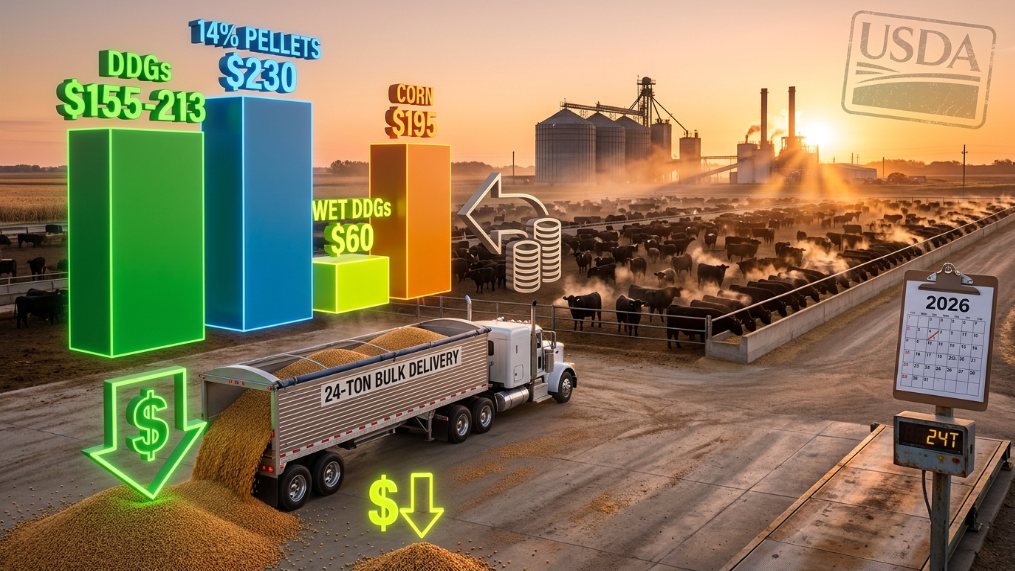
Why Bulk Feed Costs Matter More Than Ever in 2026
The U.S. cattle industry is operating at its tightest in 75 years. The national beef herd has shrunk to its lowest level since 1951, beef prices are near all-time highs, and every dollar you spend on feed hits your margin directly. USDA forecasts the 5-area steer price to average $240/cwt in 2026 — up 7% year-over-year — while 750–800 lb feeder cattle are projected at $364/cwt, a 13% jump from 2025.
With cattle values at record levels, you might think margins are easy. They’re not. Input costs — especially feed — are the single biggest variable you control. When a 1,300 lb steer consumes 25–28 lbs of dry matter per day, feed costs accumulate fast. The ranchers who understand bulk cattle feed prices USA 2026 and act on that knowledge are the ones protecting their bottom line.
USDA’s Agricultural Prices report (March 2026) confirms the Prices Paid Index for livestock inputs is running 8.1% above February 2025 levels. Feed is a major component of that pressure. Know your numbers. Buy smarter.
Current Bulk Cattle Feed Prices Per Ton (2026 Data)
The table below consolidates verified bulk cattle feed cost per ton 2026 data from the University of Missouri By-Product Feed Price Listing (March 26, 2026), Valley Feed, and regional supplier quotes.
Prices vary significantly by region, minimum order size, and protein specification. Missouri commodity suppliers typically offer the lowest bulk rates.
2026 Bulk Cattle Feed Price Table
| Feed Type | Protein % | Bulk Price Per Ton | Region / Notes |
|---|---|---|---|
| 14% Economy Pellet (Gateway FS) | 14% | $230/ton | FOB Ste. Genevieve, MO — bulk |
| 14% Beef Performer Pellet w/ VTM (NutraAg) | 14% | $233/ton | FOB Versailles, MO — 24-ton min |
| 14% Beef Pellet (Trade Comm) | 14% | $249/ton | FOB Rich Hill, MO — truckload |
| 14% Beef Pellet (Trade Comm) | 14% | $279/ton | FOB Rich Hill, MO — 1-ton min |
| 9% Economy Cattle Pellet (Mine Creek) | 9% | $210/ton | FOB Pleasanton, KS |
| 12% Steer Fattener w/ Cattle Active | 12% | $260/ton | FOB Pleasanton, KS |
| 15% Stocker Pellet w/ Additives | 15% | $295/ton | FOB Pleasanton, KS |
| Dried Distillers Grains — DDGs (range) | ~27–30% | $155–$213/ton | FOB MO/KS/NE/OK — dry bulk |
| DDG Pellets (NutraAg / Trade Comm) | ~27–30% | $247–$283/ton | FOB MO — truckload |
| DDG Cubes (Trade Comm) | ~27–30% | $349/ton | FOB Rich Hill, MO — truckload |
| Modified Wet DDGs | ~27–30% | $70–$121/ton | FOB MO — near ethanol plants |
| Wet Distillers Grains | ~27–30% | $60–$104/ton | FOB MO — highest moisture |
| Corn Gluten Feed, Loose | ~21% | $222/ton | FOB Springfield, MO |
| Corn Gluten Feed, Pelleted | ~21% | $182–$237/ton | FOB MO/KS/NE/OK |
| Cottonseed Cubes / All-Stock Pellet | ~24% | $460/ton | FOB Brownfield, TX — extruded |
| Cottonseed Hulls | ~4% | $390–$450/ton | FOB MO/KS/NE/OK |
| Soy Hulls, Pelleted | ~12% | $115–$160/ton | FOB MO/KS/NE/OK |
| Ground Corn (feedlot benchmark) | ~9% | $195–$199/ton | FOB MO / ~$4.11/bu (Feb 2026) |
| Alfalfa Hay, all baled | ~17–18% | $159/ton | National avg, Feb 2026 (USDA) |
| Soybean Meal 48% (SBM) | 48% | $347/ton | FOB Mt. Vernon, IN |
| Whole Corn (feedlot-level) | ~9% | ~$361/ton equivalent | ~$4.51/bu at feedlots, Jan 2026 |
Sources: University of Missouri By-Product Feed Listing (March 26, 2026); USDA Agricultural Prices Report, March 2026; DTN/ProFarmer; unanswered.io bulk feed price guide
Bulk Cattle Feed Price Breakdown by Feed Type
Grain-Based Complete Feeds
Corn-based complete rations remain the backbone of commercial feedlot diets. Ground corn from Missouri suppliers runs $195–$199/ton FOB, while whole corn at feedlots was priced at approximately $4.11/bu ($73/ton) at the farm gate in February 2026, according to USDA NASS — but feedlot-delivered cost runs closer to $4.51/bu ($80.50/ton) when accounting for freight. Textured and complete beef rations that blend corn with byproducts and minerals typically range $230–$295/ton depending on protein spec, with higher-protein complete feeds pushing toward $380–$460/ton. These feeds are most cost-effective when ordered in full truckload quantities of 24–25 tons.
Protein Pellets & Concentrates
Protein pellets are the most widely quoted feed type in bulk cattle feed prices USA 2026 data. The range is wide by design — it tracks directly with your protein specification:
- 9% Bronze pellets: ~$210/ton
- 12% pellets w/ additives: ~$260/ton
- 14% commodity pellets: $230–$249/ton (Midwest truckload pricing)
- 15% stocker pellets w/ additives: ~$295/ton
- 24% high-protein cubes (cottonseed-based): ~$460/ton
Stocker and backgrounder operators typically find 14–15% pellets the best balance between protein delivery and cost. Jumping from 14% to 17% protein adds roughly $30–$60/ton to your cost — justify it with a performance comparison before upgrading specs.
By-Product Feeds (DDGs, Corn Gluten Feed)
By-product feeds are the single best cost-reduction lever available to bulk buyers in 2026. Dried distillers grains (DDGs) — the most important byproduct feed in U.S. cattle nutrition — ran $155–$213/ton FOB Missouri as of March 2026. The DTN weekly spot average for DDGs was $161/ton for the week ending January 15, 2026. Pelleted DDGs command a premium at $247–$283/ton, while wet distillers grains drop as low as $60–$70/ton for operations within trucking distance of an ethanol plant. Corn gluten feed (pelleted) sits in the $182–$237/ton range. These products deliver comparable or superior energy and protein to corn — at a fraction of the cost per unit of gain.
Roughage & Hay Stretchers
Alfalfa hay averaged $159/ton nationally in February 2026 per USDA NASS, down slightly from $160/ton in January. Other hay types averaged $139/ton. Soy hulls — one of the most effective hay-stretcher ingredients — range from $105–$160/ton pelleted depending on region. Peanut hull pellets run $115–$197/ton. Hay stretcher blends using soy hulls, corn gluten feed, and molasses allow stocker operations to reduce hay consumption by 20–30% while maintaining dry matter intake — a significant savings when hay costs approach $150–$200/ton delivered.
Specialty & Organic Feeds
Specialty and Non-GMO certified feeds carry significant premiums. Extruded cottonseed cubes (24% protein, 6.5% fat) from KoTon run $460/ton FOB Brownfield, TX. Organic 16% all-stock maintenance feeds in tote bags run $600–$700/ton equivalent at specialty suppliers. These products serve niche markets — grass-fed/organic certification programs, show cattle, or operations requiring specific additives. For commercial cow-calf and feedlot programs, they rarely pencil out vs. commodity options.
Regional Price Variations Across the USA
Geography matters as much as feed type when comparing cattle feed cost per ton 2026. Here’s what the data shows:
2026 Regional Bulk Cattle Feed Price Overview
| Region | Typical Bulk Feed Price Range | Key Price Drivers |
|---|---|---|
| Midwest (MO, IA, KS, NE) | $155–$295/ton | Proximity to corn belt; dense ethanol plant network; high DDG availability; competitive supplier base |
| South/Southwest (TX, OK) | $215–$460/ton | Mid-range commodity pricing; cottonseed byproduct availability in TX; higher freight on imports |
| Southeast (AL, GA, NC) | $250–$380/ton | Higher freight costs; peanut hull byproducts locally available; less DDG competition |
| West/Pacific (CA, OR, WA) | $420–$490/ton | Highest freight costs; limited local ethanol production; hay dependency; water constraints |
The Midwest advantage is structural, not seasonal. Missouri, Iowa, Kansas, and Nebraska sit inside the corn belt, within 100–200 miles of dozens of ethanol plants producing DDGs continuously. A rancher in Missouri buying DDGs at $175/ton faces a drastically different cost structure than a California feedlot paying $420–$490/ton for a similar complete ration. If you’re operating in a high-cost region, the most powerful cost lever is sourcing from Midwest commodity brokers with FOB pricing and arranging your own freight.
What Factors Drive Bulk Cattle Feed Prices in 2026?
Seven variables dominate feedlot feed prices in 2026:
- Corn price: The foundational input. Corn was $4.11/bu at the farm gate (Feb 2026) and approximately $4.51/bu at feedlots (Jan 2026) per USDA data. A $0.50/bu corn move translates to ~$9/ton change in complete feed cost.
- Soybean meal (SBM): At $347/ton FOB Indiana in March 2026, SBM drives protein pellet and supplement pricing. The Feb 2026 SBM price was ~$325/ton.
- DDG market dynamics: DDG prices correlate tightly with corn and SBM. As corn/SBM fall, DDG values drop — and vice versa. 2026 DDG prices are running $155–$213/ton dry.
- USDA feed cost forecast: USDA projects feed prices lower in 2026 vs. 2025, supported by a record 2025/2026 corn crop and increased domestic soybean crush. This is a tailwind for buyers who act now.
- Forage supply: Hay prices are relatively stable at $152/ton (all hay, Feb 2026). Forage availability heading into 2026 is described as stable by USDA.
- Freight and logistics: FOB vs. delivered pricing can swing total cost $30–$80/ton depending on your distance from the supply source. Always calculate delivered cost, not just FOB.
- Minimum order size: Truckload minimums (24–25 tons) consistently unlock 10–20% discounts vs. single-ton pricing. The Trade Comm example — $249/ton truckload vs. $279/ton at 1-ton minimum — illustrates a $30/ton penalty for small orders.
Cheapest Feed Options to Fatten Cattle in 2026
What is the cheapest feed to fatten cattle? The answer in 2026 is clear: by-product feeds, led by DDGs and wet distillers grains, deliver the best cost-per-pound-of-gain of any commercially available option.
Here’s how the top cost-effective options stack up:
- Wet/Modified Distillers Grains ($60–$121/ton): If you’re within 50–75 miles of an ethanol plant, this is your cheapest calorie source. High moisture content limits shelf life but cuts cost dramatically. Best for operations with TMR (total mixed ration) equipment.
- Dry DDGs ($155–$213/ton): The most widely available cost-effective feed in the U.S. At 27–30% protein and ~90% TDN, DDGs replace both corn (energy) and SBM (protein) simultaneously. Inclusion rates of 20–30% of ration dry matter are standard.
- 14% Economy Pellets ($230–$249/ton): For operators who need simplicity — one feed, one delivery — Missouri commodity pellets are hard to beat. No mixing required.
- Corn + DDG Blend Rations: Blending ground corn (~$195–$199/ton) with DDGs (~$175/ton) at a 70/30 ratio produces a ~$190/ton effective ration cost with solid energy density. Many custom feedyards use this base.
- Hay Stretcher Blends (Soy Hulls + Corn Gluten Feed): Soy hull pellets at $115–$160/ton and corn gluten feed at $182–$222/ton stretch forage budgets significantly in stocker programs.
Cost Per Pound of Gain: Quick Comparison
| Feed Source | Approx. $/ton | Feed Conversion (lbs feed/lb gain) | Est. Feed Cost/lb Gain |
|---|---|---|---|
| Wet DDGs (near ethanol plant) | $80/ton | 7:1 | $0.28/lb |
| Dry DDGs (bulk Missouri) | $175/ton | 6.5:1 | $0.57/lb |
| 14% Economy Pellets | $235/ton | 7:1 | $0.82/lb |
| Corn + DDG Blend | $190/ton | 6.8:1 | $0.65/lb |
| Cottonseed Cubes | $460/ton | 6.5:1 | $1.49/lb |
Feed conversion rates based on Kansas State Feedlot Performance benchmarks;
Annual Feed Cost to Raise a Cow (2026 Estimates)
How much does it cost to feed a cow for a year in 2026? The math depends on your program type — but here are the real numbers.
A 1,200 lb dry beef cow consumes approximately 2% of body weight in dry matter per day = 24 lbs/day = ~4.4 tons/year. A growing 750 lb stocker eats roughly 18–20 lbs DM/day.
Annual Feed Cost Estimates by Program Type (2026)
| Feeding Program | Daily DM Intake | Daily Feed Cost | Annual Feed Cost Estimate |
|---|---|---|---|
| Pasture-based cow-calf (hay supplement only) | 26 lbs | $1.20–$1.80 | $440–$660/cow |
| Stocker/backgrounder (DDG + hay stretcher) | 20 lbs | $2.40–$3.20 | $875–$1,165/stocker |
| Drylot cow (complete ration, commodity pellets) | 26 lbs | $3.10–$4.20 | $1,130–$1,530/cow |
| Commercial feedlot (corn/DDG ration, finishing) | 28 lbs | $3.80–$5.50 | $570–$825 (120–150 day closeout) |
Key note: Pasture reduces annual feed cost by 50–70% vs. drylot — if land and forage are available, grazing days are your cheapest feed. Every additional day on grass vs. hay/grain saves you $1.50–$2.50/head/day. For operators buying bulk cattle feed prices USA 2026, understanding this baseline helps you calculate the breakeven value of supplemental feeding programs.
How Corn Prices Impact Cattle Feed Costs
How does corn cost more than beef when cows eat the corn? It’s a common question — and the answer reveals why beef isn’t cheap.
Beef cattle typically have a feed conversion ratio (FCR) of 6:1 to 8:1 — meaning it takes 6–8 lbs of dry feed to produce 1 lb of gain. At corn priced at $4.11/bu (February 2026 USDA) — that’s approximately $73.50/ton at the farm gate:
- A 700 lb steer gaining 3.5 lbs/day eats approximately 21 lbs of feed/day at a 6:1 FCR
- At $190/ton (blended ration), daily feed cost = $2.00/head/day
- A 150-day closeout = $300 in feed cost to produce 525 lbs of gain
- At $239/cwt beef cattle price (Feb 2026), that 525 lbs of gain = $1,255 in value — well above feed cost alone
- But add in purchase cost of a $364/cwt feeder calf at 750 lbs = $2,730 and the math gets tighter fast
Corn’s market price vs. beef price appears paradoxical because you’re not feeding raw corn — you’re running it through a biological converter with overhead, time, and risk. Feed represents 60–70% of variable production costs at commercial feedlots. The 2026 environment — with corn at $4.10–$4.60/bu at feedlots and beef cattle at record highs — is actually more favorable for cattle feeders than 2022–2023 when corn topped $7/bu.
How to Buy Bulk Cattle Feed and Save Money
These seven strategies are used by professional purchasing managers and large-scale feedlot buyers. Apply them to cut your bulk beef cattle feed costs by 10–25%:
- Order truckload minimums (24–25 tons). The price difference between a truckload and a 1-ton order can be $30–$50/ton, as shown in Missouri supplier data. Even if you don’t need a full load immediately, split with a neighbor.
- Source DDGs directly from ethanol plants. Missouri, Iowa, Kansas, and Nebraska have dozens of plants selling direct. Wet DDGs at $60–$104/ton beat any complete commercial feed on cost-per-energy basis.
- Compare FOB vs. delivered pricing explicitly. A $175/ton FOB price plus $40/ton freight = $215/ton delivered. Always run the math both ways before picking a supplier.
- Lock in prices when USDA forecasts lower feed costs. USDA is projecting feed prices lower in 2026 vs. 2025. Forward contracts with a 60–90 day window can lock in today’s relatively moderate prices before any corn market spike.
- Consider on-farm mixing vs. commercial complete feeds. If you have storage and a mixer, buying grain, DDGs, and a mineral pack separately — then blending — can cut ration cost by $30–$60/ton compared to buying pre-mixed complete feeds.
- Join a co-op or buying group. Volume purchasing clubs and farm co-ops aggregate orders across multiple ranches to hit truckload thresholds even at smaller individual operations.
- Optimize protein specification. Don’t over-spec. A stocker on grass doesn’t need 17% pellets when a 14% product delivers the required supplement at $30–$65/ton less.
Cattle Feed Price Forecast: Will Costs Drop in 2026?
The short answer: Yes — modestly. The longer answer: margins depend more on cattle prices than feed prices.
USDA’s February 2026 Livestock and Poultry Outlook confirms expected declines in corn, soybean meal, and alfalfa hay prices in 2026, extending a downward trend that began in 2024. The record 2025/2026 corn crop has boosted feed grain supplies and kept corn prices in the $4.10–$4.60/bu range at feedlots — well below the highs above $7/bu seen in 2022. DDG prices have tracked this decline: spot DDGs averaged $161/ton in mid-January 2026, down from highs above $200/ton in 2023–2024.
On the cattle side, the picture is bullish but constrained. With the U.S. beef cattle price at $239/cwt in February 2026 (up $36 year-over-year) and feeder calves at $524/cwt, cattle values are strong — but you’re also paying more for your replacement animals. USDA forecasts beef and veal prices to increase 5.5% in 2026. The bottom line: feed cost savings are real but incremental; the bigger profit variable in 2026 is the spread between feeder purchase cost and fed cattle sale price.
Frequently Asked Questions
The following FAQ section is structured for FAQPage JSON-LD schema markup implementation.
What is the cheapest feed to fatten cattle?
Wet or modified distillers grains (DDGs) from ethanol plants are the cheapest option, running $60–$121/ton in Missouri (March 2026). Dry DDGs at $155–$213/ton are the best option for operations without proximity to an ethanol plant. Both deliver 27–30% protein and high energy density at a fraction of the cost of complete commercial feeds. A corn + dry DDG blended ration typically runs $185–$200/ton and delivers excellent performance for stocker and finishing programs.
How much does it cost to feed a cow for a year in 2026?
Annual feed cost ranges from $440–$660/cow for pasture-based programs with hay supplementation only, up to $1,130–$1,530/cow/year for drylot operations on complete commodity rations. Stocker programs (backgrounding 150–200 days) average $875–$1,165 per head in total feed costs. The biggest cost variable is grazing days — every day on grass instead of purchased feed saves $1.50–$2.50/head.
What month are cattle prices the lowest?
Historically, October and November tend to see the lowest cattle prices as fall run calves flood the market. USDA monthly beef cattle price data confirms this pattern: the October–November 2025 average ran $226–$232/cwt vs. the February 2026 high of $239/cwt. That said, the historically tight 2026 herd limits the depth of any seasonal dip.
What are 600-pound calves worth in 2026?
With 750–800 lb feeder calves projected at $364/cwt for 2026, 600 lb calves carry a significant price premium per hundredweight due to lighter weight slide adjustments. Based on Kansas State price-slide modeling, 600 lb calves in strong spring 2026 markets are trading in the $400–$430/cwt range, translating to $2,400–$2,580 per head depending on condition, location, and breed.
Are cattle prices going to drop in 2026?
USDA’s forecast calls for continued strength, not decline. The 5-area steer price is projected to average $240/cwt for full-year 2026 — a 7% increase vs. 2025. Tight cattle supplies from years of herd liquidation underpin values. Any meaningful price decline requires either a demand shock or a faster-than-expected herd rebuilding cycle — neither of which USDA projects in 2026.
What is bulk cattle feed per ton in the USA?
Bulk cattle feed prices USA 2026 range widely by feed type: $155–$213/ton for DDGs, $230–$295/ton for commodity protein pellets, $195–$199/ton for ground corn, $159/ton for alfalfa hay (national average), and up to $460/ton for specialty cottonseed cubes. The Midwest (Missouri, Iowa, Kansas) consistently offers the lowest bulk rates due to corn belt proximity and dense ethanol plant infrastructure.
What is the most profitable way to raise cattle?
In 2026’s high-cattle-value environment, stocker/backgrounder programs on DDG-supplemented grass offer the strongest risk-adjusted returns. You capture grass cheaply, add weight with $155–$175/ton DDGs, and sell into the $364+/cwt feeder market. Commercial cow-calf on owned pasture remains the most stable long-term model. Custom cattle feeding (putting outside cattle on feed for a daily fee) is gaining traction as a lower-capital option. The least profitable approach in 2026 is buying high-priced feeders and finishing them on high-cost complete commercial feed rations — your margin gets squeezed from both sides.