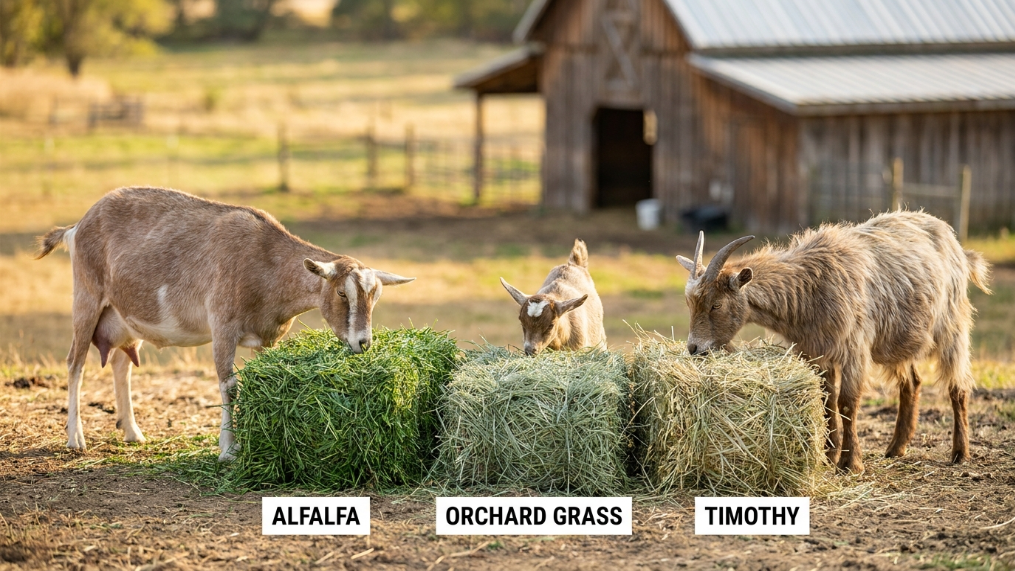
Hay is the single most important food you’ll buy for your goats. It keeps their rumen — the fermentation chamber that powers their whole body — running smoothly. Choose the wrong type, buy low-quality bales, or feed the wrong amount, and your goats will pay for it with poor milk production, weight loss, urinary problems, or worse.
This guide walks you through every decision: which goat hay types work best for which animals, how to inspect a bale before buying, how much hay to feed each day, and how to build a simple feeding schedule that works for your herd.
Goat Nutrition Basics: What Hay Needs to Provide
Goats are ruminants. They have a four-chambered stomach designed to break down fibrous plant material through fermentation. That process depends on a steady supply of long-stem fiber — exactly what good hay delivers.
Here’s what hay must provide:
- Fiber — Keeps the rumen moving and prevents digestive upsets
- Energy — Fuels daily activity, growth, and milk production
- Protein — Supports muscle, reproduction, and lactation
- Calcium and phosphorus — Critical for bone health and urinary tract function (the ratio matters — more on that later)
Not every goat needs the same thing. A lazy pet wether burns far fewer calories than a doe nursing twins. Match the hay to the animal:
- Maintenance goats (dry does, wethers, companions): moderate protein, high fiber
- Lactating dairy does: high protein, high calcium, high energy
- Growing kids: high protein and energy for rapid development
- Bucks: moderate protein, carefully balanced minerals to prevent urinary stones
Types of Hay for Goats: Legume, Grass, and Mixed
Legume Hay for Goats (Alfalfa, Clover, and More)
Legume hays — especially alfalfa — are the richest hay you can buy. Alfalfa typically runs 16–22% crude protein and is loaded with calcium. That makes it excellent for goats with high nutritional demands.
Best for: Lactating dairy does, growing kids, thin or recovering animals
Pros:
- High protein supports heavy milk production
- High calcium strengthens bones and supports kids
- Very palatable — goats love it
Cons/risks:
- Too rich for wethers and idle bucks — excess calcium disrupts the calcium:phosphorus ratio and raises urinary calculi risk
- Can cause over-conditioning (obesity) in easy-keeper does
- More expensive per bale than grass hay in most U.S. regions
Practical rule: For dairy does in peak lactation, alfalfa can make up the bulk of the ration. For a mixed pet herd, limit alfalfa to a small portion — maybe one feeding out of three — and use quality grass hay as the base.
Grass Hay for Goats (Timothy, Orchardgrass, Bermudagrass, and More)
Grass hays are lower in protein (typically 8–12%) and calcium than legumes, but they’re higher in fiber and much safer for goats that don’t need extra richness. They form the backbone of a healthy diet for most adult goats.
Timothy hay for goats is one of the most popular choices in the northern and mid-Atlantic U.S. It’s palatable, consistent in quality, and widely available. Protein typically runs 8–11%, making it ideal for maintenance animals.
Orchardgrass hay tends to be leafier and slightly higher in energy than timothy. It grows well across much of the eastern and Pacific Northwest U.S. Many goats prefer its flavor, and it works well for both maintenance animals and as a base hay for dairy does when supplemented with some alfalfa.
Bermudagrass hay dominates the southern U.S. It’s drought-tolerant and widely grown in states like Texas, Oklahoma, and Georgia. Quality varies significantly with cutting — early-cut bermudagrass (higher leaf content) is much more nutritious than mature, stemmy bales.
Other regional grasses — fescue, brome, bahiagrass, and bluegrass — are all acceptable options. Work with your local hay producer or county extension office to understand what’s grown in your area and what typical nutrient profiles look like.
Pros of grass hay:
- Supports rumen health through high fiber
- Helps prevent obesity in easy keepers
- Generally safer for wethers and bucks
- Often more affordable than legume hay
When grass hay alone is enough: For dry does, wethers, and bucks in maintenance, a good-quality grass hay plus free-choice loose minerals covers most needs. Add grain or some legume hay only when body condition drops or production demands rise.
Mixed Grass–Legume Hay for Goats
Mixed hay contains both grass and legume plants baled together — often a combination like orchardgrass and clover, or timothy and alfalfa. It naturally lands in the middle ground: more protein than pure grass hay, but less rich than pure alfalfa.
This is why many USA goat owners, especially those running small mixed herds, find mixed hay the most practical option. You get a balanced nutritional profile without managing two separate hay types.
A rough starting point: A mix that’s roughly 60–70% grass and 30–40% legume works well for a general herd that includes dry does, a buck, and some milkers. The exact ratio depends on your goats’ body condition and production stage — hay testing can fine-tune this.
Best for: Small backyard herds, family milk does alongside wethers or pets, anyone who wants simplicity without sacrificing nutrition.
Other Hay Types: Cereal Hays and Regional Options
Oat, barley, and wheat hay (cereal hays) can be good options when cut at the right time — ideally at the soft dough stage before full grain formation. They’re moderately palatable and nutritious.
Caution: Cereal hays harvested from stressed or immature plants can carry elevated nitrate levels, which are toxic to livestock. Always buy cereal hay from reputable producers and ask whether it’s been tested. Your county extension agent can help with nitrate testing if you’re unsure.
Hay Quality vs. Hay Type: How to Choose Safe, Nutritious Bales
Here’s a truth many new goat owners miss: a mediocre bale of alfalfa can be worse than an excellent bale of orchardgrass. Quality beats species every time.
How to Inspect Hay Before Buying
Color: Good hay is green to light green. Yellow or brown hay has lost nutrients through sun bleaching or heat damage.
Smell: Fresh hay smells clean and slightly sweet. Musty, sour, or ammonia-like odors mean mold or fermentation — reject the bale.
Leaf-to-stem ratio: Leafy hay is more nutritious than stemmy hay. Grab a handful and see how much crumbles off — that’s leaf material, and it’s where most of the protein lives.
Cleanliness: Look for weeds, sticks, twine remnants, or foreign objects. Dusty hay can cause respiratory issues; moldy hay can cause listeriosis and other serious illnesses.
Moisture: Squeeze the bale. It should feel dry and springy, not damp or heavy. Hay baled too wet generates heat and mold inside the bale — even if the outside looks fine.
When to Get a Hay Analysis
If you’re running dairy goats, a hay analysis is worth the $20–$40 cost. Send a core sample to your state’s agricultural lab or a private forage testing lab (your extension office can point you to one). The report tells you protein, energy (TDN), calcium, phosphorus, and more — information you need to balance a milker’s ration precisely.
Best Hay for Different Types of Goats: Practical Scenarios
| Goat Type | Recommended Hay | Key Notes |
|---|---|---|
| Pet wethers / companions | Good-quality grass hay | Limit or eliminate alfalfa; watch weight |
| Lactating dairy does | High-quality legume or mixed hay | May need grain supplement at peak lactation |
| Growing kids (weaned) | Mixed or legume hay | Don’t overfeed grain alongside rich hay |
| Dry does | Grass or mixed hay | Condition-score regularly; adjust if losing weight |
| Bucks / breeding males | Primarily grass hay | Keep calcium:phosphorus ratio in check |
The “best hay for goats” is always context-dependent. A bale that’s perfect for your dairy doe could cause urinary stones in your buck. Know your animals, watch body condition, and adjust accordingly.
How Much Hay to Feed Goats per Day
The standard rule of thumb: goats need roughly 2–3% of their body weight in dry matter forage per day. When hay is the main feed source (limited or no pasture), targeting about 2% of body weight in hay is a practical starting point.
Example Calculations
70 lb pet wether:
- 70 × 0.02 = 1.4 lbs of hay per day
- Round up slightly to 1.5 lbs to account for waste
130 lb lactating dairy doe:
- 130 × 0.025 = 3.25 lbs of hay per day (higher end due to production demands)
- She’ll also likely need 2–4 lbs of grain depending on milk output
Free-Choice vs. Weighed Rations
Many USA goat owners feed hay free-choice — meaning a rack is always stocked and goats eat what they need. This works well for most situations because goats self-regulate forage intake better than grain intake.
Weighed rations make more sense for dairy herds where you’re tracking production closely or managing a doe prone to obesity. In practice, most small hobby farms and homesteads do well with free-choice hay plus measured grain.
Feeding Schedules, Hay Racks, and Waste Reduction
Simple Sample Feeding Schedules
Backyard pet herd (no milking, limited pasture):
- Morning: Refill hay rack, check water
- Evening: Refill hay rack, check minerals
Small dairy herd:
- Morning: Milk, feed measured grain at the milk stand, refill hay
- Midday: Check hay (especially for lactating does)
- Evening: Milk, feed evening grain, refill hay
Reducing Hay Waste
Goats are notoriously wasteful — they pull hay out, walk on it, and refuse to eat soiled material. A few strategies help:
- Hay racks or mangers mounted off the ground catch most dropped material
- Slow-feeder hay nets (meant for horses) work well for small herds and dramatically cut waste
- Round bale feeders with panels work for larger herds but choose designs that keep goats from climbing in
Storing Hay Properly
- Store bales off the ground on pallets to prevent moisture wicking
- Keep hay under a roof or covered with a tarp; UV light bleaches nutrients fast
- Stack with airflow between rows to prevent heat buildup
- Plan your seasonal supply: multiply daily intake × number of goats × days in your hay season, then add 10–15% buffer for waste
Common Mistakes with Hay for Goats (and How to Avoid Them)
Feeding all-alfalfa to wethers and bucks. The high calcium disrupts the ideal 2:1 calcium-to-phosphorus ratio and dramatically raises the risk of urinary calculi — a painful, often fatal blockage. Stick to grass hay for these animals.
Using dusty or slightly moldy hay to save money. Moldy hay can cause listeriosis, pregnancy loss, and respiratory disease. It’s never worth the risk — compost it instead.
Overfeeding grain while underfeeding hay. Grain is energy-dense but low in fiber. A rumen starved of long-stem fiber gets acidic and sluggish, leading to bloat, enterotoxemia, and poor overall health. Hay always comes first.
Skipping loose minerals. Hay alone won’t cover every mineral need. Always provide a goat-specific loose mineral mix (not a salt block, not cattle minerals) and clean, fresh water at all times.
Frequently Asked Questions: Best Hay for Goats in the USA
What is the single best hay for goats?
There isn’t one — it depends on the animal. For most mixed herds, a good-quality mixed grass-legume hay is the most practical choice. For pure dairy does, high-quality alfalfa or alfalfa-mix hay is hard to beat.
Is alfalfa hay good or bad for goats?
Both, depending on who’s eating it. Alfalfa is excellent for lactating does and growing kids. It’s risky for wethers and bucks due to high calcium levels that can cause urinary stones.
Can goats eat horse hay or cow hay?
Yes — if it’s the right type and good quality. Timothy and orchardgrass sold for horses is perfectly fine for goats. Just confirm it’s free of mold, dust, and additives. Avoid hay treated with herbicides.
Timothy vs orchardgrass: which is better for goats?
Both are excellent grass hays. Orchardgrass is typically leafier and slightly higher in energy; timothy is more widely available in northern states. Either works well — buy whichever is highest quality and most affordable in your area.
Can goats live on hay alone?
Mostly yes, for maintenance animals with access to fresh water and loose minerals. High-producing dairy does and fast-growing kids will need supplemental grain to meet their energy and protein needs beyond what hay can provide.
How do I know if my goats are getting enough hay?
Check body condition score monthly by feeling the spine and ribs. You should feel the spine but not see it sharply. If ribs are prominent, increase hay (and check for parasites). Also watch for normal rumen fill — the left flank should look slightly rounded after feeding.
How do I switch my goats from one hay type to another safely?
Transition over 7–10 days by mixing increasing amounts of the new hay with the old. Sudden switches — especially to richer hay — can disrupt rumen bacteria and cause digestive upset or bloat.
Quick Start Checklist: Choosing the Best Hay for Your Herd
Use this checklist before your next hay purchase:
- Identify your goat category — pet/wether, dairy doe, growing kid, or buck
- Pick your hay type — grass for wethers/bucks, legume or mixed for milkers/kids, mixed for general herds
- Inspect every bale — green color, clean smell, leafy, dry, no mold or weeds
- Calculate daily needs — body weight × 2–2.5% = lbs of hay per day per animal
- Estimate seasonal bale needs — daily lbs × herd size × days on hay ÷ bale weight (typically 40–60 lbs for small square bales)
- Plan your storage — pallets off the ground, covered from rain and sun
- Set up feeders — hay rack or slow-feeder net to cut waste
- Stock loose minerals and water — always available, always separate from hay
Starting simple is perfectly fine. Pick a quality grass or mixed hay, watch your goats’ body condition, and adjust from there. The best goat owners aren’t the ones who memorize every nutrient table — they’re the ones who pay attention to their animals and keep learning season by season.