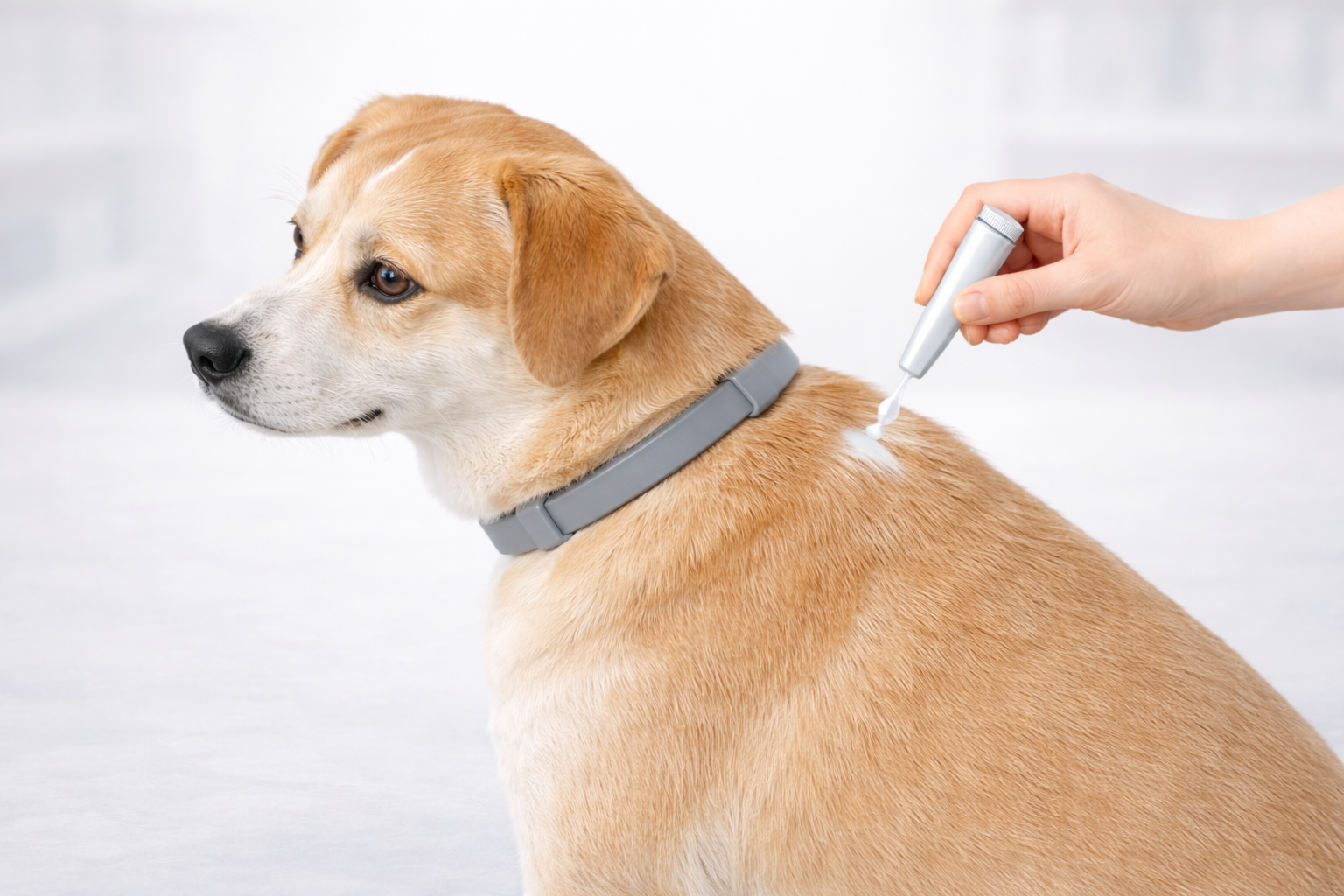
Spot-on products are liquid parasite medications that you apply to your dog’s skin (usually at the neck) so the medication spreads through the skin’s oil layer. Many owners choose them because they fit a simple monthly routine, avoid giving a pill, and-depending on the active ingredient-can kill fleas quickly on the dog without relying on the flea to feed first. Still, results can be confusing: you might see fleas after application, your dog may scratch even when fleas are dying, or a household infestation may seem to “come back” fast.
This guide explains what spot-ons are, how they work in practical terms, and how to apply them correctly. We’ll also cover ingredient “families,” which dogs tend to do well with topicals, and the most common reasons people feel disappointed-plus clear fixes. Finally, you’ll get a balanced framework for choosing between a topical, an oral product, or a collar, with safety notes you can actually use at home. You’ll also learn what to do if your dog licks it.
Key Takeaways
- Spot-ons are a topical flea option applied to the skin; they are different from shampoos, sprays, collars, and oral medications.
- Expect a brief “catch-up” period if your home already has fleas-new fleas can jump on before they die.
- Correct placement on skin (not fur) is the #1 factor for good results with spot-ons.
- Bathing, swimming, and harsh shampoos can reduce performance for some products; timing matters.
- Consistency matters: flea treatments work best when applied on schedule and paired with basic home cleanup.
- Separate pets until the application site is dry, and wash hands after applying.
- Use the right product for your dog’s age/weight range and species in the home-cats have special risks.
- If you see irritation, vomiting, weakness, or unusual behavior after use, contact your veterinarian promptly.
What Spot-On Treatments Are (and what they are not)
A spot-on is a small-volume liquid placed directly on the skin in one or several spots. People often call this a “topical flea” product because it works at the skin/haircoat level rather than inside the digestive system. Most are designed for monthly use, though labels vary.
What spot-ons are:
- A skin-applied medication that spreads through skin oils (or stays concentrated near the application site, depending on the ingredient).
- A way to kill fleas on the dog and, in some products, help reduce ticks or prevent immature flea stages from developing.
What spot-ons are not:
- Not a shampoo: Bathing can wash away residue; shampoos can also change skin oils.
- Not a collar: Collars release medication over time and have different contact considerations.
- Not an oral product: Oral products circulate in the bloodstream; some kill after the flea bites.
- Not an instant “home treatment”: If fleas are in carpets and bedding, you may still see fleas briefly as they jump on and then die.
A realistic expectation is that you might spot a flea or two in the first days after application-especially in an established infestation. That doesn’t always mean the product failed; it can mean fleas are emerging from the environment faster than you’re removing them.
How Spot-On Treatments Work (simple science, practical meaning)
Most spot-ons rely on the dog’s skin oils (the lipid layer) to distribute the active ingredient across the body. After you apply, the product begins moving outward from the spot over hours to days. In practical terms, this means:
- Application technique matters: If the liquid sits on fur instead of skin, it can’t distribute well.
- Skin condition matters: Very dirty coats, heavy topical products (oils, medicated sprays), or frequent bathing can change that lipid layer.
“Kill on contact” vs “kill after bite”
Some ingredients are largely contact-active: fleas die when they touch treated hair/skin. Others are more systemic or require the flea to bite to be exposed. Many owners prefer contact-active options because they can reduce the chance of bites, but labels and ingredients vary.
No matter the mechanism, you may still see:
- Fleas that are dying (slower movement) before they fall off.
- Persistent itching for a short period if your dog has flea allergy dermatitis; inflammation can outlast the fleas.
What changes with bathing, shampoos, swimming, grooming
- Bathing too soon after application can remove product before it spreads.
- Frequent swimming can shorten how long some products remain effective.
- Degreasing or “deep clean” shampoos may strip skin oils and interfere with distribution.
- Grooming is usually fine once the product is dry, but avoid bathing and heavy brushing in the immediate post-application window unless your veterinarian advises otherwise.
If your dog needs frequent bathing (medical skin issues, working dog lifestyle), you’ll want to pick a product whose label fits that reality-or consider a non-topical approach.
Active Ingredients (what matters more than brand)
Brand names change, but active ingredients-and how they behave-drive outcomes. When you compare options, focus on what the ingredient family targets and how it interacts with skin oils.
Common “families” you’ll see on labels include:
- Adulticides (kill adult fleas): These can be contact-active or require feeding, depending on the compound and formulation.
- Insect growth regulators (IGRs) (interrupt eggs/larvae development): These help reduce environmental build-up over time.
- Acaricides (target ticks/mites): Some spot-ons include tick-active ingredients; others are primarily flea-focused.
A key practical point: two products can both be “topical flea” options yet behave differently. Some spread widely through the coat; some remain closer to the application region. Some emphasize fast kill of adults; others add IGR components to slow re-infestation.
Also, different ingredients can have different repel vs kill profiles. “Repellency” can reduce attachment for some pests, but not every label claims it, and it’s not universal across tick-active products.
Because pets, regions, and parasite pressure vary, veterinarians often choose ingredients based on:
- local flea/tick patterns,
- your dog’s lifestyle (indoors vs outdoors),
- your dog’s skin sensitivity and bathing routine,
- the other pets in the home (especially cats).
Which Dogs Benefit Most From Topicals
Topicals can be a great fit when the household and the dog’s habits match the product’s strengths. Dogs who often do well include:
- Dogs with vomiting risk on chews (or dogs who refuse oral medication).
- Dogs that tolerate spot-ons well (no history of skin reactions to similar products).
- Households wanting a clear monthly routine with visible, hands-on application.
- Owners who want to minimize swallowing risks (e.g., dogs that “scarf” treats).
Limitations to keep in mind:
- Frequent bathing/swimming: Some topicals may not hold up well if the dog is wet often.
- Close-contact households: Families with very young children, people with sensitive skin, or many pets that groom each other may prefer options with lower contact concerns.
- Multi-pet homes: If cats live with the dog, you must choose products that are safe to have in the same household and manage drying-time separation carefully.
How To Apply Spot-On Correctly (step-by-step, no dosing)
Correct application is where most “failures” are born. Use this step-by-step approach every time:
- Read the label first. Confirm the product is for dogs (not cats), and that your dog matches the age and weight category.
- Choose the right spot. Most labels recommend between the shoulder blades or at the base of the neck-areas your dog can’t easily lick.
- Part the fur. Use your fingers to separate hair until you see the skin. This matters even on short-coated dogs.
- Apply directly to skin. Squeeze the product onto the skin, not the haircoat.
- Large dogs: follow label guidance. Some products instruct application at multiple points along the back to improve distribution. Use only the label’s directions-no improvising.
- Prevent pet-to-pet contact until dry. Keep dogs and cats separated so no one licks the application site.
- Protect kids and sensitive adults. Keep children from touching the area until it is completely dry, and avoid cuddling contact at that spot right after application.
- Wash your hands. Use soap and water after applying, and clean any product that gets on your skin.
If you spill product on fur, don’t “rub it in” like a shampoo. Rubbing can move product to places your dog can lick and can irritate the skin.
How Long They Last and When They Start Working
Most spot-ons start killing fleas within hours, but the “typical onset window” depends on the ingredient and the individual dog’s coat and skin oils. In many cases, you’ll see meaningful reduction within the first day, with continued improvement over the next several days as distribution completes and environmental fleas are addressed.
Duration is commonly about 3–4 weeks for many products, but labels vary. Consistency is what turns a one-time kill into ongoing flea prevention. If you apply late, you can leave a gap where newly emerged fleas survive long enough to reproduce.
If the label includes tick prevention, note that tick control can be more variable than flea control because ticks attach differently and can be harder to repel or kill quickly. Always match your choice to your dog’s exposure risk and your veterinarian’s local guidance.
Why It Sometimes “Doesn’t Work”
When people say a spot-on “doesn’t work,” it’s usually one of a handful of fixable issues. Use this Cause → Fix list as a checklist.
- Cause: Applied on hair, not skin.
Fix: Reapply only if the label or your veterinarian instructs; otherwise, wait and apply correctly at the next scheduled time. Next time, part the fur until skin is visible. - Cause: Bathing too close to application.
Fix: Follow label guidance for bathing before and after application. If your dog must be bathed frequently, ask your veterinarian about a product better suited to that routine. - Cause: Reinfestation from the home environment.
Fix: Treat resting areas, vacuum regularly, and wash bedding. Remember that most fleas live off the pet for much of their life cycle. - Cause: Not treating all pets.
Fix: Dogs and cats in the same home can “share” fleas. Use species-appropriate products for every pet, and coordinate timing. - Cause: Wrong weight range / expired product / counterfeit risk.
Fix: Double-check your dog’s current weight category on the label, confirm the product is within date, and buy from reputable sources. If packaging looks odd or the product’s appearance/smell is unusual, don’t use it-contact the seller and your veterinarian. - Cause: Heavy infestations need environmental control + vet plan.
Fix: In severe cases, spot-ons alone may not catch up quickly. Your veterinarian may recommend environmental treatment and a structured plan (including IGRs and household control) to break the cycle. - Cause: Skin disease or very oily/dry coat changes distribution.
Fix: Address underlying skin issues with your veterinarian. Some dogs with chronic dermatitis do better with non-topical options.
Do You Need to Treat the Whole House?
Often, yes-at least to some degree. Spot-ons treat the dog, but flea eggs, larvae, and pupae can live in carpets, cracks, bedding, and furniture. If you only treat the dog, you may keep killing new fleas as they jump on, but you can feel like you’re “losing” because you keep seeing them.
A practical minimal routine:
- Wash bedding (dog beds, blankets) in hot water when possible, then dry thoroughly.
- Vacuum carpets, rugs, and upholstery several times a week during the first few weeks. Empty the canister or bag promptly.
- Focus on resting areas: Under beds, along baseboards, and favorite lounging spots.
- Limit clutter where dust and flea debris accumulate.
You don’t always need to fog the house or use harsh chemicals, especially if the infestation is mild. The goal is to remove developing stages and help your chosen flea prevention product catch up.
Topical vs Oral vs Collar: How to Choose
No method is perfect for every dog. The best choice is the one you can use correctly and consistently, fits your household, and matches your dog’s lifestyle and health needs. You’ll get the best results when you pick a method that suits your real routine-bathing habits, child contact, and multi-pet dynamics-not an ideal routine.
TABLE #1
| Method | Best for | Water/bath impact | Contact safety | Common mistakes | When to choose it |
|---|---|---|---|---|---|
| Spot-on (topical) | Dogs that tolerate skin-applied products; owners who want a visible monthly routine | Can be reduced by bathing/swimming depending on label | Requires drying-time precautions; avoid pet-to-pet licking | Applying to fur; bathing too soon; using wrong species/weight | Choose if oral meds are hard, and you can manage drying and bathing timing |
| Oral (chew/tablet) | Dogs that bathe/swim often; households wanting low residue on coat | Not affected by bathing | Minimal coat contact risk; still follow label cautions | Skipping doses; giving with wrong food instructions; vomiting/poor acceptance | Choose if your dog tolerates oral meds and lifestyle makes topicals inconvenient |
| Collar | Long-duration coverage for some products; outdoor exposure | Generally stable in water, but labels vary | Continuous contact; supervise kids and pet grooming behavior | Loose fit; removing often; assuming it treats the home | Choose if you need long-lasting coverage and can manage fit and contact rules |
| Shampoo/spray (adjunct) | Short-term knockdown; specific situations | Washed off quickly | Variable; depends on product | Expecting long protection from a bath | Choose as a short-term helper with a longer-term plan |
Use this table to start a conversation with your veterinarian, especially if your dog has skin disease, a history of seizures, is very young, is pregnant/nursing, or takes other medications.
Safety Notes
Spot-ons are medications. Use them exactly as the label says.
- Age/weight label compliance. Do not use a puppy product on an adult dog or the other way around. Do not “split” products or combine sizes unless your veterinarian tells you to.
- Cat warning (permethrin). Some dog spot-ons contain permethrin, which can be dangerous to cats. Keep cats away from treated dogs until the product is fully dry, and never use a dog-only product on a cat.
- Skin irritation basics. Mild redness or itching can happen at the application site. If irritation is more than mild, if it spreads, or if your dog seems uncomfortable, contact your veterinarian.
- What to do if a dog licks product or has irritation. Some dogs drool or vomit if they taste it. Wipe away any wet product you can safely remove, prevent further licking, and contact your veterinarian for advice-especially if signs continue.
- If adverse reaction suspected. Stop using the product. If the label allows washing the area, use gentle soap and water. Then call your veterinarian or an emergency clinic for guidance.
Always tell your veterinarian exactly which product you used and when you applied it.
FAQ
How does spot-on flea treatment work on dogs?
A spot-on is applied to the skin, usually at the neck, and the active ingredient spreads through the skin’s oil layer. Fleas are exposed when they contact the treated coat or skin (and in some products, after they bite). Because the medication works on the dog, new fleas from the environment can still jump on briefly before they die.
How long does it take to work?
Many products begin killing fleas within hours, with stronger visible improvement by 24–48 hours. In a home with an active infestation, you may still see fleas for days because new fleas are emerging from carpets and bedding. Staying on schedule is key for flea prevention.
Do I have to clean my whole house?
You usually don’t need an extreme “deep clean,” but you do need basic environmental control if fleas are present. Wash bedding, vacuum often, and treat your pet’s favorite resting areas. This helps reduce the number of new fleas that can jump back onto your dog.
Why don’t vets recommend Frontline?
Some veterinarians still use products in that ingredient family, but recommendations can change over time. Reasons a vet may suggest a different option include: changing efficacy patterns in some areas, repeated reinfestation from the home, inconsistent application, or a dog’s lifestyle (frequent bathing, swimming, multi-pet home). A vet’s choice is usually about fit and local conditions, not a single brand being “good” or “bad.”
Can I combine topical and oral products?
Only do this with veterinary guidance. Some combinations are appropriate in specific situations, while others increase the chance of side effects or provide no added benefit. Bring the exact product names and active ingredients to your vet so they can advise safely.
CONCLUSION
Spot-ons can be a practical option when you apply them correctly and use them consistently. The biggest success factors are: getting the liquid onto the skin, following label rules about bathing and contact, and reducing reinfestation from your home environment. If results disappoint, the fix is often in technique, timing, or household coordination-not “trying a stronger product” at random.
Ask your vet if…
- your dog is very young, underweight, pregnant, or nursing
- your dog has a history of seizures or chronic skin disease
- you have cats in the home and are considering a dog-only spot-on
- your dog swims or needs frequent medicated baths
- you used a product correctly and still see fleas after a full month