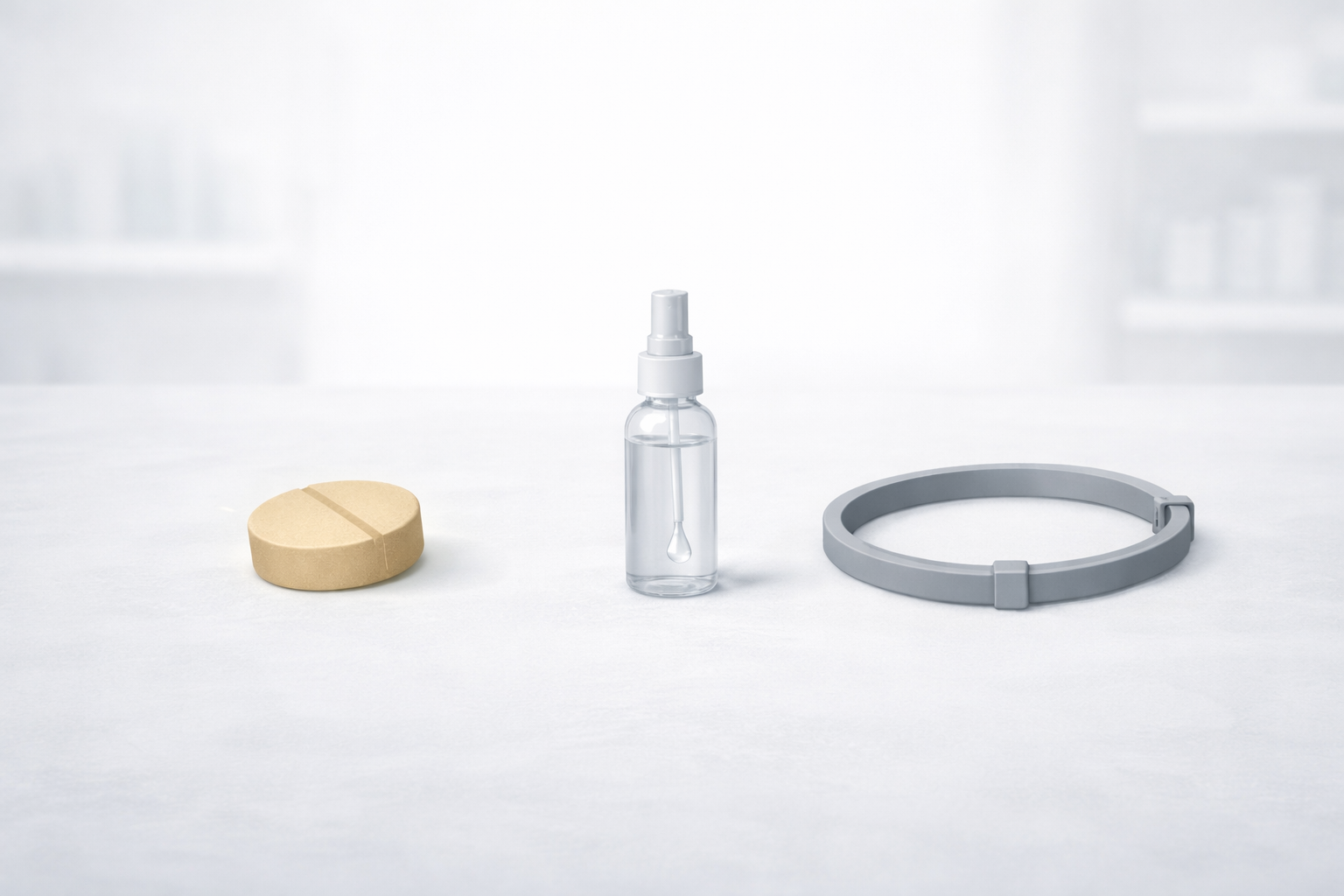
Choosing the “safest” flea control for your dog isn’t about finding a single product that’s safest for every dog. It’s about matching the right option to your dog’s health, your household, and your ability to use it correctly and consistently. A product that’s very safe for a healthy adult dog may be a poor fit for a puppy, a dog with a neurologic history, or a home with cats and toddlers. And even a well-studied product can become risky if it’s used on the wrong weight range, layered with another pesticide, or applied in a way that increases exposure.
This guide gives you a vet-aligned, practical way to choose. You’ll learn what “safe” actually means in flea control, how flea biology affects reinfestation, and how the main prevention categories compare for everyday life (bathing, swimming, kids, cats, and tick exposure). You’ll also get a quick checklist, an IF/THEN decision framework, and scenario playbooks-so you can walk into your vet appointment (or your OTC aisle decision) with clarity, not guesswork.
SECTION A – What “Safe” Means in Flea Control (define the term)
Safety is not “natural vs chemical”
A lot of “safest” conversations get stuck on the idea that “natural” equals safe and “chemical” equals dangerous. In real veterinary practice, safety is about the total risk picture: the dog’s size and age, underlying conditions, other medications, the parasite risk where you live, and how the product will be used in the real world.
Even “natural” options can irritate skin, be toxic if ingested, or simply fail-leading to ongoing bites, scratching, infection, and repeated re-exposure. On the other side, many conventional flea preventives are widely used because they’re predictable and label-tested-but they still require correct selection and monitoring.
Safety = right product for the right dog + right use + monitoring
A “safe” flea plan has three parts:
- Appropriate match
The product is suitable for the dog’s age/weight band and health profile, and fits the household (cats, kids, immunocompromised family members, grooming habits). - Correct use
Correct product, correct dog, correct schedule, correct application technique, and no risky stacking. - Monitoring
You know what mild side effects can look like, what’s “stop and call the vet,” and how to respond if something seems off.
When “least toxic” questions come up (risk/benefit, calmly)
“Least toxic” is understandable-but it can be misleading. The risk of a product has to be weighed against the risk of fleas themselves: discomfort, secondary skin infections, flea allergy flare-ups, and (in some settings) parasite transmission. Effective flea control often requires preventing re-infestation, which means thinking beyond the dog to the home environment. CAPC notes that comprehensive flea control needs to address fleas on pets, environmental infestation, and prevention of reinfestation, and that moderate to severe infestations may take time to control.
SECTION B – Flea Basics That Affect Safety (fast but useful)
Flea lifecycle and why reinfestation happens
Most of the flea population isn’t on your dog. Adults are the visible part, but eggs, larvae, and pupae live in the environment (carpets, bedding, cracks in flooring). Under typical household conditions, the flea life cycle often completes over weeks, but it can speed up or slow down depending on temperature and humidity.
Practical takeaway: you can treat the dog correctly and still “see fleas” for a while if the environment is loaded with immature stages.
Why treating the home matters
If fleas are established indoors, home steps can reduce the pesticide burden you need on the dog-because you’re lowering the reinfestation pressure.
Common vet-aligned basics include:
- Wash pet bedding and throw blankets regularly.
- Vacuum carpets/upholstery and focus on where pets sleep; discard the vacuum bag or empty the canister promptly.
- Keep a steady routine for several weeks because pupae can “wait out” short bursts of cleaning.
Merck’s veterinary manual guidance for pet owners emphasizes washing bedding and vacuuming crevices and pet-rest areas, and notes that control can take weeks to months in heavier cases.
When you should suspect fleas vs allergies vs other issues (non-diagnostic language)
You might suspect fleas if you notice:
- new itching focused around the rump/tail base,
- small dark specks (“flea dirt”) that smear reddish-brown when wet,
- a pet that suddenly can’t settle and bites at the skin.
But itch can also come from allergies, mites, skin infection, or environmental irritation. If you’re unsure-or if itch continues despite consistent prevention-your veterinarian can help you avoid “treating the wrong problem” while repeatedly changing products.
SECTION C – Vet-Approved Categories (core)
Oral chewables (systemic)
How they work
Oral preventives circulate systemically. When fleas feed, they’re exposed to the active ingredient and die over time. These products are popular because there’s no residue on the coat and no “don’t touch for X hours” issues like some topicals.
Pros/cons for safety (vomiting, neurologic caution context)
Common tolerability issues can include mild gastrointestinal upset (like vomiting or loose stool), especially when starting a new medication. Most dogs do fine, but it’s a reason to introduce thoughtfully and monitor.
Neurologic caution (balanced, not scary): The FDA has communicated that products in the isoxazoline class have been associated with neurologic adverse events (such as tremors, incoordination, and seizures) in some dogs and cats, and advises owners and veterinarians to consider this information when choosing products-especially for pets with a history of seizures or neurologic disorders.
This is not a reason for panic. It’s a reason for a shared decision with your vet if your dog has a neurologic history or you’re seeing concerning signs.
Best-fit scenarios (swimming, frequent bathing)
Oral options can be a strong practical fit when:
- your dog swims often or is bathed frequently,
- you have kids who cuddle the dog constantly,
- you want to avoid topical residue or application variability.
Example mention (not endorsement)
Your vet may discuss combination preventives that also cover other parasites; simparica trio is one example in that broader category. Ask your veterinarian whether a combination product is appropriate for your dog’s health profile and local parasite risks. (Example mentioned for familiarity, not as a universal recommendation.)
(That’s mention #1 of simparica trio.)
Spot-on / topical options
How they spread and why application technique matters
Spot-ons spread across skin oils (or stay localized depending on formulation). Because the medication is placed on the skin, application technique matters. If a product is applied to hair instead of skin, split across multiple sites incorrectly, or rubbed off through bathing too soon, results and tolerability can change.
This is where many safety issues actually come from: not “the product is unsafe,” but “the product was used in a way that increased exposure or reduced effectiveness.”
Cat household warning (permethrin)
If you have cats, this section matters a lot.
Some dog spot-ons (and some dog tick products) contain permethrin, which can be extremely toxic to cats-even through contact with a treated dog before the product is fully dry. Multiple veterinary and animal-health sources emphasize strict cat-safety precautions and separation after application.
If your household includes cats, do not “assume it’s fine because it’s sold everywhere.” Read labels carefully and ask your vet for cat-safe options and handling rules.
Skin sensitivity and contact precautions
Topicals can irritate sensitive skin or cause temporary hair changes at the application site. They can also pose contact considerations:
- avoid petting the application area until dry,
- wash hands after applying,
- prevent kids from snuggling the application site right away.
Use the phrase naturally: a topical flea option can be a good fit when you want to avoid systemic medication, but it requires extra attention to correct placement and household contact precautions.
(That’s topical flea mention #1.)
Collars
How collars work, contact safety, durability
Modern parasite collars typically release active ingredients over time. Some distribute across the skin and coat; others act more locally. Collars can be appealing for people who struggle with monthly routines, but they raise two practical safety questions:
- Contact exposure: kids and other pets touch the collar area a lot.
- Fit and wear: too loose can reduce effectiveness; too tight can irritate skin.
If your dog chews collars or another pet grooms the collar area, talk with your vet before choosing this category.
When a tick collar helps vs when it’s not ideal
A tick collar may be useful for dogs with consistent outdoor exposure where ticks are a daily reality-especially when owners need longer-acting compliance support. But it may be less ideal if:
- the dog has sensitive skin around the neck,
- there are toddlers who grab collars,
- the dog frequently plays with other dogs who mouth the collar.
(That’s tick collar mention #1.)
Fast knockdown / short-term help
What can kill fleas quickly, but why it’s not full prevention
Some products provide rapid adult-flea knockdown and can kill fleas on the dog quickly. (That’s kill fleas mention #1.)
These can be useful as support, but they’re usually not a complete prevention plan because they may not provide long residual control, and they don’t address environmental stages.
Where it fits (rescue intake, heavy infestation support)
Short-term tools can fit when:
- a newly adopted dog arrives with heavy flea burden,
- you need immediate relief while starting a longer-term plan,
- you’re coordinating a whole-house approach (all pets + home steps).
Your veterinarian can help you pair “fast relief” with an appropriate long-acting strategy so you don’t get stuck in a cycle of repeated reinfestation.
TABLE #1 – Category comparison (simple, scannable)
| Category | Typical duration | Water/bath impact | Kills vs repels | Best for | Key safety notes | Common mistakes |
|---|---|---|---|---|---|---|
| Oral chewables (systemic) | Often monthly (varies) | Minimal impact | Primarily kills after feeding | Frequent swimmers, frequent bathing, kids in home | Monitor for GI upset; discuss neurologic history with vet (FDA caution) | Giving wrong weight band; stacking with other pesticides |
| Spot-on / topical options | Often monthly (varies) | Some impacted by bathing/swimming | Kills; some have repellency depending on product | Owners avoiding systemic meds; targeted control | Cat safety critical for permethrin-containing dog products ; avoid contact until dry | Applying to hair not skin; bathing too soon; using dog product on cats |
| Collars | Often multi-month | Usually durable; check label | Often repels + kills (varies) | Long-acting compliance support | Skin irritation risk; contact exposure; chewing/mouthing concerns | Poor fit; not replacing on schedule; letting pets chew it |
| Fast knockdown / short-term help | Hours–days (varies) | Usually minimal | Kills adults; limited residual | Heavy infestation support, intake situations | Not a stand-alone prevention; still need environmental control | Using as the only plan; repeating without fixing home source |
SECTION D – How to Choose the Safest Option (Decision Framework)
1) A 2-minute checklist
Use this before you buy anything or refill anything:
- Age and life stage: puppy/young dog vs adult vs senior
- Weight band: confirm your dog’s current weight is within the label range
- Cats in the home (or visiting cats): yes/no (permethrin risk matters)
- Kids / high-touch household: toddlers, immunocompromised family members, frequent cuddling
- Neurologic history: prior seizures, tremors, unexplained episodes (discuss with your vet)
- Swimming / frequent baths / grooming: weekly baths? lake dog?
- Local parasite pressure: fleas year-round? heavy hiking? local tick prevention needs? (That’s tick prevention mention #1.)
- Your routine reality: are you good with monthly schedules or do you need longer-acting reminders?
- Other products used: shampoos, sprays, collars, yard treatments-avoid accidental stacking
2) Mini decision tree (IF/THEN bullets)
- IF your home has cats THEN avoid dog products that are unsafe for cats (especially permethrin-containing spot-ons) and ask your vet for cat-safe household strategy.
- IF your dog swims a lot or gets frequent baths THEN discuss oral options or water-resistant strategies to reduce “washed-off” variability.
- IF your dog has a seizure history or unexplained neurologic events THEN ask your vet specifically about neurologic cautions and monitoring with oral isoxazoline-class products.
- IF your dog has sensitive skin or contact dermatitis THEN consider non-irritating categories first and avoid “trial and error” layering.
- IF you consistently miss monthly doses THEN consider longer-acting formats or reminder systems that reduce gaps (gaps are a top reason for “it didn’t work”).
- IF you hike or live in a high-tick area THEN prioritize products and routines that address tick prevention alongside flea control. (That’s tick prevention mention #2.)
- IF fleas are already established in the home THEN pair pet prevention with environmental steps (vacuuming, laundry, bedding routines) so you’re not chasing reinfestation.
3) “Scenario playbook” (at least 7 scenarios)
Scenario 1: Puppy / young dog
Safest approach: strict label match for minimum age/weight and vet guidance. Puppies are more vulnerable to dosing errors and inappropriate products. If you’re adopting a young dog with fleas, your vet can choose a plan that fits the puppy’s age and household risk factors without guesswork.
Scenario 2: Small dog vs large dog (weight-range emphasis)
Small-dog safety hinges on avoiding accidental “over-strength” products. Large-dog safety hinges on correct size selection and not assuming one tube fits all. For any size dog, don’t split doses or “stretch” products across pets. Weight-banding exists for a reason.
Scenario 3: Dogs with seizure history
This is a “talk first” scenario, not a “panic” scenario. The FDA’s communication about potential neurologic adverse events with isoxazoline-class products means dogs with seizure history deserve a tailored discussion and monitoring plan.
If an oral chewable is still chosen, your vet may recommend extra observation around the first doses and clear instructions for what to do if symptoms occur (without you needing to guess).
Scenario 4: Multi-pet home with cats
Avoid casual use of dog spot-ons that can harm cats. Cats can be exposed by direct contact, shared bedding, or grooming interactions.
This is also a “treat every pet” scenario: if one pet is protected and the others aren’t, fleas keep circulating. Coordinate a whole-house plan with your vet.
Scenario 5: Skin irritation–prone dogs
If your dog has a history of skin reactions, prioritize:
- minimizing direct skin residue,
- avoiding frequent product changes,
- using one method consistently rather than stacking multiple options.
If you try a skin-applied option, watch for localized redness/itch and keep your vet in the loop. Use gentle handling rules to reduce contact spread to people.
Scenario 6: Heavy tick exposure (hiking, woods)
Here safety is about preventing disease risk while matching your dog’s lifestyle. In high-exposure settings, tick prevention often needs to be reliable even after rain, brush contact, and repeated outdoor days. (That’s tick prevention mention #3.)
Ask your vet how your region’s tick risks should influence product choice, and whether additional checks and grooming routines are needed alongside preventives.
Scenario 7: Owner needs long-acting compliance help
If monthly schedules fail, safety improves when the plan becomes simpler. A longer-acting approach may reduce gaps (and gaps are a major cause of reinfestation). In some households, a collar category can help-provided the dog tolerates it and contact exposure is managed.
Scenario 8: Frequent bathing / grooming household
If your dog is professionally groomed often, bath timing and product choice matter. Some topical products can be affected by bathing schedules; oral options may avoid that variability. If you use a skin-applied option, coordinate the timing with grooming and follow label guidance.
SECTION E – Prescription vs OTC (what safety difference looks like)
Prescription doesn’t automatically mean “safer,” and OTC doesn’t automatically mean “dangerous.” The safety differences often show up in label clarity, product consistency, and guidance.
Label accuracy, counterfeit risk, weight-banding
- Weight-banding helps reduce dosing errors. Choosing the wrong band is one of the easiest ways to increase side-effect risk or reduce effectiveness.
- Buying from reputable sources matters. Counterfeit or improperly stored products can undermine both safety and performance.
When OTC can be reasonable, when it’s risky
OTC can be reasonable when:
- you have an adult dog with no special risk factors,
- you can follow label instructions precisely,
- your household doesn’t include cats that could be harmed by certain ingredients,
- you can commit to consistency.
OTC becomes risky when:
- the dog is very young, very small, medically complex, or has a neurologic history,
- multiple pets make cross-exposure likely,
- you’re tempted to mix several products because “one didn’t work.”
“Vet-approved” explained without overclaiming
“Vet-approved” in this article means: categories and products commonly used in veterinary practice with label-based selection and monitoring-not “guaranteed safe” and not “best for everyone.” Your vet’s role is to match the safest option to your dog and risk environment.
SECTION F – Safe Use Rules (very practical)
Application tips without dosing
- Use only products labeled for dogs and for your dog’s current age and weight band.
- Apply exactly as directed on the label. For skin-applied products, part the hair so product reaches skin (not just fur).
- Prevent immediate licking or rubbing on furniture when relevant, and follow any “hands-off until dry” guidance.
Use the phrase naturally: a second topical flea product should not be added “just in case” unless your veterinarian explicitly tells you how to do that safely.
(That’s topical flea mention #2.)
Prevent double-dosing / stacking products
A common safety mistake is stacking:
- an oral preventive + a topical pesticide + a collar
…because fleas were seen once.
Seeing a flea doesn’t automatically mean failure. Merck notes that residual products don’t always kill instantly and that owners may still spot fleas while an infestation is being eliminated.
If you’re concerned, the safest move is to pause and ask your vet, not to layer more chemicals.
Contact precautions after topical use
- Wash hands after application.
- Don’t let kids sleep face-to-face with the application site right away.
- In cat homes, separate pets as advised by the label and your vet to prevent cat exposure.
What mild vs serious reactions can look like (general, non-graphic)
Mild reactions can include:
- temporary skin irritation at the application site,
- mild stomach upset,
- temporary lethargy.
More concerning signs (call your vet promptly) may include:
- persistent vomiting,
- marked weakness,
- significant tremors, wobbliness, or unusual neurologic signs.
The FDA notes neurologic adverse events have been reported with isoxazoline products in some pets, so take neurologic signs seriously without assuming the worst.
What to do: stop product, wash if topical, call vet
General first-response rules (not a substitute for veterinary advice):
- Stop the product (do not re-dose).
- If it’s a topical and you suspect a reaction, wash the application area with mild soap as directed by a veterinarian.
- Call your vet for next steps and report what product was used and when.
SECTION G – Why “It Didn’t Work” (most missing competitor section)
If you’ve ever thought, “We used the product and still have fleas,” you’re not alone. The most common reasons are practical-not mysterious resistance or “bad products.”
Missed doses
Gaps are the #1 cause. Fleas rebound quickly when protection lapses.
Wrong application
For skin-applied products, applying to hair instead of skin, using the wrong site, or bathing too soon can reduce results. For collars, poor fit or removing it “sometimes” breaks continuity.
Reinfestation from environment
CAPC emphasizes that comprehensive flea control must include the environment and prevention of reinfestation, and that heavier infestations can take months to bring under control.
Merck’s owner guidance likewise highlights washing bedding and vacuuming, especially where pets sleep.
Need to treat home (laundry, vacuum schedule)
Practical routine:
- Wash bedding weekly during active infestation.
- Vacuum 2–4 times/week initially, then weekly as things improve.
- Focus on pet rest areas, couch crevices, and under furniture.
When to involve a veterinarian for persistent infestations
Call your vet if:
- itching persists despite consistent use,
- multiple pets are involved and coordination is hard,
- you’re seeing skin infection signs,
- you suspect you’re dealing with allergies rather than fleas,
- you need a safer plan because of cats, kids, or medical issues.
Sometimes the safest plan is the one that prevents “over-treating” by giving you a clear, coordinated approach.
SECTION H – FAQ (must answer directly)
What is the least toxic flea medicine for dogs?
“Least toxic” depends on the dog and household. Often, the least risky option is the one that:
- matches the dog’s age/weight band,
- fits health history (including neurologic history),
- is easiest for you to use consistently without stacking.
If you have cats, “least toxic” frequently means avoiding dog permethrin products that can harm cats through contact.
A vet can help you choose a plan that minimizes total exposure while still controlling fleas reliably.
What is the most vet recommended flea treatment for dogs?
Vets don’t recommend one universal product for all dogs. They typically recommend a category (oral vs topical vs collar) that fits the dog’s lifestyle, local parasite risk, and household factors. In many clinics, oral and topical preventives are commonly used because they’re predictable when used correctly-but the “most recommended” option for your dog depends on seizure history, cat exposure risk, bathing habits, and how reliably you can maintain the schedule.
Is NexGard or Frontline safer for dogs? (answer by categories + dog factors)
These represent different approaches and ingredients, so “safer” depends on the dog:
- If your dog has a neurologic history, you should discuss oral isoxazoline-class cautions with your vet (FDA notes reported neurologic adverse events in some pets).
- If your household has cats and you’re considering any dog topical that could endanger cats (especially permethrin-containing products), cat safety becomes a dominant factor.
A safer comparison question is: “Which category best fits my dog’s medical history, and what monitoring should I do after starting?”
Do holistic vets recommend anything that actually works?
Some integrative or holistic-leaning vets emphasize environmental control, grooming, and risk-based prevention-especially when parasite pressure is low. Home cleaning (vacuuming, laundering bedding) is genuinely helpful and supported by veterinary guidance.
However, for established infestations or high-risk regions, “natural-only” approaches may fail and prolong discomfort. A balanced plan can include environmental steps plus a carefully chosen preventive that matches your dog’s risk profile.
Can I rely on a collar alone?
Sometimes, but not always. A collar-only plan can work for certain dogs and households when:
- the dog tolerates it well,
- the collar stays on continuously and fits correctly,
- contact exposure is manageable (kids, cats, other pets),
- your parasite risk level matches what the collar is designed to cover.
If you’re in heavy tick areas, a tick collar can be part of a broader plan, but it isn’t automatically the best fit for every household.
(That’s tick collar mention #2.)
Do I need year-round protection?
Many households do best with consistent prevention because indoor conditions can allow fleas to persist even when it’s cold outside, and because gaps can restart infestations. Your local climate and your dog’s exposure matter-ask your vet what’s appropriate where you live and whether your region’s fleas and tick prevention risks are seasonal or ongoing.
Bonus: Where does simparica trio fit?
As an example, simparica trio is sometimes discussed when vets want a single product approach that addresses multiple parasites, which can improve consistency for some owners. It is not automatically “safest”-the safest choice depends on your dog’s health history, including any neurologic history, and your household factors.
(That’s mention #2 of simparica trio.)
CONCLUSION
The safest flea plan is rarely about finding a universally “gentle” product. It’s about a tailored choice that fits your dog’s age and weight band, your household (especially cats and kids), your dog’s medical history, and your ability to use the product correctly and consistently. Pair that with environmental steps, and you reduce reinfestation pressure-often with less overall frustration and fewer “stacking” mistakes.
Talk to your vet if:
- your dog is very young, very small, or medically complex,
- there’s a seizure/neurologic history or concerning signs after starting a product,
- your household includes cats (especially when considering dog spot-ons),
- fleas persist despite consistent use and home cleaning,
- you feel tempted to combine multiple pesticides because “something isn’t working.”