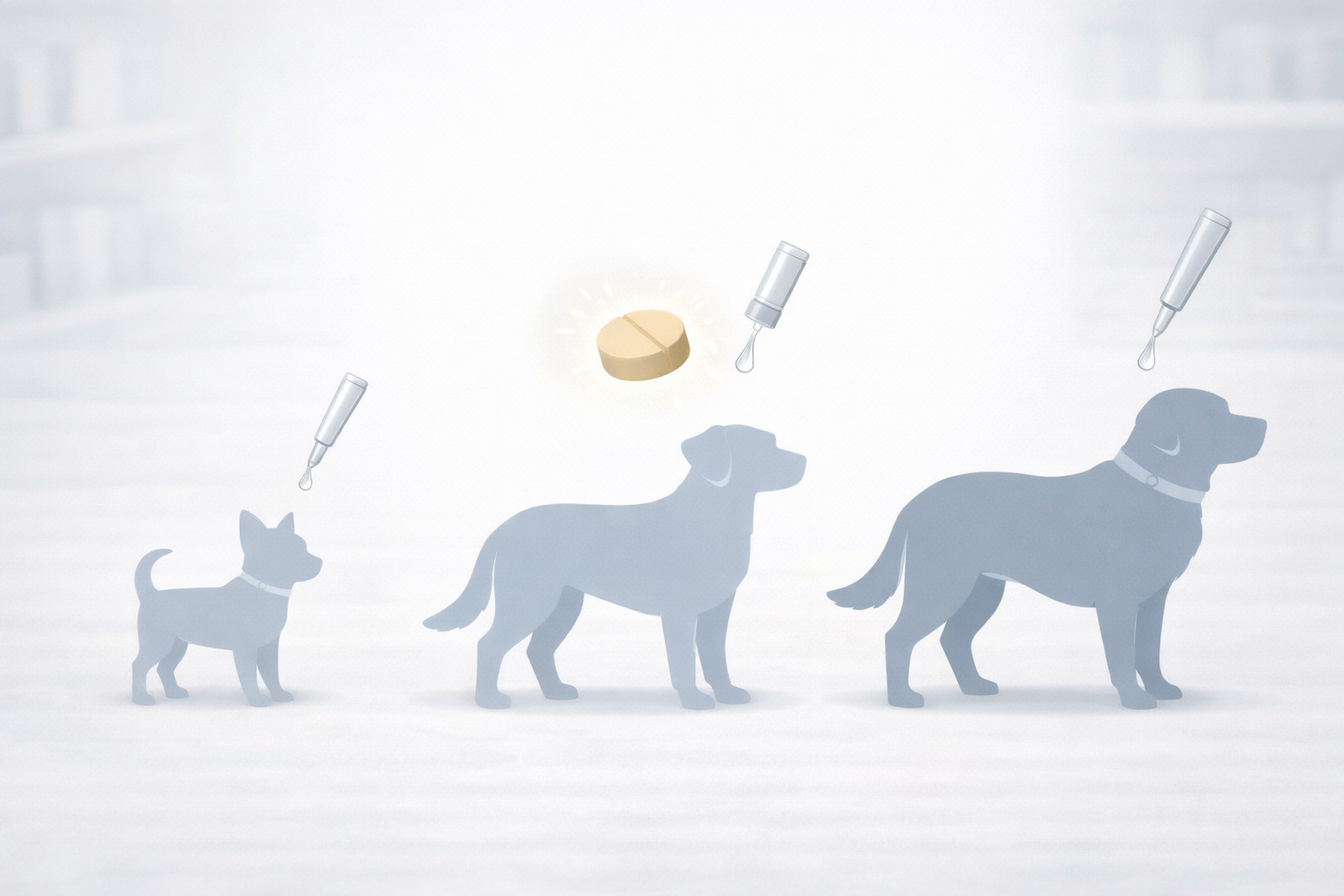
Flea treatments are weight-specific for a reason: the same product can act very differently in a 5 kg (11 lb) dog than in a 35 kg (77 lb) dog. Two main safety problems drive most mistakes. First, overexposure in small dogs: a product intended for a larger dog may deliver too much active ingredient for a small body to handle comfortably, increasing the risk of adverse effects. Second, under-treatment in large dogs: using a product meant for a smaller dog (or trying to “make it work”) may not reach an effective level, letting fleas survive and continue biting.
This guide is not a substitute for veterinary care, and it won’t tell you “how much” to give. Instead, it explains why size matters, why “adjusting the amount” is unsafe, and how to choose a flea product by label range (and with veterinary input when needed). The goal is simple: help you avoid the most common and most preventable sizing errors.
Why Dog Size Matters in Flea Treatment
Body mass vs drug concentration
Most flea medications are manufactured in size ranges because the total amount delivered is designed to match a dog’s body size and how the drug distributes in the body. That doesn’t mean the medication is “stronger” for big dogs in a simple way. Some products change total volume, some change formulation, and some change both. The label size range is part of the safety design.
Faster absorption and sensitivity in small dogs
Smaller dogs often have less margin for error. A relatively small “extra” exposure can represent a much larger proportion of their body weight. Some small dogs also react more noticeably to skin-applied products (irritation, itchiness) or to flavorings/excipients in oral products. This doesn’t mean small dogs can’t use flea prevention-it means they need the correct size range and careful attention to the label.
Why “just adjusting the amount” is unsafe
Owners often assume flea products behave like “linear math”: half the product = half the effect. Real formulations rarely work that way. Reasons include:
- Fixed design of applicators and tablets. Pipettes deliver a set amount intended to spread in a particular way; tablets are manufactured to dissolve and absorb predictably.
- Non-linear safety margins. A small dog receiving even a “slightly too large” product can jump from “fine” to “not fine” faster than owners expect.
- Different inactive ingredients and delivery systems. Two sizes in the same brand line may not be identical except for quantity.
Because of that, do not try to self-adjust a flea medication. If your dog is between sizes or you bought the wrong box, the safest move is to pause and contact your veterinarian or the manufacturer’s helpline listed on the package.
Flea Treatment for Small Dogs
Typical weight range (high-level)
“Small dog” usually refers to the lower labeled ranges on flea products (often toy and small breeds). The exact cutoffs vary by product, so the only number that matters is the one on your product’s label range.
Why small dogs are more sensitive
Small dogs can be more vulnerable to sizing mistakes because:
- Higher relative exposure if the product is oversized.
- Less body surface area for topical products to distribute, which can contribute to local irritation if the product is not the right size.
- More noticeable side effects from stress, taste, or GI upset (even when effects are mild).
Also, many small dogs are older or have dental disease, heart disease, or other conditions that can complicate “routine” medication decisions. That’s another reason correct labeling and vet guidance matter.
Application considerations (single application site)
For topical products, owners often struggle with getting the medication onto the skin rather than the fur-especially in tiny dogs with dense coats. Conceptually, topical flea products rely on skin contact and distribution. If most of it ends up on hair, it may not work as intended and may be more likely to cause mess, odor, or licking.
(Important safety note: don’t improvise “application tricks” from the internet. If you’re unsure you applied it correctly, contact your veterinarian or the manufacturer rather than reapplying.)
Common mistakes owners make
Small-dog sizing mistakes tend to fall into a few patterns:
- Using a larger-dog product because it was “on sale” or “already in the house.” This is one of the highest-risk errors.
- Using a dog product on a small dog that is actually below the minimum label weight. “Almost big enough” still counts as too small.
- Switching products without re-weighing. Small dogs can gain or lose weight quickly with age, diet changes, or illness.
- Letting children handle the pet after topical application. Smaller dogs are more likely to be picked up and cuddled; label precautions about contact time matter.
Flea Treatment for Medium Dogs
Why this group is the “standard reference”
Many flea products are designed with “average” dogs in mind, and medium-size ranges are often the most commonly purchased and most broadly tested. That can make medium dogs seem “easy.” But the biggest risk in this group is complacency-assuming the same box will always be right.
Application distribution concepts (no instructions)
Medium dogs generally have enough body surface for topical distribution to work as designed-if the correct product is chosen and the label directions are followed. Owners still run into issues with thick coats, bathing frequency, swimming, and multi-pet households (where another animal may lick the application area). Those factors can affect safety and effectiveness and are worth discussing with your vet if fleas are persistent.
Borderline-weight dogs: why caution is needed
Borderline weights are common in medium dogs: young dogs growing fast, adults fluctuating seasonally, or dogs on a weight-loss plan. If your dog is close to a cutoff on the label range, you should treat that as a decision point, not a “close enough” situation.
A practical mindset is: measure the dog’s current weight the same day you plan to treat, and use the label range that matches that measurement. If your dog is near the boundary, veterinary guidance matters because the safest choice can depend on age, breed, health status, and the specific product’s safety profile.
Flea Treatment for Large and Extra-Large Dogs
Why higher total dose ≠ stronger concentration
A common misconception is that large-dog products are “stronger” in a way that would make them more effective on any dog. In reality, large-dog products often deliver a larger total amount to cover a bigger body, not a “better” concentration. This is why a large-dog treatment can be dangerous in a small dog: it’s not “extra protection,” it’s too much exposure for that body size.
Why splitting into multiple application points is sometimes required (conceptual)
Some topical products are designed for larger dogs with the expectation that coverage across a bigger surface area may require distribution across more than one spot. This is a label-driven concept: the package directions may describe how the product should be placed to help it spread properly. The key point is that large-dog products are engineered with body size and surface area in mind-another reason “adjusting” or substituting sizes is unsafe.
Why under-dosing is common in large dogs
Large dogs are more likely to be under-treated because owners:
- Use the wrong size range to save money.
- Try to stretch a product between multiple doses or multiple pets.
- Assume a partial application is “better than nothing.”
- Apply to fur instead of skin on thick-coated breeds.
Under-treatment can lead to persistent flea populations, ongoing biting and itching, and frustration that pushes owners toward riskier “DIY fixes.”
Can You Use the Wrong Size and Adjust It? (Critical Section)
Here are direct answers, because this is where many serious mistakes happen.
Can I use a large dog treatment on a small dog?
No. A large-dog product is intended for a larger body size and may expose a small dog to an unsafe level of active ingredient and/or formulation components. Even if someone online says they “did it once and it was fine,” that is not a safety guarantee. Individual dogs vary, and adverse reactions can be unpredictable. The safest approach is to use only the size range that matches your dog’s current weight.
Can I give two small doses to a big dog?
No. Two small-dog products are not a safe substitute for one large-dog product. Reasons include differences in formulation, delivery system, how the product spreads (for topicals), and how it’s absorbed. Also, trying to combine products increases the risk of accidental overexposure-especially if the dog is also using other parasite preventives.
Why pipettes and tablets are not linear by size
It’s tempting to think “the label sizes are just marketing,” but they exist because the product’s safety and performance are validated in those ranges. Pipettes are designed around skin distribution and surface area; tablets are designed around absorption and metabolism. Across sizes, the manufacturer may change more than just “how much is inside.” That’s why mixing and matching sizes (or brands) is risky.
If you’re in a situation where you bought the wrong size: don’t improvise. Call your veterinarian, the clinic’s after-hours line if needed, or the manufacturer’s support number.
What Happens If You Use the Wrong Size?
Overdose risks (small dogs)
When a small dog receives a product meant for a larger dog, the risk is adverse effects. Depending on the product and the dog, this can include:
- Unusual drooling (especially if the dog licks a topical product)
- Vomiting or diarrhea
- Tremors, agitation, or abnormal sensitivity
- Skin irritation at the application site
- Lethargy or behavior changes
Not every symptom means an emergency, but any neurologic signs (tremors, unsteady walking, seizures) or severe, worsening symptoms should be treated as urgent.
Treatment failure and resistance risk (large dogs)
When a large dog is under-treated, fleas may survive and continue reproducing. That causes:
- Continued itching, skin infections, “hot spots,” and hair loss in sensitive dogs
- Risk of tapeworm infection (fleas can transmit tapeworms)
- Ongoing household infestation requiring environmental control
- Pressure that can contribute to reduced effectiveness over time in flea populations (a practical concern when fleas are repeatedly exposed to inadequate levels)
If your large dog is still getting bitten despite treatment, it doesn’t necessarily mean the product “doesn’t work.” It may mean the size range was wrong, the application was compromised, the environment is heavily infested, or another pet is acting as a reservoir.
When to call a veterinarian immediately
Call a veterinarian right away if you suspect the wrong size was used and your dog has:
- Tremors, weakness, collapse, disorientation, or seizures
- Trouble breathing, repeated vomiting, or severe diarrhea
- Swelling of the face, hives, or sudden intense itchiness (possible allergic reaction)
- Any rapid change that worries you-especially in very small, very young, or medically fragile dogs
If your dog seems normal but you know the wrong product/size was used, still call. Early guidance can prevent escalation and helps you avoid unsafe “fixes” like re-dosing or bathing at the wrong time.
Puppies and Size-Based Restrictions
Why age + weight both matter
Puppies aren’t just “small adults.” Their skin barrier, metabolism, and nervous system are still developing, and they may groom more (licking topical products). Many flea products have minimum age requirements in addition to weight ranges. Both matter.
Why “almost at the weight limit” still counts as too small
This is a common owner temptation: “He’s basically there.” But the label minimum exists for safety testing. If a puppy is below the labeled minimum-by any amount-the correct response is wait and ask your veterinarian for a safe plan rather than trying to “make it work.”
Safer interim steps without medication (high-level)
If a puppy is too young or too small for your planned product, your veterinarian may suggest interim options. Meanwhile, high-level, non-medication steps can reduce flea pressure:
- Environmental control: wash bedding, vacuum thoroughly, and treat the home environment as advised by your vet
- Physical removal: flea combing can help reduce fleas you can catch, especially in light infestations
- Preventing exposure: avoid flea-heavy areas and contact with untreated animals
Avoid DIY “natural” chemical cocktails or internet recipes-many are irritating or toxic, and they still don’t solve the sizing problem.
How to Choose the Right Size Safely (Decision Framework)
Use this checklist before you treat:
- Current weight (measured the same day)
Use a reliable scale. Guessing leads to sizing errors-especially in fluffy or overweight dogs. - Age
Confirm the product’s minimum age requirement. If you’re unsure, don’t assume-check the label or ask your vet. - Health conditions and medications
Tell your veterinarian if your dog has a history of seizures, liver/kidney disease, severe allergies, skin disease, or is on other preventives/medications. These factors can change what “safest” looks like. - Borderline-weight rules (concept only)
If your dog is near a cutoff, treat it as a “pause point.” The safest choice is not always obvious across different products. Veterinary input is the best safeguard. - Household context
Multi-pet homes add risks: a cat licking a dog’s topical product, dogs grooming each other, or one untreated pet keeping fleas alive. Choose products and timing with your veterinarian’s help. - Product type considerations
Topicals, oral medications, collars, and shampoos have different risk profiles and household implications. The “right” choice depends on the dog and the situation, not just size.
When vet input is required:
- Your dog is borderline for a label range
- Your dog is a puppy or senior with medical issues
- Your dog has had a reaction before
- Fleas persist despite correct use (could be environmental infestation or incorrect product match)
Common Myths About Flea Treatment Size
“More is better”
More is not better-it’s riskier. Flea products are designed to be effective within labeled ranges. Outside those ranges, you’re no longer in the safety-tested zone.
“Natural products don’t need sizing”
“Natural” does not automatically mean gentle or safe. Many essential oils and plant-derived compounds can be irritating or toxic to pets, and they can still cause problems when used in the wrong amount-or in sensitive animals.
“If it worked once, it’s fine again”
Dogs change: weight shifts, aging, new health conditions, and new medications can all change risk. A past “okay” experience doesn’t guarantee future safety-especially if the product size range no longer matches.
“Dogs and cats can share products”
They should not. Never use cat flea products on dogs or dog flea products on cats unless the label explicitly states cross-species use. Some ingredients that are commonly tolerated by one species can be dangerous for the other. This is one of the most important safety rules in flea control.
FAQ (Direct, Calm Answers)
Does weight really matter for flea medication?
Yes. Weight affects how much exposure a dog gets relative to body size and how safely the product can work. The labeled size range is part of the product’s safety design.
What happens if I accidentally use the wrong size?
It depends on the direction of the error. Oversizing (especially in small dogs) increases the risk of adverse effects. Undersizing (especially in large dogs) increases the risk of treatment failure and ongoing infestation. In either case, call your veterinarian or the manufacturer for guidance rather than trying to “fix it” yourself.
Can I split flea medication between dogs?
No. Do not share, split, or “divide” flea treatments between pets. That creates a high risk of giving each pet the wrong amount or an inappropriate formulation, and it can lead to both safety problems and failure to control fleas.
Why are flea treatments sold in size ranges?
Because the manufacturer tests and validates safety and effectiveness within those weight categories. Size ranges help reduce accidental overdosing and underdosing and account for differences in body size and distribution.
Conclusion
Size-based flea treatment isn’t about convenience-it’s about risk management. Small dogs face higher risk from oversized products, while large dogs are more likely to be under-treated when owners try to stretch or substitute sizes. The safest approach is consistent: weigh your dog, match the product’s labeled weight range, follow label directions exactly, and avoid DIY adjustments.
Fleas are frustrating, but “making it work” with the wrong size can turn a manageable problem into a medical one. When in doubt, pause and ask your veterinarian.