Cattle feed pellets represent a significant advancement in livestock nutrition, combining carefully formulated ingredients into a concentrated, easily digestible form that maximizes performance across all cattle production systems. High-protein and high-energy pellets have emerged as the preferred choice for commercial operations seeking to optimize weight gain, milk production, and overall herd health while managing feed costs effectively.
The agriculture industry recognizes that feed represents 55-70% of total dairy production costs, making the selection of premium pellet formulations a critical business decision. Unlike loose grains or meal-based supplements, pellets deliver precise nutrient ratios in each serving, eliminating selective feeding behavior and ensuring every animal receives optimal nutrition for their production stage.
Understanding High-Protein & High-Energy Cattle Feed Pellets
What Are Cattle Feed Pellets?
Cattle feed pellets are processed, concentrated feed products manufactured by blending multiple ingredients-grains, protein meals, mineral premixes, and additives-then conditioning and pressing them into small cylindrical forms. This mechanical process enhances nutrient density while improving palatability and digestibility compared to traditional loose feed formulations.
High-protein and high-energy pellets specifically target rapid growth, weight gain acceleration, and milk production enhancement. These formulations typically contain 14-20% crude protein (CP) on a dry matter (DM) basis and metabolizable energy (ME) levels ranging from 11.0 to 13.1 MJ/kg DM, depending on the production stage and cattle type.
Why Pelleted Feed Outperforms Loose Grain
Research demonstrates that pelleted cattle feed delivers multiple advantages over conventional feeding methods. The pelleting process applies heat and pressure, which destroys anti-nutritional factors and improves starch digestibility by approximately 60% compared to whole grains. This enhanced digestibility translates directly into improved feed conversion ratios and faster weight gain-typically 10-15% performance improvements in commercial settings.
Additionally, pellets eliminate waste. Animals cannot sort through pelleted feed for preferred ingredients, meaning they consume the complete nutrient profile in every bite. Loose grains experience 15-25% waste rates from selective feeding and feed scatter, whereas high-quality pellets demonstrate durability indices exceeding 90%, ensuring minimal deterioration during storage and handling.
Nutritional Composition & Specifications
Crude Protein Requirements by Cattle Type
Crude protein serves as the foundational nutrient for muscle development, milk synthesis, and immune function. Optimal protein levels vary significantly by production stage:
Beef Cattle (Growing Phase): 14-16% CP on a DM basis supports lean tissue deposition and frame growth. Younger cattle (6-12 months) benefit from higher protein concentrations, as their skeletal development and muscle accretion rates peak during this period.
Beef Cattle (Finishing Phase): 12-14% CP maintains growth momentum while reducing costs. Finishing diets emphasize energy density over protein, as mature cattle require less amino acid availability for growth compared to developing animals.
Dairy Cattle (Peak Lactation): 14-18% CP supports milk protein synthesis and mammary gland function. Lactating dairy cows at peak production can require up to 18% CP on a DM basis, though carefully balanced diets with 14-16% CP and proper amino acid profiles frequently achieve comparable milk yields with improved feed efficiency and reduced nitrogen excretion.
Calves & Young Stock: 16-20% CP accelerates weaning success and early ruminant development. Creep pellets designed for pre-weaned calves typically target 18-20% CP to promote rapid digestive tract maturation and microbial colonization.
Metabolizable Energy: The Performance Driver
Metabolizable energy (ME) represents the energy actually available to cattle for maintenance, growth, and production after accounting for digestive losses. Energy density directly correlates with performance outcomes-cattle fed high-energy diets gain weight faster with superior feed conversion efficiency.
Beef Cattle Growing Diets: 10.5-11.5 MJ ME/kg DM supports moderate daily weight gains (0.8-1.2 kg/day) suitable for stocker operations and backgrounding programs.
High-Energy Finishing Diets: 11.5-13.1 MJ ME/kg DM maximizes rapid weight gain and carcass deposition, essential for feedlot operations targeting 1.3-2.0 kg/day average daily gain.
Dairy Lactation Rations: 11.5-12.5 MJ ME/kg DM provides the intense energy requirement of high-producing dairy cattle. Insufficient energy density forces lactating cows into negative energy balance, reducing fertility, immunocompetence, and milk protein yield.
The relationship between crude protein and metabolizable energy (CP:ME ratio) profoundly influences feed efficiency. Research shows that improving CP:ME ratios from 48:1 to 68:1 (g CP per Mcal ME) linearly enhances feed conversion efficiency by approximately 8-10%, with concurrent improvements in structural growth and body condition maintenance.
Essential Fiber, Fat, and Mineral Specifications
Acid Detergent Fiber (ADF) & Neutral Detergent Fiber (NDF): ADF should not exceed 24-28% in high-energy pellets, while NDF typically ranges 30-40% DM. Excessive fiber dilutes energy density and reduces performance; insufficient fiber compromises rumen health and milk fat production.
Crude Fat: 3-6% on a DM basis provides concentrated energy (2.25 times the energy value of carbohydrates) without suppressing feed intake. Fat beyond 6% impairs digestibility of other nutrients through ruminal effects.
Mineral Profile: Calcium (0.5-0.8%), phosphorus (0.3-0.5%), and trace minerals (copper, zinc, cobalt, selenium) must meet NRC standards. Improper calcium-to-phosphorus ratios (ideally 1.5:1 to 2.5:1) cause hypocalcemia, metabolic disorders, and reduced feed intake.
Key Ingredients in High-Performance Cattle Pellets
Grain Components: The Energy Foundation
Corn remains the gold standard energy ingredient, delivering 9% CP, 88% total digestible nutrients (TDN), and approximately 12.5 MJ ME/kg DM. Corn’s high starch content requires gradual introduction to cattle diets to prevent ruminal acidosis, but its consistent nutrient profile and palatability make it indispensable to commercial formulations.
Barley & Sorghum provide excellent energy with slightly elevated fiber and often lower metabolizable energy (11.3 and 10.6 MJ ME/kg DM respectively) compared to corn. These alternative grains offer cost flexibility and supply chain diversification.
Molasses (8-15% inclusion) enhances palatability, reduces dust, and supplies readily fermentable carbohydrates that support microbial protein synthesis without the acidosis risk of excessive starch.
Protein Ingredients: Building Performance
Soybean Meal (45% CP) historically dominated protein supplementation due to its complete amino acid profile, 11 MJ ME/kg DM energy value, and 35% rumen bypass protein. However, market volatility has prompted exploration of alternatives.
High-Protein Distillers Dried Grains (HP-DDG, 30-40% CP) have emerged as viable soybean meal replacements, offering superior rumen undegradable protein (RUP) properties-critical for rapidly growing cattle and milk protein synthesis. Research confirms that HP-DDG can completely replace soybean meal in supplements fed at 6 kg/animal/day without compromising performance while reducing urine nitrogen excretion.
Corn Gluten Feed provides highly digestible protein (19-21% CP) with strong bypass protein characteristics and competitive metabolizable energy (11.6-11.8 MJ ME/kg DM). Its co-product status often provides economic advantages.
Cottonseed Meal & Whole Cottonseed deliver 21-37% CP with excellent palatability and constitute the primary ingredient in many commercial beef cattle pellets.
Fiber & Processing Aids
Wheat Bran (15-20% inclusion) balances crude protein levels while adding digestible fiber and vitamin E content, supporting immune function and reproductive performance.
Rice Bran (variable inclusion) provides moderate protein and energy with elevated fat content unless defatted, requiring careful handling to prevent rancidity.
Calcium Stearate and other processing aids enhance pellet durability and flowability, reducing equipment wear while maintaining structural integrity through storage and transport.
Benefits of High-Protein & High-Energy Cattle Pellets
Accelerated Weight Gain & Growth Performance
Cattle fed high-energy, properly balanced pellets demonstrate 15-30% faster weight gain compared to animals on low-quality forage-only diets. Beef steers consuming 11.5+ MJ ME/kg DM pellets routinely achieve 1.5-2.0 kg average daily gain (ADG), while marginally supplemented control groups gain 0.8-1.2 kg/day.
For breeding cattle, strategically timed pellet supplementation during critical growth windows (6-14 months of age) maximizes frame size and skeletal maturity, directly improving reproductive capacity, longevity, and carcass quality in subsequent production cycles.
Enhanced Feed Conversion Efficiency
Feed conversion ratio (FCR)-the amount of feed required per unit of weight gain-improves dramatically with proper pellet formulation. Cattle on optimally formulated 12+ MJ ME/kg DM pellets achieve FCR of 5.0-5.5:1 (kg feed per kg gain), compared to 7.0-9.0:1 for cattle on forage-only programs.
This efficiency improvement directly impacts profitability. A 1-point improvement in FCR reduces total feed costs by 15-20%, translating to $50-150 additional profit per head depending on feed prices and market conditions.
Milk Production & Composition Enhancement
Lactating dairy cattle respond dramatically to high-energy pellet supplementation. Cows consuming strategically formulated pellets (14-16% CP, 12+ MJ ME/kg DM) produce 3-8% more milk compared to baseline forage diets. More importantly, milk protein and fat percentages improve-critical factors in cheese and butter manufacturing that command premium prices.
Energy-corrected milk (ECM) yield-standardized to 4% fat and 3.2% protein-often increases 5-10% when suboptimal forages are supplemented with high-quality pellets, reflecting superior energy availability for productive function.
Reduced Metabolic Disorders & Improved Herd Health
Adequate energy density prevents negative energy balance in periparturient dairy cows, reducing ketosis, fatty liver syndrome, and immune dysfunction. Cattle consuming insufficient energy experience elevated cortisol, reduced antibody response, and susceptibility to infectious disease.
Properly formulated pellets with balanced mineral profiles and adequate trace mineral inclusion (copper 8-10 ppm, zinc 40-50 ppm, selenium 0.3 ppm) support immune function, reduce mastitis incidence by 10-15%, and improve reproductive performance through enhanced oocyte quality and luteal function.
Economic Advantages & Cost Efficiency
While premium pellets carry higher per-kilogram costs than commodity grains, their superior digestibility, consistency, and reduced waste translate to lower cost per unit of performance. Feed manufacturers report 10-12% cost savings in total feed budget when pellets replace loose grain-based programs due to:
- Reduced feed waste (minimal scatter, no selective feeding)
- Improved digestibility reducing feed intake requirements
- Consistent nutrient delivery preventing subclinical deficiencies
- Reduced mixing and labor requirements
- Extended shelf life preventing oxidation losses
Selecting the Right Pellet Formulation
Matching Feed to Production Stage
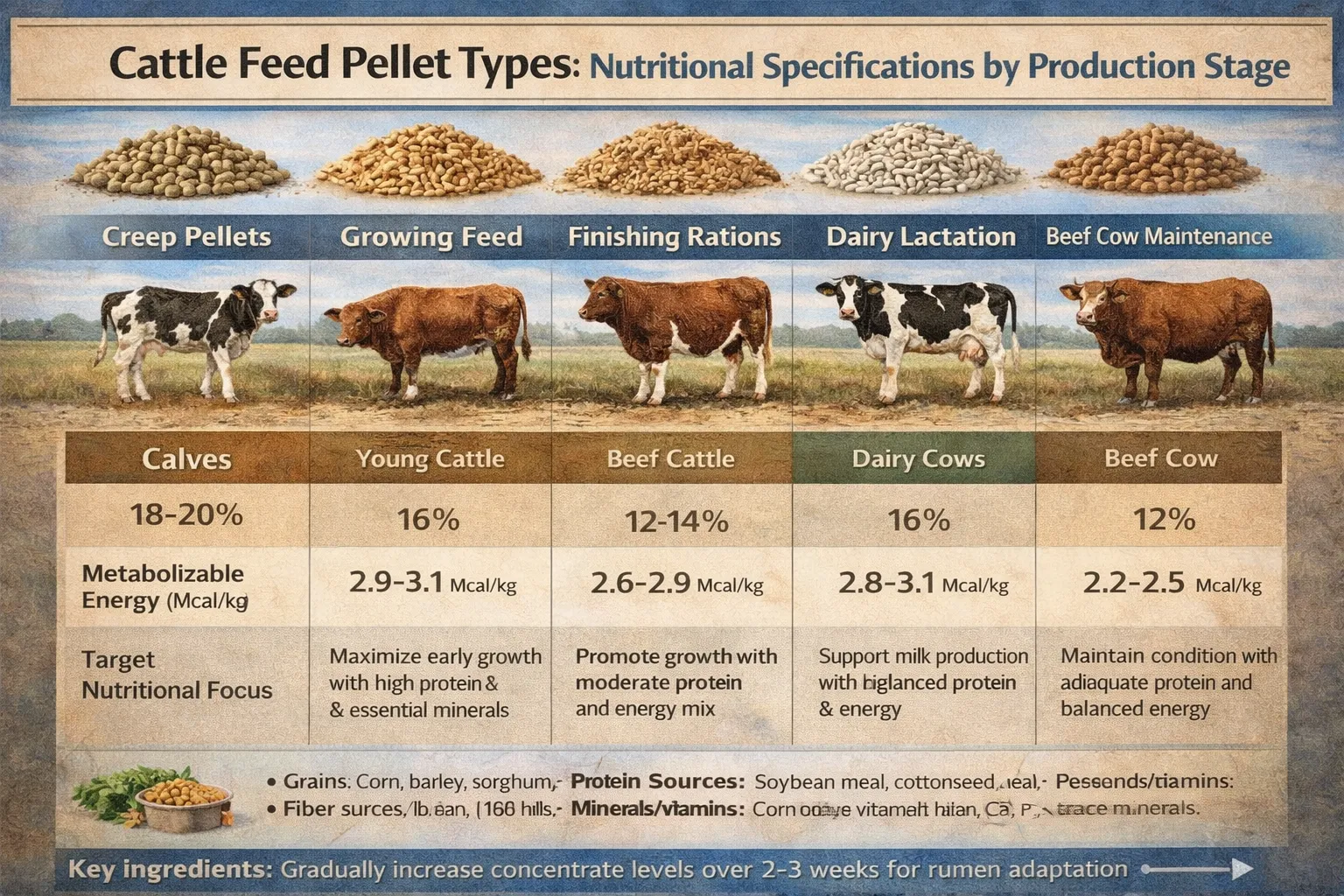
Creep Pellets for Calves (18-20% CP, 12.5 MJ ME/kg DM) introduce ruminant nutrition during the nursing phase, promoting early rumen microbial colonization and smooth weaning transitions. Pellets containing milk products, high-quality protein, and coccidiostats optimize digestive health.
Growing Phase Supplements (16% CP, 11.5 MJ ME/kg DM) balance growth with economical forage integration, ideal for stocker operations where pasture quality fluctuates seasonally.
Finishing Rations (12-14% CP, 12.0-13.1 MJ ME/kg DM) emphasize rapid energy intake and lean tissue deposition, engineered for 100-120 day feedlot finishing protocols.
Dairy Lactation Pellets (16% CP, 12.0+ MJ ME/kg DM) integrate with forage programs to achieve peak milk production, formulated with protected amino acids (lysine, methionine) for milk protein synthesis optimization.
Beef Cow Maintenance (12% CP, 10.5 MJ ME/kg DM) supports fetal/lactational demands during pregnancy and nursing without excess condition that increases metabolic disorders.
Quality Indicators & Guaranteed Analysis
Premium pellets feature:
- Pellet Durability Index >90%: Indicates superior structural integrity
- Consistent Guaranteed Analysis: Batch-to-batch variation <5% for crude protein, energy
- Ingredient Transparency: Named ingredients (cottonseed meal, not “plant protein source”)
- Independent Testing: Third-party laboratory verification of nutrient content
- Mold & Mycotoxin Testing: Ensures safety for pregnant cattle and young calves
Examine guaranteed analysis labels carefully-legitimate manufacturers provide:
- Minimum crude protein %
- Maximum crude fiber %
- Minimum ether extract %
- Specific mineral ranges (calcium, phosphorus, sodium)
- Vitamin A level (critical for reproduction and immunity)
Best Feeding Practices & Management
Daily Intake Recommendations
Beef Cattle: Allocate 1.5-2.5% of bodyweight daily in total dry matter intake, with pellets comprising 0.75-1.5% of bodyweight depending on forage quality. Growing steers on pasture typically require 2-3 kg pellet supplementation daily, while feedlot finishing cattle consume 5-8 kg pellets per head daily as the concentrate portion of total mixed rations.
Dairy Cattle: Formulate complete mixed rations (TMR) containing 40-60% forage (dry matter basis) and 40-60% concentrate, with high-quality pellets comprising 50-75% of the concentrate portion. Peak lactation cows (40+ kg milk/day) typically consume 8-12 kg pellets daily as part of their 20-25 kg total dry matter intake.
Calves & Young Stock: Introduce creep pellets gradually at 3-5 days of age, increasing from 0.5 kg/day at initiation to 1.0-2.0 kg/day at weaning (60-90 days). Provide ad libitum high-quality hay and clean water simultaneously.
Transition & Adaptation Protocols
Cattle require 10-14 day adaptation periods when transitioning to new pellet formulations. Introduce new pellets by replacing 25% of the previous diet for 3-4 days, advancing to 50% for 3-4 days, then 75% before full transition. Abrupt diet changes cause ruminal acidosis, characterized by reduced feed intake, diarrhea, and temporary performance decline.
Storage & Quality Maintenance
Store pellets in clean, dry facilities protected from moisture ingress and rodent contamination. Optimal storage conditions maintain <12% moisture content and temperatures below 25°C. Periodically inspect stored pellets for evidence of mold, insect infestation, or caking-indicators of improper storage.
First-in, first-out (FIFO) inventory rotation prevents nutrient oxidation and vitamin degradation. Vitamin A content declines approximately 15% annually even under proper storage, necessitating fresh supplies to maintain formulation integrity.
Frequently Asked Questions
What cattle feed is high in protein?
High-protein cattle feeds contain 18-50% crude protein and include soybean meal (45%), cottonseed meal (37%), distillers grains (25-30%), fish meal (60-65%), and specialty pellets formulated specifically for young cattle and dairy operations. Creep pellets designed for pre-weaned calves typically deliver 18-20% CP, while lactation pellets for dairy cattle contain 15-18% CP to support milk protein synthesis.
What is a good source of protein for cattle?
Quality protein sources balance three criteria: digestibility, amino acid profile completeness, and cost-effectiveness. Soybean meal historically dominated due to its 45% CP content, complete essential amino acid spectrum, and proven performance. However, high-protein distillers grains (30-40% CP), cottonseed meal (37% CP), and corn gluten feed (19-21% CP with high bypass protein) provide competitive alternatives, particularly when formulated with rumen-protected amino acids (lysine, methionine).
For intensive beef production, combining multiple protein sources creates a more resilient diet against market volatility while optimizing amino acid ratios for the specific production stage.
What cattle feed is high in energy?
High-energy feeds contain >10.5 MJ ME/kg DM and include corn (12.5 MJ/kg), barley (12.5 MJ/kg), sorghum (10.6 MJ/kg), and formulated pellets specifically engineered for finishing cattle (11.5-13.1 MJ/kg). Whole cottonseed (13.1 MJ ME/kg) provides exceptional energy density alongside quality protein. Rumen-protected fats, when properly formulated as calcium soaps or prill forms, deliver 37-46 MJ/kg gross energy, though their effective energy for production varies based on diet matrix interactions.
Can you feed cows too much protein?
Yes-excess dietary protein creates metabolic inefficiency and economic waste. Cattle cannot store excess amino acids; surplus protein is deaminated and converted to urea for urinary excretion, a metabolically costly process that generates waste heat, reduces energy efficiency, and elevates environmental nitrogen pollution.
Cattle fed 18% CP diets often show no performance advantage over 14-16% CP diets formulated with optimal amino acid profiles and proper RDP:RUP ratios. Excessive protein reduces dry matter intake in heat-stressed cattle, diminishes feed conversion efficiency, and increases susceptibility to ketosis and subacute ruminal acidosis.
Optimal practice involves feeding the lowest crude protein level that meets amino acid requirements, typically achieved through amino acid-balanced diet formulations rather than high blanket protein levels.
What puts weight on cows fast?
Rapid weight gain requires three integrated components: high-energy diet density (12+ MJ ME/kg DM), adequate crude protein with balanced amino acids (12-16% CP depending on growth stage), and proper mineral supplementation. Cattle achieve maximum growth velocity when fed complete mixed rations (TMR) with 60-70% concentrate inclusion, formulated to provide 11.5+ MJ ME/kg DM and containing essential amino acids in optimal ratios to energy content.
Supplementary rumen-protected fat (2-4% inclusion) enhances energy density without ruminal fermentation disruption, particularly effective in finishing diets. Strategic use of growth promotants (ionophores, beta-agonists where approved) can increase daily gain 10-15% when combined with superior nutrition.
How do I formulate animal feeds using local ingredients?
Effective feed formulation balances four fundamental principles: (1) meeting energy requirements through grain inclusion (corn, barley, sorghum), (2) achieving protein targets via meal ingredients (soybean, cottonseed, sunflower), (3) maintaining adequate fiber for rumen health (wheat bran, roughage components), and (4) balancing minerals and vitamins to prevent deficiency.
Standard beef cattle finishing formulations on a dry matter basis include 45-50% corn, 10-15% wheat bran or barley, 10-15% sorghum or oats, 12-15% protein meal (soybean or cottonseed), 8% additives (minerals, vitamins, binders), and 5-8% roughage. Dairy formulations require higher protein inclusion (18-20% soybean meal vs. 12-15% in beef) due to lactational amino acid demands.
Local ingredient substitution demands laboratory analysis of proximate composition (protein, fiber, moisture) and ideally metabolizable energy determination through digestibility studies. Small-scale trials (25-50 head) validate formulation adjustments before full herd implementation.
What are the cost differences between cattle feeding methods?
Feeding method costs vary dramatically by production system. Pasture-only systems (minimal supplementation) generate lowest direct feed costs but sacrifice 20-30% growth performance compared to supplemented systems. Typical annual feed cost per head ranges $400-700 for extensive systems.
Strategic supplementation with high-quality pellets ($300-500/ton) increases per-head feed costs by $150-300 annually but improves daily gain by 0.3-0.5 kg, often returning $200-400 additional revenue per head through faster turnover and improved carcass value.
Complete confinement with total mixed rations (TMR) generates $600-1200 annual feed cost per head but delivers maximum performance (1.8+ kg/day ADG for beef steers) and precise nutrient management unavailable in forage-based systems. High-producing dairy cattle consuming 20-25 kg DM daily incur $2000-3500 annual feed cost per head-40-50% higher than beef cattle but justified by 8000-12000 kg milk production annually.
Economic optimization requires calculating return on feed investment (ROFI) specific to local feed prices, market conditions, and production goals rather than pursuing lowest absolute feed cost.
What are natural and effective cattle feed ingredients?
Natural, forage-based systems emphasize pasture quality optimization, legume integration (alfalfa, clover), and native hay production. High-quality pasture (>2.0 Mcal NEm/kg DM, >12% CP) supports 0.8-1.2 kg/day gain without supplementation during growing season.
Conservation feeding-utilizing fermented feeds (silage, haylage)-preserves seasonal forage abundance for winter feeding, reducing total supplementation requirements. Fermentation processes enhance forage digestibility by 5-10% compared to sun-cured hay, making preserved forages economically competitive with grains for maintenance requirements.
Sustainable intensification incorporates agro-industrial byproducts (distillers grains, citrus pulp, whey co-products) and crop residues (wheat straw, corn stover) into balanced rations, reducing reliance on grain crops and creating circular economy benefits. Research confirms that properly formulated byproduct-based diets deliver performance equivalent to conventional ingredient diets while supporting environmental sustainability objectives.
Conclusion
High-protein and high-energy cattle feed pellets represent essential tools for modern livestock operations seeking to optimize performance, economic efficiency, and environmental sustainability. The scientific literature consistently demonstrates 10-30% performance improvements when cattle transition from marginal forage-only diets to strategically formulated pellet supplementation.
Success requires matching feed formulations to specific production stages, maintaining quality consistency through reliable sourcing and testing, and integrating pellets into comprehensive herd management protocols. Whether managing beef cattle through accelerated growth phases, supporting dairy cattle through peak lactation, or balancing economics with sustainability in extensive grazing systems, properly selected high-protein and high-energy pellets deliver measurable return on investment while supporting long-term herd health and productivity.
Invest in quality pellets formulated by reputable manufacturers with transparent ingredient sourcing, third-party nutrient verification, and evidence-based formulation science. The performance improvements and economic returns far exceed the modest premium cost versus commodity alternatives.