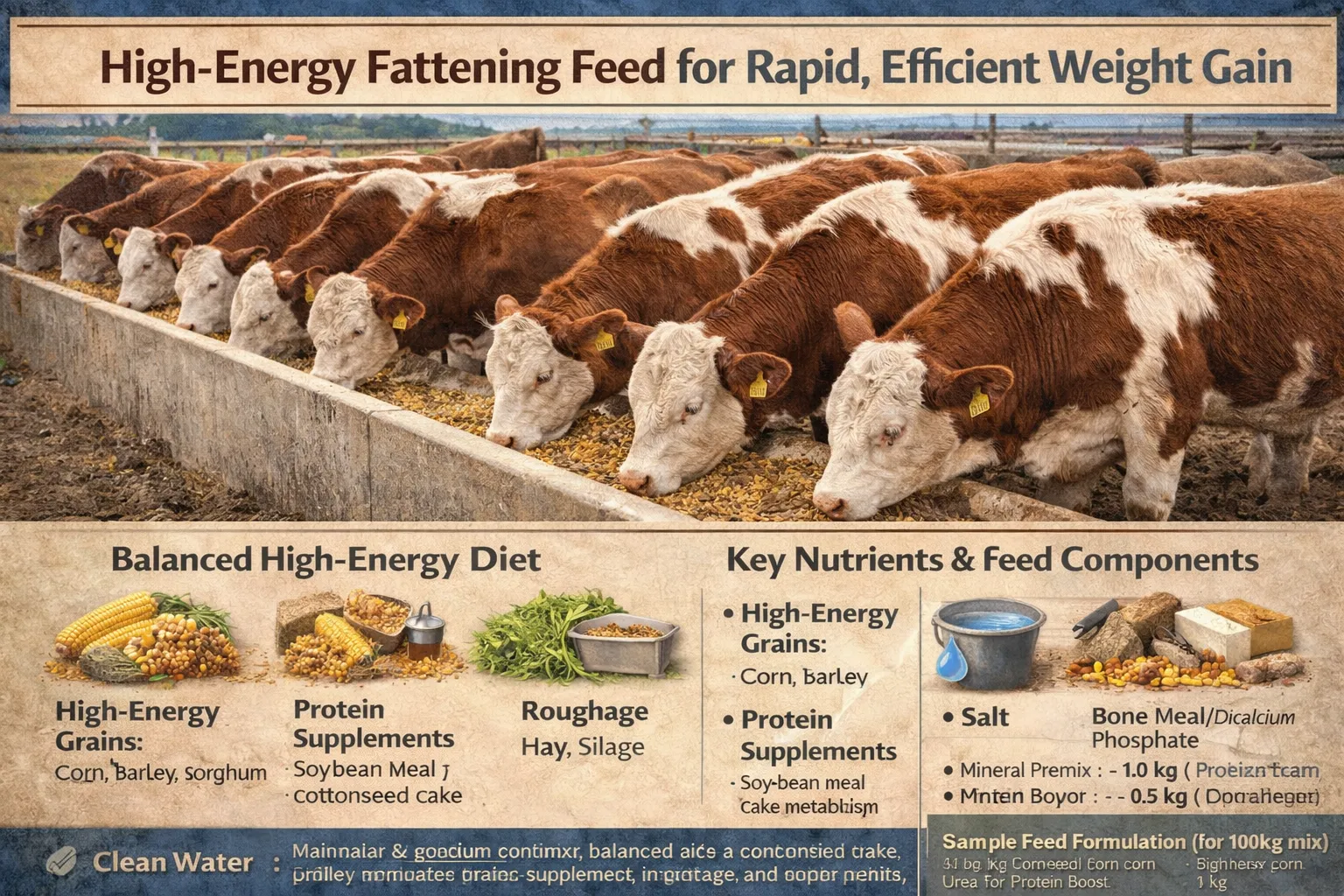
Efficient finishing is the difference between profit and loss in beef production. The right cattle fattening feed for rapid weight gain does more than add kilos quickly – it delivers consistent performance, protects animal health, and maximizes carcass value.
This pillar guide explains exactly how to design and manage high‑performance fattening diets, which ingredients and additives actually drive faster growth, how to keep costs under control, and how to avoid the health problems that can destroy margins. Use it as a practical blueprint to build or refine your own finishing program.
1. What “Rapid Weight Gain” Really Means in Practice
In most feedlot or intensive finishing systems, “rapid” but still safe growth typically means:
- Average daily gain (ADG) of around 1–1.6 kg (2.2–3.5 lb) per head in the finishing phase, depending on genetics and starting weight.
- Feed intake around 2.5–3.0% of bodyweight per day on a dry‑matter basis for grain‑based rations.
Pushing much harder than this for long periods usually increases the risk of digestive upsets, lameness, and unacceptable carcass fat, while sharply raising feed costs per kilo of gain.
The goal is not just adding weight quickly, but achieving:
- High ADG with good feed efficiency (low feed‑to‑gain ratio)
- Desirable carcass finish and marbling
- Minimal health problems and mortalities
- A predictable, repeatable system you can scale
2. Key Factors That Influence Weight Gain
Before choosing any cattle fattening feed, be clear about the non‑feed factors that strongly affect performance.
2.1 Genetics and class of animal
- Young growing steers and heifers respond best to energy‑dense rations and convert feed more efficiently than older cows or bulls destined for cull markets.
- Some breeds and crosses, such as British and Wagyu‑influenced cattle, naturally deposit more intramuscular fat (marbling) when adequately fed.
2.2 Starting weight and body condition
Underweight or parasite‑burdened animals will initially use nutrients to restore health and frame before they convert feed efficiently into saleable meat. Strategic deworming and mineral correction are essential before intensive feeding.
2.3 Health status and stress
Respiratory disease, parasite loads, heat stress, and poor handling can cut daily weight gain dramatically and destroy feed efficiency. Effective vaccination, biosecurity, and low‑stress handling pay for themselves quickly during finishing.
2.4 Housing and environment
- Barn‑based or feedlot systems allow tighter control over intake and usually support faster gain than pasture‑only systems.
- Good ventilation, dry bedding, clean water, and adequate space at the feed bunk reduce stress and competition, all of which support better growth.
3. Core Components of a High‑Performance Fattening Ration
A high‑gain ration is built around six pillars: forage, energy, protein, fiber structure, minerals/vitamins, and water.
3.1 Forage base
Even in high‑grain feedlot diets, cattle require some effective fiber to maintain rumen health and prevent acidosis. Typical grain‑finishing rations still include around 10–20% roughage (on a dry matter basis) from good‑quality grass hay, silage, or chopped crop residues.
Forage quality matters: digestible forages support higher intakes and better performance than very stemmy, low‑quality roughage.
3.2 High‑energy ingredients
Energy drives growth. For rapid weight gain, most intensive programs rely on:
- Cereal grains: corn, barley, wheat, sorghum
- High‑energy by‑products: molasses, corn gluten feed, distillers grains
- Some added fats or oils in certain systems
Grain‑based finishing rations often contain 60–75% concentrate (grains plus by‑products) to support ADG above 1.2 kg per day when managed correctly.
3.3 Protein sources
Growing and finishing cattle need sufficient crude protein – often in the 12–14% range for well‑finished feedlot diets – with the right balance of rumen‑degradable and bypass protein.
Common protein ingredients include:
- Soybean meal, canola meal, cottonseed meal
- Sunflower cake or other oilseed cakes
- Commercial protein concentrates or urea‑containing premixes (when correctly balanced)
Protein‑vitamin‑mineral supplements have repeatedly been shown to improve average daily gain and immune status when basal diets are short of key nutrients.
3.4 Fiber structure
Effective fiber (typically from hay, silage, or straw) stimulates chewing and saliva production, which buffers the rumen. Too little physically effective fiber dramatically increases the risk of rumen acidosis, bloat, liver abscesses, and laminitis when cattle are on high‑grain diets.
3.5 Minerals and vitamins
Deficiencies in calcium, phosphorus, magnesium, trace minerals (copper, zinc, selenium) and vitamins A, D, and E can limit growth and increase disease susceptibility even when energy and protein seem adequate.
Mineral premixes or complete commercial fattening feeds should supply:
- Balanced macro‑minerals for bone growth and muscle function
- Chelated or organic trace minerals where deficiencies or high antagonists are known
- Vitamin fortification, especially in drought or dry‑season conditions
3.6 Clean, continuous water
Lack of clean, cool water reduces feed intake immediately and therefore reduces weight gain. Water quality (salinity, sulfates, microbes) is just as important as quantity.
4. Feeding Strategies for Rapid, Safe Weight Gain
The best cattle fattening feed still fails if feeding management is poor. These strategies keep gains high and health problems low.
4.1 Pen‑fattening vs pasture‑plus‑supplement
- Pen or feedlot fattening uses a confined area and a high‑energy, fully mixed ration for 45–120 days to quickly add finish.
- Pasture‑plus‑supplement systems allow animals to graze but top up with grain or protein‑energy supplements to cover nutrient gaps.
Feedlot systems typically deliver the fastest gains but require higher capital and tighter management. Pasture systems are more flexible and often cheaper per day but may give lower daily gains.
4.2 Step‑up from forage to high‑grain
Cattle coming off grass must be adapted gradually to heavy grain diets to avoid acidosis. Extension programs commonly recommend step‑up rations over 21–28 days, slowly increasing the grain proportion while reducing roughage.
Practical guidelines:
- Start with more roughage (40–50% DM) and modest grain, then increase grain by no more than about 10% of the ration at a time.
- Watch manure consistency, rumen fill, and behavior closely after each change; back off if animals show signs of digestive upset.
4.3 Feed intake targets and bunk management
- As a rule of thumb, finishing cattle on grain‑based diets eat around 2.5–3.0% of bodyweight in dry matter daily.
- Growing steers might receive roughly 1–1.5 kg of grain per 45 kg (100 lb) bodyweight early in the program, and 2–2.5 kg per 45 kg in the finishing phase.
Consistent feeding times (two to three times per day), clean bunks, and prevention of long “empty bunk” periods help maintain steady intake and better feed‑to‑gain ratios.
5. Using Feed Additives to Accelerate Weight Gain
Correctly chosen feed additives can improve average daily gain, feed efficiency, and carcass characteristics – especially in intensive systems. Always follow label directions and local regulations.
5.1 Ionophores
Ionophores such as monensin, lasalocid, and laidlomycin alter rumen fermentation, typically increasing propionate production and reducing bloat and coccidiosis risk. Research and field data show:
- Improved feed efficiency and modest increases in daily weight gain in feedlot cattle.
These products are widely used in North American feedlots and some other regions but may be restricted elsewhere.
5.2 Beta‑agonists
Beta‑agonists (e.g., ractopamine, zilpaterol) are fed only for the last 28–42 days before slaughter in some countries. They redirect nutrients toward lean muscle accretion, leading to:
- Increased rate of gain and carcass weight
- Improved feed efficiency and carcass leanness during the final feeding period
Because of residue and welfare concerns, beta‑agonists are banned or limited in many export markets, so check market requirements carefully.
5.3 Probiotics, yeasts, and biological additives
Probiotic and yeast products help stabilize rumen microbiota, improve fiber digestion, and support immune function. Studies in young and finishing cattle report:
- Higher average daily gains and better feed conversion when probiotic or yeast products are included in rations.
These are particularly useful when diets change rapidly or when cattle are exposed to stress.
5.4 Vitamin and mineral complexes
Specialized vitamin‑mineral feed additives have been shown to:
- Increase live‑weight gain by 10–15% in young cattle where baseline diets were deficient
- Improve blood parameters and immunity, reducing disease risk and treatment costs
5.5 Appetite stimulants and flavoring agents
Aromatic or essential‑oil‑based flavor additives can stimulate feed intake and may improve growth performance, especially in phase‑feeding systems or heat stress.
6. Low‑Cost Fattening Feeds and Local Ingredient Options
Rapid weight gain does not always require expensive commercial pellets. Many profitable systems rely on local by‑products and crop residues, strategically balanced with concentrates.
Typical cost‑effective ingredients include:
- Crop residues: maize stover, wheat or rice straw, sorghum stalks, ground and mixed with concentrates
- Grasses and hay from planted pastures used with grain or protein supplements
- Agro‑industrial by‑products: molasses, oilseed cakes, bran, corn gluten feed, distillers grains
Key principles for low‑cost rations:
- Use cheap local roughage for bulk and rumen function.
- Add enough grain or energy supplement to push ADG into your target range.
- Correct obvious protein and mineral deficiencies with focused supplements rather than over‑feeding expensive ingredients.
7. Example Ration Frameworks for Rapid Weight Gain
The following are generic starting frameworks, not complete formulations. Always adapt to local ingredient availability, animal type, and market requirements with a qualified nutritionist.
7.1 Grain‑based feedlot finishing ration (per 100 kg of dry matter)
- 60–70% cereal grain (corn, barley, wheat, sorghum)
- 10–15% protein meal (soybean, cottonseed, canola, sunflower cake, or commercial protein concentrate)
- 15–20% roughage (hay, silage, chopped straw or stover)
- 2–4% molasses or other liquid energy source
- 2–4% mineral‑vitamin premix and salt
Such rations are consistent with published “typical feedlot diets” targeting around 3 lb (1.36 kg) daily gain with efficient feed conversion.
7.2 Pasture‑plus‑supplement system
- Free‑choice grazing on good pasture or crop residues
- 0.5–2.0 kg/head/day of a 30% crude protein supplement, adjusted by season and forage quality, has been shown to significantly increase intake and daily gain in grazing heifers and stocker cattle.
This approach is ideal where land is plentiful but high‑quality concentrate is expensive.
7.3 Smallholder low‑cost concentrate mix (illustrative)
For producers mixing feed on‑farm, a simple grower/finisher concentrate (to be fed alongside roughage) might resemble:
- 40–50% ground maize or other grain
- 20–25% bran or by‑product feed
- 20–25% oilseed cake (cottonseed, sunflower, or similar)
- 3–5% mineral‑vitamin premix and salt
Farm‑level programs using similar proportions, combined with adequate hay or crop residues, have supported profitable pen fattening in smallholder systems.
8. Monitoring Performance and Optimizing ROI
A high‑gain program must be managed with numbers, not guesswork.
8.1 Track weights and average daily gain
- Record individual or group starting weights.
- Re‑weigh every 30–45 days.
- Calculate ADG = (current weight – starting weight) ÷ days on feed.
Feedlot producers commonly target 2.5–3.5 lb (1.1–1.6 kg) ADG in the finishing phase; substantial deviations signal problems in feed quality, health, or management.
8.2 Monitor feed intake and feed‑to‑gain ratio
- Estimate daily dry matter intake per head.
- Calculate feed:gain ratio (kg of feed DM per kg of weight gain).
Comparisons show that improving feed efficiency from 8:1 to 6:1 can save well over $100 per head in feed costs over a finishing period at typical ration costs.
8.3 Watch health and behavior indicators
Warning signs that demand ration or management adjustments include:
- Sudden changes in manure consistency
- Off‑feed animals or large variation in bunk clean‑up
- Lameness, bloating, or excessive lying
- Rough hair coat, depressed demeanor
Prompt veterinary and nutritional intervention preserves both performance and welfare.
9. Health Risks When Pushing for Faster Gains
Intensive programs that chase very rapid weight gain without safeguards commonly run into:
- Rumen acidosis and bloat – from too much rapidly fermentable starch and too little effective fiber
- Liver abscesses – linked to chronic acidosis and rumen wall damage
- Laminitis and lameness – due to grain overload, mineral imbalance, or poor flooring
- Respiratory disease – especially in stressed, newly received calves
Risk‑reduction strategies include gradual step‑up to high‑grain diets, adequate roughage, correct mineral balance, use of ionophores where allowed, sound vaccination programs, and low‑stress handling.
10. How to Choose the Best Cattle Fattening Feed Product
When evaluating commercial fattening feeds or premixes, focus on:
- Nutrient profile aligned with your system
- Is it designed for pasture‑based, backgrounding, or high‑grain finishing?
- Does it supply adequate energy, protein, and minerals for your target ADG?
- Proven performance data
- Look for trial results showing improvements in ADG, feed efficiency, or carcass weight under conditions similar to your farm.
- Additive package
- Does it include appropriate ionophores, probiotics, or other additives allowed in your market and suited to your goals?
- Support and formulation flexibility
- Reputable suppliers provide ration balancing services, on‑farm troubleshooting, and support with step‑up programs and bunk management.
- Total cost per kilo of gain, not price per bag
- A more expensive feed can be cheaper per kilo of saleable beef if it significantly improves growth and feed efficiency.
Strategically chosen feeds and additives can turn average animals into top performers and compress the days needed to reach slaughter weight, giving you more production cycles per year.
11. FAQ: Practical Answers About Cattle Fattening Feed for Rapid Weight Gain
1. How can I get beef cattle to gain weight quickly but safely?
Target a high‑energy, well‑balanced ration, introduced gradually, with consistent feeding times and clean water. Aim for a grain‑based diet with 60–70% concentrates, 15–20% quality roughage, and adequate protein and minerals, while keeping animals healthy, dewormed, and stress‑free. This combination supports strong daily weight gain without pushing cattle into dangerous digestive problems.
2. What is the best feed for weight gain in cattle?
The “best” feed depends on your system and local prices, but rapid, efficient gain usually comes from:
- A high‑energy grain such as corn or barley
- A quality protein source (soybean meal, cottonseed cake, or a protein–vitamin–mineral concentrate)
- Good‑quality hay or silage for fiber
- A balanced mineral‑vitamin premix and, where legal and appropriate, an ionophore or other growth‑promoting additive
Feeds that combine these elements into a complete finishing ration typically outperform single‑ingredient “quick fixes.”
3. What is the best fattening ration for cattle in a feedlot?
An effective finishing ration often contains:
- 60–75% grain and high‑energy by‑products
- 10–15% protein meal
- 10–20% roughage
- 2–5% molasses, minerals, and vitamins
When paired with a proper step‑up program and good bunk management, such diets routinely achieve ADG over 1.2 kg with good feed efficiency in commercial feedlots.
4. How quickly can I safely finish cattle on grain?
Well‑grown weaners or yearlings can often be finished in 70–120 days on a high‑energy feedlot diet, depending on entry weight, target grade, and genetics. Rushing faster than that by “crashing” them onto very heavy grain without adaptation sharply increases health risks and may produce overly fat carcasses.
5. How do I put weight on a very skinny cow or heifer?
First, correct underlying problems – deworm, treat diseases, and ensure good teeth and mobility. Then provide:
- Free‑choice good‑quality forage
- Gradual introduction of grain or high‑energy supplements
- Adequate protein and mineral supplementation
Skinny animals often need several weeks of rebuilding before they respond like normal finishers, but once health is restored, they can still achieve good weight gain.
6. Are grain‑based diets harmful compared with grass?
Cattle are adapted to ferment fiber, but they can utilize grain very efficiently when the diet is correctly balanced and introduced gradually. Problems arise when:
- Grain is increased too fast
- Effective fiber is too low
- Minerals are unbalanced
- Animals are stressed or overcrowded
Well‑managed grain diets can be safe and highly efficient; poorly managed ones cause acidosis, bloat, and lameness.
7. What are some low‑cost feeds for rapid weight gain?
Cost‑effective options include:
- Maize or sorghum stover plus home‑grown hay, fortified with a grain–protein concentrate
- By‑products such as bran, molasses, and oilseed cakes
- Grazed planted pastures (ryegrass, Kikuyu, etc.) with grain or protein supplementation in the trough
The key is balancing these cheap ingredients with just enough concentrate and minerals to reach your target rate of gain.
8. How much feed per day should finishing cattle eat?
As a guideline, most feedlot cattle eat around 2.5–3.0% of their bodyweight in dry matter each day on high‑grain diets. A 450 kg steer might therefore consume 11–13.5 kg of dry matter (roughly 13.5–15 kg “as‑fed” in a typical grain mix), depending on ration composition and environment.
9. Are feed additives really necessary for rapid weight gain?
Not always, but they are powerful tools. Ionophores and beta‑agonists (where permitted) have been shown to significantly improve feed efficiency and carcass weight in the final weeks on feed. Probiotics, yeasts, and vitamin‑mineral additives can also improve growth and health, especially in stressed or intensively fed cattle. Think of them as refinements on top of a sound base diet, not replacements for it.
10. How do I fatten show heifers quickly without ruining their structure?
Show heifers need controlled, even growth rather than extreme fat deposition. Use:
- A moderate‑energy ration with adequate protein and minerals
- Slow, steady increases in concentrate rather than sudden jumps
- Careful monitoring of body condition and soundness
Many show programs target ADG around 0.8–1.1 kg (1.75–2.5 lb) so animals look fresh, sound, and feminine rather than over‑finished.
11. Can I mix my own cattle fattening feed at home?
Yes, many successful producers mix on‑farm rations using home‑grown grains, crop residues, and purchased protein–mineral premixes. The keys are:
- Getting an accurate laboratory analysis of major ingredients
- Working with a qualified nutritionist to balance energy, protein, fiber, and minerals
- Following a strict mixing procedure to avoid “hot spots” of urea or additives
Well‑designed home‑mix rations can match or beat the performance of commercial feeds at lower cost when done correctly.
A carefully formulated cattle fattening feed for rapid weight gain, combined with disciplined feeding management and health care, turns your herd’s genetic potential into consistent, profitable performance. By applying the principles in this guide – from ration design and step‑up strategies to smart use of additives and vigilant monitoring – you put yourself in the strongest position to outperform competing producers in both growth and carcass value.