The transition period-spanning from approximately three weeks before calving through three weeks after calving-represents the most metabolically demanding and economically critical phase in the dairy cow production cycle. During this period, dairy cows undergo dramatic hormonal, endocrine, and metabolic shifts that fundamentally alter their nutritional requirements and physiological status. The quality and composition of dry cow feed during this interval directly determines the cow’s ability to successfully navigate calving, minimize metabolic disease incidence, optimize early lactation performance, and maintain reproductive health for the subsequent lactation cycle.
Research demonstrates that approximately 75% of metabolic diseases in dairy cattle occur within the first 30 days of lactation, with the majority of these conditions originating from improper dry period nutrition and management. The stakes are substantial: metabolic disorders cost dairy operations an estimated $300–$2,500 per affected cow through direct treatment expenses, reduced milk production, extended calving intervals, and premature culling. Strategic dry cow feeding, therefore, represents one of the highest-return management investments available to dairy producers.
Understanding the Dry Cow Period Structure
Effective dry cow management requires dividing the 60-day dry period into two distinct phases, each with unique nutritional objectives and dietary formulations.
Far-Off Dry Period (Days 60–21 before calving)
During the far-off dry period, the cow is not yet subject to rapid fetal development or imminent lactation metabolic demands. The primary goals are to maintain appropriate body condition score (BCS), preserve rumen health and microbial populations, and provide baseline nutrient adequacy without energy excess. Research demonstrates that far-off dry cows can easily consume 40–80% more net energy than required when fed energy-dense rations, leading to excessive body weight and fat deposition. This overconsumption triggers downstream metabolic dysfunction during the transition period.
The recommended energy density for far-off dry cows is 0.57–0.60 Mcal net energy for lactation (NEL) per pound of dry matter, substantially lower than lactation rations. This controlled-energy approach is best achieved by incorporating high-straw, low-concentrate diets containing approximately 25–27 pounds of dry matter per day for a 1,500-pound Holstein cow. Forages should comprise 85–88% of total ration dry matter, with crude protein maintained at 12–14% to support adequate colostrum quality and feed intake while preventing excess dietary nitrogen.
Close-Up Dry Period (Days 21–0 before calving)
The close-up period fundamentally differs from the far-off phase: fetal growth accelerates dramatically, colostrum synthesis begins in earnest, and the cow’s dry matter intake begins declining 7–10 days before calving. Simultaneously, nutrient density requirements increase because energy and nutrient intake cannot rise proportionally with demand.
Close-up diets require substantially higher nutrient concentration, with energy density increased to 0.63–0.68 Mcal NEL per pound of dry matter. Crude protein should be elevated to 15–16% using sources rich in digestible undegraded protein (DUP), with some research suggesting targets as high as 16–17% crude protein to support optimal colostrum composition and early lactation productivity. However, research on high-straw, low-energy single-diet systems demonstrates that modest adjustments to far-off formulations-via concentrate changes rather than forage substitution-can successfully bridge both periods without requiring two separate diets.
Body Condition Scoring: Foundation of Transition Health
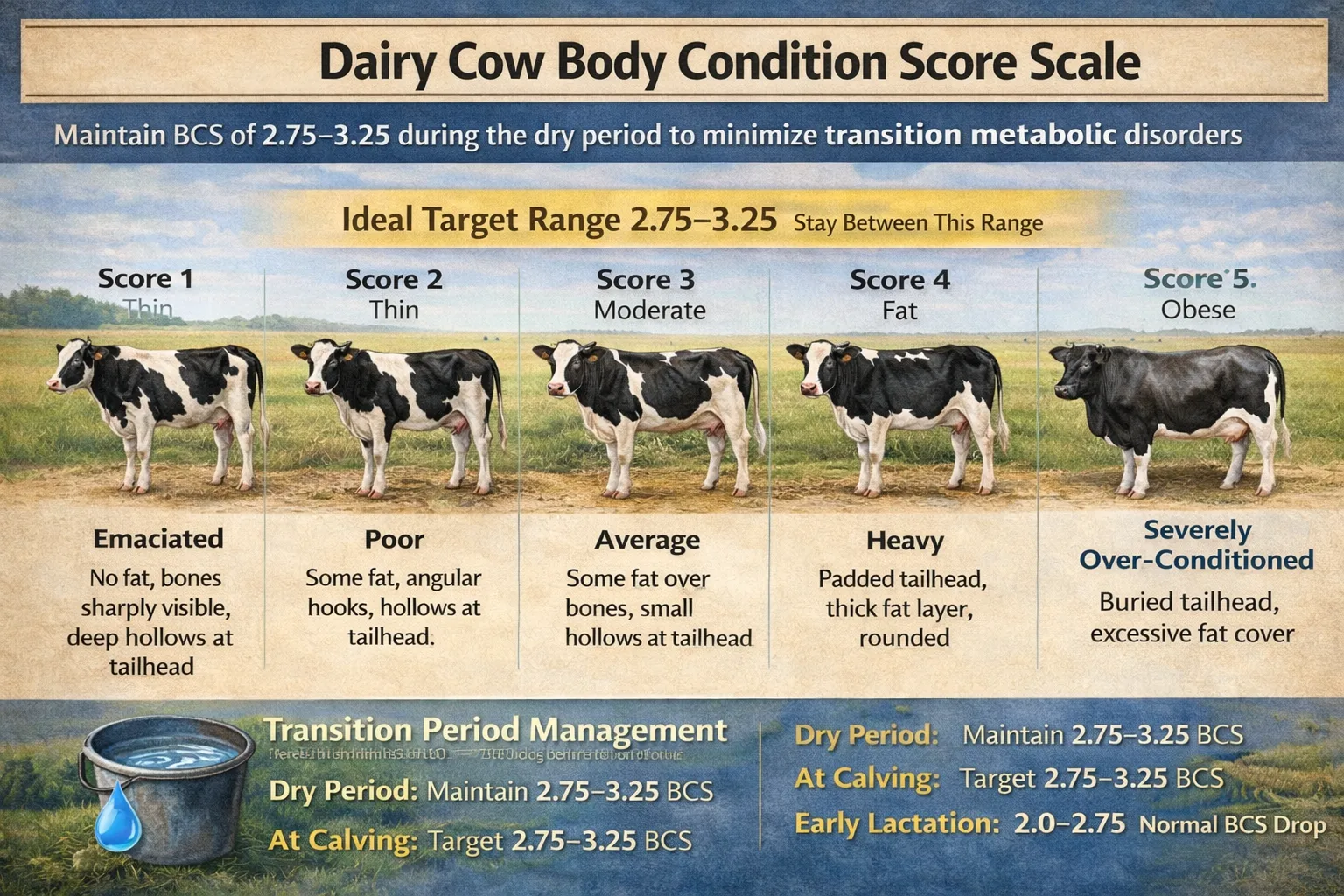
Body condition score represents a visual and tactile assessment of body fat reserves using a 5-point scale with 0.25-point increments, and it is the single most predictive indicator of transition period success.
Target Body Condition Scores
Current research supports target BCS of 2.75–3.25 at both dry-off and calving, representing a meaningful shift downward from historical recommendations of 3.25–3.75. Cows entering the dry period with a BCS exceeding 3.5 face substantially elevated risk for reduced dry matter intake at calving, metabolic disease incidence, and dystocia (difficult calving). Conversely, underconditioned cows (BCS <2.5) enter lactation without adequate energy reserves to buffer the inevitable negative energy balance of early lactation.
The optimal BCS of approximately 3.0 represents a biological compromise: it is low enough to promote strong postcalving dry matter intake and minimize metabolic disease risk, yet sufficiently reserves sufficient body tissue to support initial lactation demands. Field data from Ontario dairy herds revealed that although 57% of dry cows fell within the new recommended range (2.75–3.25), 40% remained overconditioned (>3.25), indicating that substantial industry adoption of lower BCS targets remains incomplete.
Managing Body Condition During Dry Period
Preventing body condition gain during the far-off period requires disciplined feed management, not restriction of total feed volume but rather controlled energy intake through diet formulation. For grazing situations, stocking densities should not exceed 8–12 cows per hectare to prevent excessive forage consumption and condition gains. For housed cattle, energy density adjustment through straw incorporation and concentrate limitation achieves the same result without limiting dry matter intake-a critical distinction that preserves rumen function.
Cows that lose more than 0.5 BCS points between calving and peak milk yield experience significantly elevated metabolic disease incidence and impaired reproductive performance. The target window is loss of no more than 0.5 BCS over this critical period, with peak negative energy balance typically occurring 14–21 days postcalving.
Dry Matter Intake: The Critical Management Driver
Dry matter intake (DMI) during the transition period directly determines nutrient intake and subsequently dictates metabolic health and production outcomes. The challenge is paradoxical: nutrient demands increase while intake capacity decreases, reaching its nadir at calving.
Intake Dynamics and Decline Patterns
Mature dairy cows experience a 35% decline in DMI during the final week before calving, with this decline beginning 7–10 days prepartum. First-lactation heifers show earlier and sometimes more pronounced intake reductions, beginning 4–7 days before calving. This intake depression directly increases the risk of negative energy balance and contributes substantially to metabolic disorder incidence.
During the dry period itself, forage dry matter intake should be maintained at 1.8–2.0% of body weight per day minimum, with forage comprising at least 45% of total dry matter intake. For a 1,500-pound Holstein, this translates to approximately 13.5–15 pounds of forage dry matter daily.
Dietary Factors Influencing Intake
Forage quality, particle length, and physical form significantly impact DMI during the transition period. Research demonstrates that cows fed diets with shorter wheat straw particles (2.54 cm) consumed more total dry matter during the dry period but had fewer meals per day and faster feeding rates compared to cows fed longer particles (10.16 cm). This suggests that while short-chopped forage may promote intake quantity, longer particles may promote more natural feeding behavior and rumen mat formation.
Feed sorting-the selective consumption of longer, coarser particles while rejecting fine material-is a critical intake management challenge during close-up periods. Cows fed high-straw diets containing >19 mm particles actively sort against the longest particles, potentially reducing effective neutral detergent fiber (NDF) intake and promoting subacute rumen acidosis (SARA). Management strategies to minimize sorting include adequate feed bunk space (>1 meter per cow), continuous feed availability, soft bedding to reduce stress, and feed delivery practices that present ration uniformity (adding water or molasses-based supplements to improve cohesion).
Mineral and Vitamin Supplementation: Preventing Metabolic Disorders
Mineral nutrition during the dry period is distinctly different from lactation requirements, with calcium, magnesium, and the cation-anion relationship forming the cornerstone of metabolic disease prevention.
Calcium and Phosphorus Management
Paradoxically, low-calcium feeding during the close-up period prevents milk fever (hypocalcemia), while high calcium feeding after calving supports lactation and reduces metabolic disease incidence. This seemingly contradictory approach reflects calcium homeostatic mechanisms: when dietary calcium is restricted prepartum, the cow’s body “pre-activates” the physiological systems responsible for calcium mobilization, allowing rapid adaptation to the dramatically increased postpartum calcium demand for milk secretion.
Recommended concentrations for dry cow diets are 0.4–0.6% calcium on a dry matter basis, with some research supporting the lower end of this range. For close-up periods, limiting dietary calcium below 0.5% of dry matter has proven effective. Conversely, high dietary phosphorus (>0.5% of dry matter) impairs calcium homeostasis and promotes hypocalcemia risk. Current recommendations limit phosphorus to 0.25–0.35% of dry matter in dry cow diets, substantially lower than historical formulations.
The calcium-to-phosphorus ratio, while historically emphasized, is less important than absolute dietary phosphorus concentration for preventing milk fever. Modern practice focuses on calcium restriction combined with strict phosphorus limitation as the foundation for hypocalcemia prevention.
Magnesium: Essential for Calcium Mobilization
Magnesium is fundamental to calcium homeostasis and immune function during the transition period. Adequate dietary magnesium (0.30–0.40% of dry matter in far-off rations, elevated to 0.40–0.50% in close-up rations) ensures normal parathyroid hormone function and calcium mobilization from bone stores. Magnesium deficiency exacerbates milk fever risk and contributes to grass tetany in grazing situations with high-potassium forages.
Organic magnesium sources, though more expensive, demonstrate superior bioavailability compared to magnesium oxide. In grazing-based systems with forages containing potassium levels exceeding 2% of dry matter, magnesium supplementation becomes particularly critical because excess potassium impairs magnesium absorption in the rumen.
Dietary Cation-Anion Difference (DCAD): Precise pH Manipulation
The Dietary Cation-Anion Difference (DCAD) is calculated as: DCAD = (Na⁺ + K⁺) − (Cl⁻ + S²⁻) (measured in milliequivalents per kilogram of dry matter).
This formula quantifies the net charge of mineral ions in the diet and directly determines systemic acid-base status. A positive DCAD (cations exceeding anions) promotes systemic alkalosis and impairs calcium mobilization. A negative DCAD (anions exceeding cations) induces mild metabolic acidosis that activates calcium mobilization mechanisms and enhances calcium resorption from bone reserves.
Current evidence supports a close-up dry cow DCAD target between −50 and −150 mEq/kg of dry matter, with many practitioners achieving success at −100 mEq/kg. Achieving this target requires two strategies: (1) selecting forages with naturally low potassium content, and (2) adding anionic salts (calcium chloride, magnesium sulfate, ammonium chloride) or hydrochloric acid–treated protein sources.
Field implementation demonstrates that reducing DCAD from typical dietary levels (+100 to +250 mEq/kg) to negative values reduces clinical milk fever incidence from approximately 9% to 4%, with subclinical hypocalcemia reductions of similar magnitude. However, excessively negative DCAD (below −150 mEq/kg) reduces feed palatability and may depress dry matter intake by 10–15%, offsetting some hypocalcemia prevention benefits.
Trace Minerals and Vitamins
Vitamin E and selenium supplementation during the dry period significantly reduces retained placenta incidence, mastitis risk, and supports immune competence during the metabolically stressful transition period. Target selenium supplementation is 0.3 mg per kilogram of dry matter, while vitamin E is recommended at minimum 1,500 IU daily during the close-up period, with some protocols utilizing up to 3,000 IU.
Zinc, copper, and manganese support immune function, colostrum quality, and placental integrity. While requirements are modest (20–40 mg/kg zinc, 10–12 mg/kg copper, 30–40 mg/kg manganese), deficiencies are more prevalent than commonly recognized, particularly in grass-based systems where forage trace mineral content varies substantially by soil status.
Preventing Critical Transition Period Metabolic Disorders
Dry cow feeding directly influences the incidence of four major metabolic disorders that collectively generate the majority of transition period disease burden.
Milk Fever (Hypocalcemia)
Milk fever, or parturient paresis, occurs when blood calcium concentration drops below 7.0 mg/dL (critical hypocalcemia), resulting in muscle weakness, recumbency, and potential death if untreated. Early detection and treatment with intravenous calcium borogluconate achieves cure rates exceeding 90%, but prevention through dry period nutrition is substantially more cost-effective and humane.
Modern milk fever prevention combines calcium restriction (0.4–0.6% dry matter), magnesium elevation (0.40–0.50%), anionic salt supplementation (to achieve negative DCAD), and avoidance of high-potassium forages. This multifactorial approach reduces clinical milk fever incidence to <1% in well-managed herds, though subclinical hypocalcemia remains prevalent in 50–73% of multiparous cows despite excellent clinical disease control.
Retained Placenta
Retained fetal membranes (retained placenta), defined as failure to expel placental tissue within 24 hours of calving, occur in approximately 3–10% of calvings and generate downstream consequences including metritis, mastitis, increased culling, and impaired reproductive performance. Subclinical milk fever is the single strongest predisposing factor for retained placenta, with deficient selenium and vitamin E also increasing risk.
Prevention focuses on milk fever control (addressing underlying hypocalcemia), adequate selenium and vitamin E supplementation, and maintenance of appropriate body condition score (avoiding overconditioned cows at calving). Special dry cow mineral blends formulated during the final 7–10 days before calving, incorporating optimized trace mineral ratios, have demonstrated efficacy in reducing retained placenta incidence below 5%.
Displaced Abomasum
Displaced abomasum (DA), occurring in approximately 3–5% of freshly calved cows, causes acute loss of rumen function and requires surgical intervention in most cases. The displaced abomasum results from inadequate rumen fill combined with gas accumulation, factors directly influenced by precalving dry matter intake and diet composition.
Prevention requires maximizing rumen fill through adequate forage intake (>85% forage on dry matter basis), limiting overconditioned cows at calving, preventing rapid dietary transitions from dry to lactation rations, and ensuring adequate feed bunk space and continuous feed availability. Some research suggests that including high-straw, low-energy diets during the close-up period produces more consistent dry matter intake leading up to calving, compared to higher-energy “steam-up” approaches.
Negative Energy Balance and Ketosis
Negative energy balance (NEB) occurs when energy demands for maintenance and milk production exceed dietary energy intake, a near-universal characteristic of early lactation that is distinctly normal but becomes pathological when excessive. Subclinical ketosis, defined by elevated blood β-hydroxybutyrate (BHB) without clinical signs, occurs in 30–50% of early-lactation cows and contributes to impaired immunity, reduced fertility, and metabolic disease susceptibility.
Dry period feeding influences NEB severity through body condition management (ensuring cows enter lactation without excess body fat that triggers rapid mobilization), energy density optimization in close-up rations (supporting adequate energy intake despite intake reduction), and mineral nutrition that promotes optimal rumen fermentation efficiency and microbial populations adapted to high-starch postpartum rations.
Feed Bunk Management and Transition Cow Environment
Dry matter intake during the transition period is substantially influenced by farm environmental factors and management practices, particularly feed delivery and bunk management.
Feed bunk allocation should exceed 1 meter per cow to minimize competitive pressure and ensure all animals achieve adequate intake, especially subordinate cows in the social hierarchy. Stocking density in transition pens should not exceed 100% (one cow per stall or pen equivalent) to prevent overcrowding stress that suppresses feed intake.
Minimizing pen changes and social mixing during the final week before calving preserves feed intake behavior and reduces stress responses that activate lactogenic hormone transitions prematurely. When pen changes are necessary, they should occur 1–2 weeks before expected calving to allow social reorganization and reestablishment of feeding routines before the critical intake depression period begins.
Feed delivery practices merit attention: providing fresh feed 3–4 times daily during the close-up period maintains optimal feed palatability and encourages more consistent intake throughout the day. Adding water to total mixed rations (TMR) or molasses-based liquid supplements improves feed cohesion, reduces sorting, and enhances palatability-factors particularly important when anionic salt supplements reduce natural diet palatability.
Practical Implementation and Feed Specification
Far-off dry cow diet specification (first 40 days of dry period):
- Energy density: 0.59–0.63 Mcal NEL/lb dry matter
- Crude protein: 12–14% (on dry matter basis)
- Calcium: 0.4–0.5%
- Phosphorus: 0.25–0.35%
- Magnesium: 0.30–0.35%
- Potassium: minimize via forage selection
- Dry matter intake: 25–27 lbs per day
- Vitamin E: 1,500 IU minimum daily
Close-up dry cow diet specification (final 21 days before calving):
- Energy density: 0.63–0.68 Mcal NEL/lb dry matter
- Crude protein: 15–16%
- Calcium: 0.4–0.6% (preferably ≤0.5%)
- Phosphorus: 0.25–0.35%
- Magnesium: 0.40–0.50%
- Potassium: minimize via forage selection; target <1.2% if possible
- DCAD: −50 to −150 mEq/kg dry matter (target −100)
- Sulfur: 0.35–0.40%
- Selenium: 0.3 mg/kg
- Vitamin E: 1,500–3,000 IU daily
- Dry matter intake: allow 22–25 lbs per day despite natural decline
These specifications assume a 1,500-pound lactating Holstein in moderate body condition. Adjustments for breed size, parity (first-lactation animals often require different timing of transitions), and individual farm forage compositions are essential for optimization.
Frequently Asked Questions
Q: What is the optimal dry cow body condition score at calving?
A: Current evidence supports a target body condition score (BCS) of 2.75–3.25 at calving, with an ideal midpoint of 3.0. This represents a meaningful downward adjustment from historical recommendations. Cows exceeding BCS 3.5 at calving face elevated risk for reduced dry matter intake, metabolic disease, and dystocia. BCS below 2.5 provides insufficient energy reserves for early lactation support. Body condition scoring should be performed 2–4 weeks before dry-off, with management interventions implemented early if cows fall outside target ranges.
Q: Why is negative dietary cation-anion difference important for dry cows?
A: Dietary cation-anion difference (DCAD) directly determines systemic acid-base status. Negative DCAD (typically −50 to −150 mEq/kg of dry matter) induces mild metabolic acidosis that activates the cow’s calcium homeostatic mechanisms, essentially “pre-activating” the physiological systems responsible for mobilizing calcium from bone reserves. This adaptation allows rapid response to the massive postpartum calcium demand from milk secretion. Herds implementing negative DCAD dry cow feeding protocols reduce clinical milk fever incidence from approximately 9% to 4%, demonstrating substantial practical benefit. Achieving negative DCAD requires selecting low-potassium forages and supplementing anionic salts or acid-treated products.
Q: How much dry matter should dry cows consume daily?
A: Dry cows should consume approximately 2% of their body weight in dry matter daily, translating to 13–15 pounds of dry matter per day for a 1,500-pound Holstein cow. Forage should comprise 85–88% of total ration dry matter, with concentrate supplementation providing energy and nutrient density increases. Natural dry matter intake decline begins 7–10 days before calving, reaching approximately 65–70% of typical intake by calving day. Far-off period dry matter intake often exceeds requirements (ranging from 25–30+ pounds per day), necessitating controlled-energy diet formulation to prevent overconsumption of net energy.
Q: What is the relationship between milk fever and retained placenta?
A: Subclinical milk fever (blood calcium below 8.0 mg/dL without clinical signs) is the single strongest predisposing factor for retained fetal membranes. Calcium is essential for smooth muscle function in the uterus and throughout the reproductive tract; inadequate calcium impairs the myometrial contractions necessary for efficient placental expulsion. Additionally, impaired calcium status compromises immune function, elevating risk for secondary bacterial infection and metritis. Preventing milk fever through appropriate dry cow mineral nutrition (calcium restriction, magnesium elevation, anionic salts) reduces retained placenta incidence substantially.
Q: Should all dry cows receive vitamin E supplementation?
A: Yes, vitamin E supplementation during the dry period is strongly recommended for all cows, particularly during the close-up period. Target supplementation is minimum 1,500 IU daily, with many practitioners using 2,000–3,000 IU for maximum benefit. Vitamin E supports colostrum quality, immune function, and reduces retained placenta and mastitis incidence. Vitamin E also synergizes with selenium in antioxidant function; selenium-deficient cows show diminished vitamin E efficacy. In pasture-based systems with naturally low forage vitamin E content, supplementation becomes even more critical.
Q: What is subclinical milk fever, and why does it matter if it has no clinical signs?
A: Subclinical hypocalcemia, defined as blood calcium below 8.0 mg/dL without clinical disease signs (recumbency, loss of appetite), occurs in 50–73% of multiparous cows despite excellent clinical milk fever control. Although cows show no obvious illness, subclinical hypocalcemia impairs immune function, increases mastitis and metritis risk, impairs placental expulsion (retained placenta), reduces dry matter intake in early lactation, and extends calving-to-conception intervals. Field studies estimate economic losses from subclinical hypocalcemia at $200–$400 per affected cow, substantially exceeding the $100–$200 cost of clinical milk fever treatment. Addressing subclinical hypocalcemia through rigorous dry period mineral management generates substantial return on investment.
Q: How do I know if my dry cow feeding program is working?
A: Monitor transition period success using multiple indicators: (1) clinical disease incidence-target <3% for metabolic disorders (milk fever, ketosis, displaced abomasum) within the first 30 days of lactation; (2) body condition-verify cows lose no more than 0.5 BCS between calving and peak milk yield; (3) dry matter intake-ensure rapid recovery to 90%+ of normal intake within 7–10 days postcalving; (4) milk production-expect peak milk yield within 50–80 days of calving with adequate early lactation production trajectory. Additionally, assess milk components (fat and protein) and reproductive performance (days to first ovulation, conception rates). If metabolic disease incidence exceeds 5%, body condition loss is excessive (>0.75 BCS), or early lactation dry matter intake remains depressed, consult with a nutritionist to evaluate and adjust the dry period feeding program.
Q: Can dry cows be fed a single diet, or do far-off and close-up groups require different formulations?
A: Research increasingly supports successful single-diet dry cow programs using high-straw, low-energy rations (0.59–0.63 Mcal NEL/lb dry matter) throughout the entire dry period, with mineral/vitamin premix modifications during the close-up phase rather than forage changes. Single-diet approaches simplify farm logistics and reduce management complexity. However, conventional two-diet programs (far-off at lower energy density, close-up at higher density) remain effective when properly formulated. The critical factor is ensuring the far-off diet is formulated to near NRC requirements to prevent excess energy consumption-excessive energy intake during the far-off period impairs transition outcomes more than any advantages from close-up energy elevation. Producer preference, feed ingredient availability, and farm infrastructure should guide the choice between single-diet and two-diet approaches.
Q: What feed ingredients are best for dry cows, and which should be avoided?
A: Optimal dry cow diet ingredients include corn silage (moderate energy, good palatability), high-quality grass hays (good fiber content and physical characteristics), legume hays in moderation (high calcium but also high potassium-limit to 30–40% of forage to control DCAD), and wheat straw (excellent fiber source for energy dilution). Winter cereals (barley, oats) are acceptable grains. Avoid high-potassium feeds (fresh potassium-rich pastures, alfalfa meal), moldy or dusty hays (spoilage risk), and excessive protein sources that elevate urine pH. If potassium content of forages is high (>1.2% of dry matter), compensate with anionic salt supplementation and careful concentrate selection. Forage mineral analysis should guide ingredient selection, as test results allow DCAD and trace mineral targeting specific to available feeds.
Conclusion
Optimal dry cow feeding represents the foundational management practice that determines subsequent lactation success, with economic returns substantially exceeding nutrition program costs. The transition period-particularly the close-up phase-demands precise attention to body condition maintenance, controlled energy intake, targeted mineral supplementation emphasizing calcium restriction and magnesium/anionic salt elevation, and management practices that preserve dry matter intake despite natural biological intake depression.
The evidence base supporting these practices is robust, with decades of research demonstrating that herds implementing comprehensive dry cow nutrition programs achieve clinical metabolic disease incidence below 3%, optimize early lactation production and fertility, and generate economic net returns of $200–$400 per cow through enhanced health and productivity. Given these benefits, dairy producers should view dry cow feeding not as a cost center but as a critical investment vehicle for herd health and profitability.