Building a Foundation for Lifelong Productivity
A calf’s first weeks of life determine its trajectory as a productive herd member. The decisions you make during this critical window-from colostrum management through the transition to solid feed-directly impact growth rates, disease resistance, reproductive success, and lifetime milk production. Yet despite decades of research, many farms still fail to optimize early calf nutrition, resulting in weak immune systems, delayed rumen development, and performance losses that persist into adulthood.
This comprehensive guide reveals the science-backed strategies and practical protocols that transform calf nutrition from a routine task into a competitive advantage. You’ll learn exactly what separates high-performing calves from those that struggle at weaning, how to leverage starter feed to accelerate rumen development, and the specific immune-boosting protocols that reduce disease pressure by 30-40% during the critical preweaning period.
The 3-2-1 Rule: The Foundation of Calf Health
Before discussing starter feed, every operation must master colostrum management, the single most critical factor determining calf health and lifetime productivity. The 3-2-1 rule is the industry standard:
- 3 liters minimum (or 5-6% of birth weight for larger breeds like Holsteins requiring 4 liters)
- Within 2 hours of birth (absorption efficiency is highest in the first two hours, drops sharply by 6 hours, and ceases by 24 hours)
- From the dam’s first milking (subsequent milkings contain half the immunoglobulin concentration)
Why Timing and Volume Matter
Colostrum is not milk-it is a biologically complex fluid containing immunoglobulins (IgG, IgM, IgA), maternal leucocytes, growth factors, hormones, oligosaccharides, and microRNAs. These compounds are absorbed through the calf’s intestinal epithelium in the first hours of life through a process called passive transfer of immunity. A calf fed 4 liters of high-quality colostrum (>50 mg/mL IgG) within the first 2 hours achieves serum IgG levels of approximately 31 mg/mL by 24 hours, compared to only 23.5 mg/mL in calves receiving suboptimal colostrum feeding-a 24% difference that translates directly to disease susceptibility.
The implications are stark: approximately 70% of calves examined at veterinary diagnostic facilities had received inadequate colostrum. These calves face 3-4x higher mortality risk, increased morbidity from bovine respiratory disease complex (BRDC), higher treatment costs, and delayed sexual maturity. Conversely, calves receiving excellent passive transfer show reduced disease incidence throughout life, improved first-lactation milk production, earlier first calving, and enhanced feed efficiency.
Colostrum Quality Standards
Not all colostrum is created equal. Quality depends on:
- Immunoglobulin concentration: Minimum 50 g/L IgG (measurable with a Brix refractometer: target >22% Brix)
- Bacterial contamination: Total bacterial count <100,000 CFU/mL; total coliform count <10,000 CFU/mL
- Source: Always feed from the dam’s first milking; never pool colostrum from multiple cows (reduces quality and increases disease transmission risk)
A second colostrum feeding 8-12 hours after the first further strengthens passive transfer, with research showing that calves receiving two colostrum feedings have 30-40% better disease outcomes than single-feeding protocols.
Calf Starter Feed: The Catalyst for Rumen Development
Colostrum and milk replacer provide essential liquid nutrition, but they bypass the rumen entirely via the esophageal groove. Only when calves consume dry starter feed does rumen development begin-a physiological transformation that must occur before weaning. Without proper rumen development, calves experience the “weaning dip,” a sharp decline in growth rate and feed intake lasting weeks after transition to solid feed.
When and How to Introduce Starter
Offer high-quality calf starter beginning on day 5-7 of life. Calves need to consume approximately 0.5 kg (1.1 lbs) of starter daily for 21-28 consecutive days to achieve functional rumen development. Even small amounts stimulate rumen papillae development and bacterial colonization.
Presentation matters: Place starter in shallow bowls that allow calves to scrape with their tongues. Deep containers accumulate saliva and spoiled feed, discouraging intake. Fresh starter should be offered multiple times daily in small portions rather than ad libitum stale feed.
Protein Specification: Quality Over Quantity
Calf starter protein recommendations range from 18-22% crude protein (as-fed basis), but this oversimplifies a complex nutritional relationship. Protein requirements depend on:
- Calf age and growth target: A 60-kg calf gaining 0.6 kg/day requires ~0.6 kg crude protein daily from combined milk replacer and starter sources.
- Milk replacer protein concentration: If feeding 25% CP milk replacer, starter can be 18-20% CP. If feeding restricted milk programs, starter should be 20-22% CP.
- Amino acid balance: Crude protein is a crude measurement; amino acid composition determines actual biological value.
Amino Acid Considerations
Methionine is frequently limiting in commercial calf starters, particularly those relying heavily on soybean meal. Methionine supplementation or inclusion of diverse protein sources (canola meal, fish meal, animal proteins) improves growth rate, feed efficiency, and immune response. Essential amino acids-particularly lysine, methionine, and threonine-deserve specific attention because they directly support antibody production and immune cell function under disease challenges.
Protein Source Quality
High-quality calf starters prioritize proteins free of anti-nutritional factors (ANFs) such as trypsin inhibitors and allergenic proteins (β-conglycinin). Young calves’ rumens cannot fully degrade ANFs, allowing them to pass into the intestine where they disrupt nutrient absorption, increase fecal inconsistency, and impair growth. Protein sources should be:
- Highly digestible (animal proteins, milk-derived proteins, processed plant proteins)
- Free of ANFs or ANF-reduced through proper processing
- Formulated to provide balanced essential amino acid profiles
Fermentable Carbohydrates: Fueling Rumen Fermentation
The magic of rumen development lies in fermentation. When calves consume grain-based starter feeds, rumen microbes ferment starch into volatile fatty acids (VFAs)-primarily acetate, propionate, and butyrate-which become the calf’s primary fuel source. Butyrate specifically stimulates the development of rumen epithelial papillae (finger-like projections that increase absorptive surface area) and thickens the rumen wall.
Optimal Grain Selection
Research comparing grain sources shows significant differences in VFA production:
- Corn- and wheat-based starters: Produce higher concentrations of propionate and butyrate, maximizing papillae development and energy availability
- Barley- and oat-based starters: Produce different VFA profiles, requiring careful evaluation against production targets
- Physical form: Texturized or pelleted starters maintain optimal rumen pH better than finely ground meals, which increase acidity and reduce starter intake
Calves fed texturized starter with whole corn achieved higher rumen pH (less acidosis) compared to those fed ground corn diets, translating to improved feed intake and growth.
Particle Size and Processing
The ideal starter contains 75% of particles exceeding 1190 micrometers in diameter. Excessive fine particles reduce pH, cause rumen parakeratosis (hardening of the rumen lining), reduce feed intake, and impair growth. Proper processing-balancing digestibility with particle integrity-is crucial.
Fat: Concentrated Energy and Immune Support
Calf starters traditionally contain 5-7% fat, but emerging research supports higher fat inclusion (8-12%) when fat sources are carefully selected:
- Calcium salts of omega-3 fatty acids (flaxseed oil-derived): Increase blood IgG levels, boost immune response, and improve feed efficiency by 3-5%
- Fish oil or marine-derived omega-3s: Enhanced immune competence and reduced inflammatory markers
- Conventional vegetable oils: Standard energy source but less immunologically beneficial
Calves receiving high-fat (calcium salts of flaxseed oil) starters showed higher average daily gain throughout the preweaning period and superior feed conversion efficiency compared to controls-meaningful improvements on a per-calf basis that compound across the herd.
Palatability: The Hidden Performance Driver
A frequently overlooked variable in starter feed design is palatability. Calves fed starter with optimized flavor enhancers (particularly sodium saccharin at 9.9 g/kg dry matter) show:
- 19% higher dry matter intake (1,749 g/day vs. 1,470 g/day)
- 12% faster growth (730 g/day ADG vs. 650 g/day)
- 13% better feed efficiency (2.05 FCR vs. 2.36)
- Earlier weaning capability (59 days vs. 64 days)
These metrics are not cosmetic; they reflect improved nutrient utilization and accelerated rumen maturation. Earlier weaning reduces labor costs, milk feed expenses, and housing duration while supporting earlier entry into postweaning growth phases.
Additives: Precision Immunity and Rumen Health
Beyond base nutrients, evidence-supported additives enhance starter feed efficacy:
Probiotics and Yeast
Saccharomyces cerevisiae and Bacillus species improve rumen microbial balance, enhance fermentation efficiency, and increase antibody production (IgG). Yeast cell wall supplementation (mannans and β-glucans) enhances gut integrity and modulates immune responses, increasing average daily gain in vaccinated and non-vaccinated calves.
Organic Acids and Butyrate
Sodium propionate and sodium butyrate increase rumen papillae length and width and accelerate rumen epithelial development. Rumen-protected butyrate provides additional benefits during weaning stress transitions.
Minerals and Trace Elements
Selenium-enriched yeast, zinc, and copper support immune function, antioxidant capacity, and cellular development. Supplementation tends toward improved immune markers and higher average daily gains.
Implementation: Designing a High-Performance Feeding Program
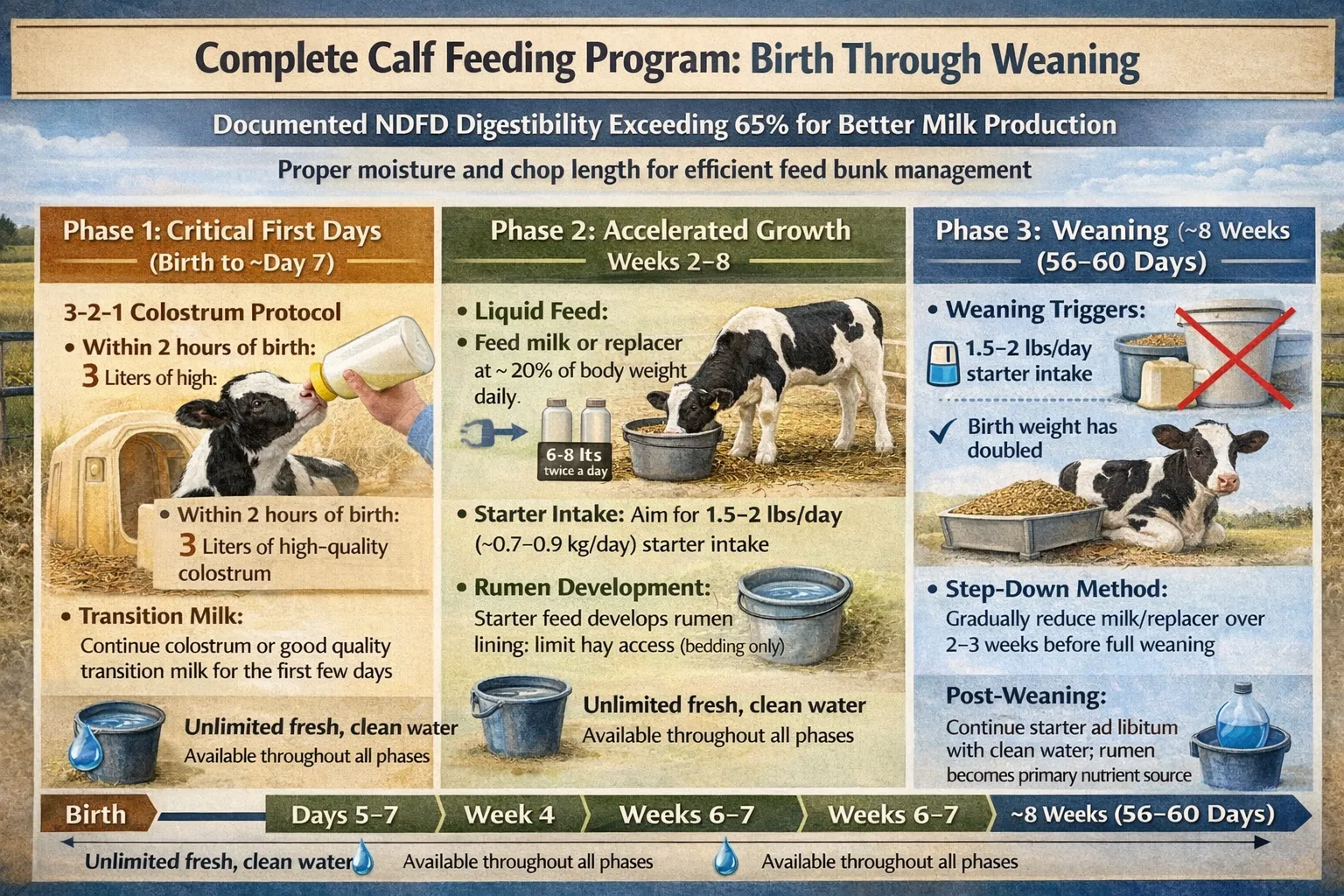
Timeline from Birth to Weaning (56 days)
Days 1-3: Passive Immunity Phase
- Follow the 3-2-1 rule: 3+ liters within 2 hours of birth from first milking
- Repeat colostrum feeding at 8-12 hours
- Transition to transition milk or whole milk on day 2-3
- Introduce water ad libitum
Days 5-7: Rumen Initiation
- Offer high-quality calf starter (18-22% CP, 5-7% fat, pelleted/texturized)
- Place in shallow bowls; refresh frequently
- Feed 10% of body weight daily in milk replacer (or equivalent)
Weeks 2-8: Accelerated Growth
- Increase milk replacer to 14-16% of body weight (if using high-protein milk, 26% CP)
- Maintain fresh water and starter ad libitum
- Target starter intake of 2-3 kg daily by week 8
- Introduce forage (alfalfa hay or straw) around week 3-4 to support rumen development
Weaning Protocol
- Wean when calf consumes 1.5-2 kg starter daily for 3 consecutive days
- Reduce milk gradually over 5-7 days rather than abruptly
- Maintain excellent water and forage availability
Calf Starter Specification (Recommended Formula)
| Nutrient | Target | Rationale |
|---|---|---|
| Crude Protein | 20% (as-fed) | Supports growth + rumen development |
| Crude Fat | 7-9% | Energy + omega-3s for immunity |
| Crude Fiber | 6-8% | Supports rumen maturation |
| Starch/Fermentable CHO | 40-45% | VFA production for papillae |
| Calcium | 0.8-1.0% | Skeletal growth |
| Phosphorus | 0.6-0.8% | Skeletal growth (Ca:P = 1.2-1.5:1) |
| Probiotics | 10^8-10^9 CFU/g | Rumen microbiota balance |
| Methionine | 0.35-0.45% | Limited amino acid support |
Connecting Starter Feed to Immune Competence
The relationship between nutrition and immunity extends beyond colostrum and milk replacer. The starter feed directly influences immune development through multiple mechanisms:
- Amino acids as immune substrates: Protein-derived amino acids synthesize immunoglobulin heavy chains, immune cell receptors, and cytokine precursors. Deficiencies impair vaccination response, antibody titers, and cell-mediated immunity.
- Rumen fermentation and mucosal immunity: Butyrate production supports intestinal epithelial barrier integrity, mucus layer thickness, and secretory IgA production. Strong barriers physically exclude pathogens while chemical defenses neutralize microbial threats.
- Microbiota succession: Properly fermented starter feeds shape rumen microbiota composition, favoring beneficial species while suppressing pathogenic competitors. This metabolic advantage reduces disease challenge severity and duration.
- Energy availability for immune response: Adequate energy (via fermentable carbs and fats) ensures immune cells have substrate for proliferation and effector functions. Energy-deficient calves show impaired T-cell and B-cell function regardless of other nutrient status.
Expected Performance Outcomes
Well-executed calf starter protocols deliver measurable results:
- Growth rate: 0.6-0.73 kg/day average daily gain preweaning; maintained or improved post-weaning
- Feed efficiency: 2.0-2.3 feed conversion ratio (gain per kg of solid feed)
- Weaning age: 56-60 days with stable intake transition
- Disease incidence: 40-50% reduction in preweaning morbidity (scours, pneumonia, navel infection)
- Weaning stability: Minimal growth dip; calves gaining >0.4 kg/day in week 1 post-weaning
- Future performance: Higher first-lactation milk production (+300-500 lbs); earlier sexual maturity (3-5 days earlier first service); improved reproductive efficiency
FAQ: Answering Your Critical Questions
Q1: What is the 3-2-1 rule, and is it really that important?
A: The 3-2-1 rule-3 liters of colostrum, within 2 hours of birth, from the dam’s first milking-is the single most evidence-supported intervention in calf health. This timeline maximizes immunoglobulin absorption while minimizing disease transmission risk. Calves following this protocol have 30-40% lower preweaning morbidity and significantly improved lifetime productivity. Yes, it is that important.
Q2: How do I know if colostrum is high-quality?
A: Test colostrum with a Brix refractometer before feeding. High-quality colostrum reads ≥22% Brix, corresponding to approximately 50+ mg/mL IgG. If a refractometer is unavailable, ensure colostrum comes from the dam’s first milking, is free of visible contamination, and is fed immediately (within 1-2 hours of milking). Never use colostrum from cows with mastitis or known pathogens.
Q3: How much milk replacer should I feed?
A: Feed 10-12% of body weight daily in the first 2 weeks, then increase to 14-16% if the calf is not consuming adequate starter. Higher milk volumes support faster growth but require strong starter intake to trigger proper rumen development. Restrict feeding only if labor demands; research shows restricted milk (4-5 L daily) impairs immune function and increases disease risk compared to intensified programs (8+ L daily).
Q4: When should I introduce calf starter?
A: Introduce high-quality starter feed on day 5-7 of life. Do not delay-early exposure (even in small amounts) triggers rumen microbe colonization and papillae development. Calves consuming starter by day 10 achieve earlier functional rumen maturity and smoother weaning transitions.
Q5: What’s the difference between pelleted and texturized starter?
A: Pelleted feed is ground and compressed; texturized feed contains whole grains mixed with pelleted ingredients. Texturized starters maintain higher rumen pH, reduce acidosis risk, and support better intake in some trials. Both formats work well if particle size is optimized. Choose based on your calves’ response and operational preference.
Q6: How do I prevent scours when feeding starter?
A: Scours result from multiple factors: poor colostrum quality/timing, cold milk replacer, abrupt feeding changes, or starter feed too high in protein (>22%) or too finely ground. Prevent scours by: (1) ensuring excellent colostrum, (2) feeding milk at proper temperature (38-40°C), (3) offering starter particles >1 mm, (4) keeping protein at 18-20%, and (5) ensuring adequate forage intake.
Q7: How much protein does a calf really need?
A: Protein requirements depend on growth target and milk feeding level. A 60-kg calf gaining 0.6 kg/day requires approximately 0.6 kg crude protein daily from combined sources (milk + starter). If feeding 25% protein milk replacer at 8 L daily, the calf receives ~200g protein from milk; starter must supply the remaining 400g, requiring 2 kg of 20% protein starter. Adjust based on your specific program.
Q8: What additives are actually worth the cost?
A: Three additives show strong return on investment: (1) probiotics (Saccharomyces cerevisiae or Bacillus species) improving feed efficiency by 5-8%, (2) rumen-protected butyrate supporting weaning transitions and reducing stress-related disease, and (3) methionine or balanced amino acids (if soybean meal is the primary protein). Avoid additives with insufficient research validation.
Q9: How do I know when a calf is ready to wean?
A: Wean when the calf consistently consumes 1.5-2 kg of starter daily for 3 consecutive days and shows strong appetite. Age is secondary to intake; some calves wean at 45 days, others at 70+ days depending on milk feeding level and starter palatability. Calves weaned too early (before adequate rumen development) experience severe growth dips and health challenges.
Q10: How to boost a calf’s immune system?
A: Immune system development is a cascade: (1) excellent colostrum provides passive antibodies and maternal factors; (2) high-quality starter feed supplies amino acids for antibody synthesis, energy for immune cell proliferation, and substrates for rumen fermentation supporting mucosal immunity; (3) adequate vitamins and minerals (especially vitamins A, D, E, selenium, zinc) enable immune cell function; (4) early probiotic exposure shapes beneficial microbiota. Vaccination timing and strategy are secondary-foundation is nutrition.
Q11: What’s the relationship between starter feed and antibiotic use?
A: Strong evidence shows that optimized nutrition (excellent colostrum, early starter introduction, high-quality ingredients, probiotic supplementation) reduces preweaning disease incidence by 30-50%, directly lowering antibiotic dependency. This addresses growing antimicrobial resistance concerns while improving profitability.
Q12: Can I use the same starter for multiple feeding programs?
A: Ideally, no. A starter for calves receiving high milk volumes (8+ L daily) can be 18% protein; a starter for restricted milk programs requires 20-22% protein. A “one-size-fits-all” approach compromises optimization. However, a well-formulated 20% protein, balanced-amino-acid starter performs acceptably across programs as a practical compromise.
Q13: How do I transition from preweaning to postweaning feed?
A: Introduce a postweaning grower (16% protein, higher fiber from forage incorporation) 2-3 weeks before weaning. Offer both starter and grower ad libitum so calves self-select. This gradual transition reduces metabolic shock and maintains growth continuity through the critical weaning window.
Q14: What’s the cost-benefit of premium starter?
A: Premium starter containing optimized amino acids, probiotics, and higher-quality protein sources costs 5-15% more than commodity starters. This investment returns 2-3:1 through improved feed efficiency (15-20% better FCR), reduced disease treatment costs, reduced antibiotic use, and faster growth (saving 1-2 weeks to target weights). On a per-calf basis over the preweaning period, premium starter pays for itself multiple times over.
Q15: How do environmental conditions affect starter performance?
A: Heat-stressed calves require slightly higher fat starters for concentrated energy and additional water/electrolyte intake. Cold-stressed calves benefit from elevated energy density and higher-protein supplementation. Group housing requires more careful disease prevention through excellent sanitation and robust starter feed quality. Individual housing allows optimization per calf’s unique state.
Transform Your Herd’s Future
The calf in front of you today is your herd’s foundation-genetically, immunologically, and productively. The nutrition you provide in the first weeks of life echoes through decades of production. Implementing a science-backed calf starter feed program, paired with excellence in colostrum management and supportive milk feeding, is not a cost-it is the highest-return investment you can make in herd health and profitability.
Begin with mastery of the 3-2-1 rule, introduce starter by day 5-7, specify a 20% protein, fermentable-carbohydrate-rich feed formulated with attention to amino acid balance and ingredient quality, and monitor intake and growth closely. The calves will respond with accelerated rumen development, reduced disease pressure, improved weaning stability, and enhanced lifetime productivity.
The evidence is clear. The path is proven. The time to implement is now.
Last Updated: January 2026 | Based on peer-reviewed research and field-proven protocols