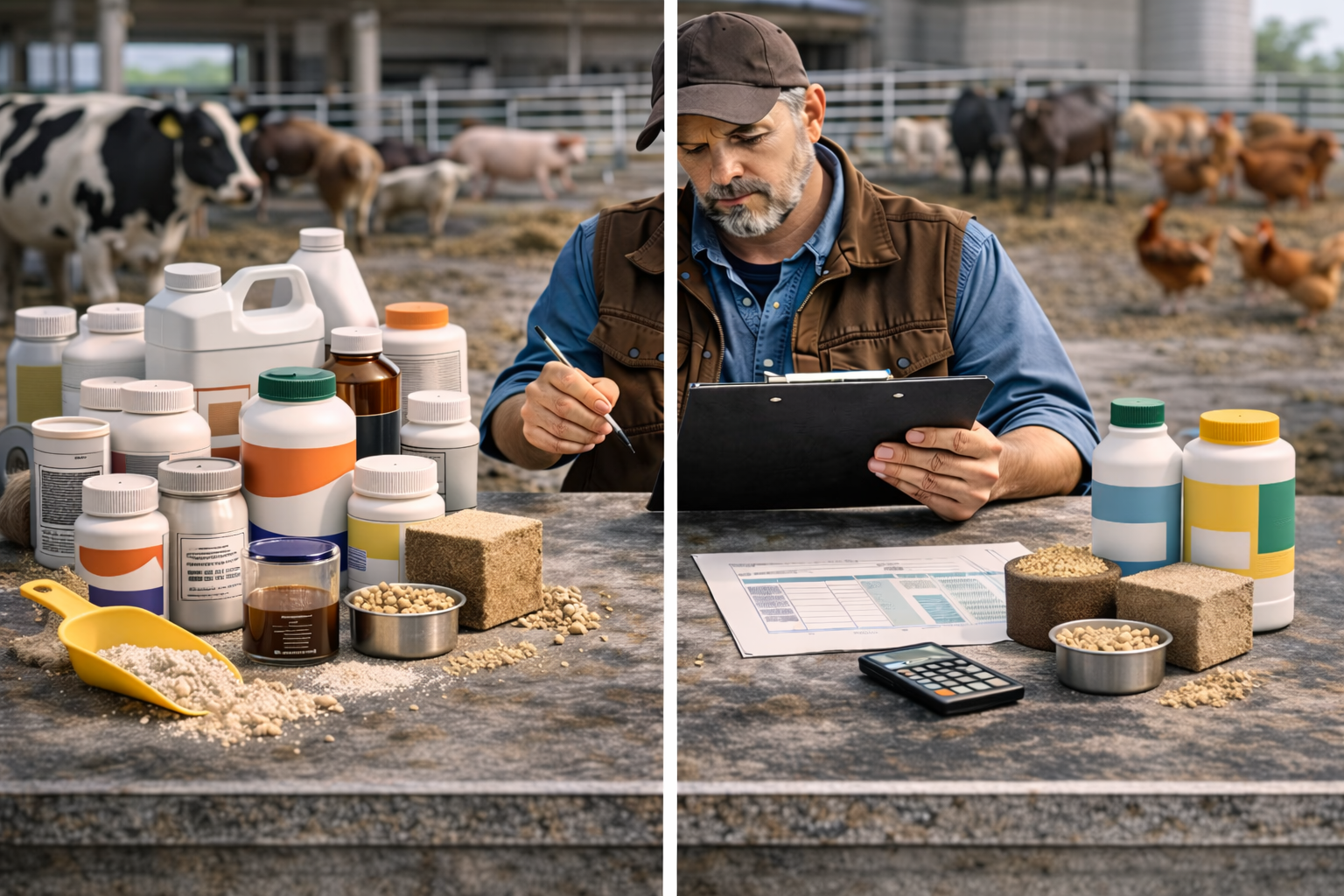
Vitamins and minerals are the biological spark plugs of farm animal nutrition. While energy and protein fuel basic growth and maintenance, it is the micro-ingredients—the vitamins and minerals—that dictate whether an animal successfully breeds, fights off infection, builds strong bone, or produces high-quality milk and eggs.
However, clinical deficiencies are rarely obvious at first. Long before a cow goes down with milk fever or a flock of layers starts producing soft-shelled eggs, subclinical deficiencies quietly drain farm profitability through lower conception rates, elevated somatic cell counts, and poor feed conversion.
Because different farm animals have drastically different metabolic demands, there is no such thing as a universal mineral program. A generic “all-stock” supplement often results in dangerous over-supplementation for one species and severe deficiencies for another. This guide explains exactly which vitamin and mineral feed supplements your livestock and poultry actually need, and how to choose the right form and formulation without wasting money on the wrong product.
What are vitamin and mineral feed supplements for farm animals?

Summary of Key Facts:
What Vitamin and Mineral Feed Supplements Actually Are
To buy supplements intelligently, you must separate them from the rest of your feed bill.
Complete feeds supply the macronutrients: carbohydrates, fats, and crude protein. Feed additives (like preservatives, pellet binders, or medications) alter the feed’s physical properties or treat disease. Vitamin and mineral supplements, however, are purely functional nutrition. They provide the micro-building blocks required for the animal’s body to actually use the macronutrients it consumes.
Supplementation is meant to fill gaps and optimize performance, not to replace a balanced ration. If a beef cow is starving on snow-covered, overgrazed pasture, a premium trace mineral tub will not save her—she needs calories and protein first. But if she is eating plenty of mature winter forage, a targeted mineral supplement ensures her rumen microbes can digest that fiber and her reproductive system can prepare for a healthy calf.
Why Vitamins and Minerals Matter in Farm Animal Nutrition
These micro-ingredients govern almost every profitable outcome on a farm:
- Skeletal development: Calcium, phosphorus, and vitamin D are non-negotiable for building the frames of fast-growing broilers and replacement heifers.
- Immunity: Zinc, copper, selenium, and vitamin E drive the production of white blood cells and antibodies, reducing treatment costs for mastitis or respiratory disease.
- Fertility and Reproduction: Manganese, zinc, and vitamin A are critical for sperm motility in males, optimal ovulation in females, and strong fetal development.
- Growth and Feed Efficiency: B-complex vitamins and cobalt support rumen function and energy metabolism, allowing animals to extract more daily gain from the same amount of feed.
- Milk and Egg Production: Massive amounts of calcium are exported daily in milk and eggshells; without constant dietary replenishment, the animal will strip its own bones to maintain production.
- Stress Resilience: Antioxidant vitamins (E and C) and trace minerals neutralize cellular damage during heat stress, transport, or weaning.
Macro Minerals vs. Trace Minerals vs. Vitamins
Livestock require nutrients in different volumes. Macro minerals are needed in grams per day, trace minerals in milligrams, and vitamins in microscopic international units (IUs).
Macro Minerals
- Calcium & Phosphorus: The foundation of bones, teeth, milk, and eggshells. They must be fed in a precise ratio (usually 2:1 for mammals, much higher in layers) to prevent metabolic crashes.
- Magnesium: Critical for nervous system function. Deficiencies on lush spring grass cause deadly Grass Tetany.
- Sodium & Chlorine (Salt): Regulates cellular fluid balance and drives water/feed intake. Often used to control the consumption of free-choice mineral mixes.
- Potassium: Vital for muscle contraction and heat stress survival.
- Sulfur: Required by rumen microbes to synthesize essential amino acids for wool and hair growth.
Trace Minerals
- Zinc: Essential for hoof/pad health, skin integrity, and immune response.
- Copper: Crucial for fertility, immune function, and coat color. (Warning: Highly toxic to sheep at levels required by cattle).
- Manganese: Supports joint health, cartilage formation, and reproductive efficiency.
- Selenium: Works with Vitamin E as a powerful antioxidant. Deficiencies cause White Muscle Disease in calves and lambs.
- Iodine: Regulates thyroid hormones, dictating the animal’s basal metabolic rate.
- Cobalt: Required by rumen microbes to manufacture Vitamin B12.
- Iron: Prevents anemia, particularly in indoor-raised neonatal piglets.
- Molybdenum: Generally an antagonist (ties up copper), but trace amounts are needed for specific enzyme functions.
Vitamins
- Vitamin A: Essential for vision, mucous membrane integrity (gut/lung barriers), and fertility. Depletes quickly when animals are fed stored, sun-bleached hay.
- Vitamin D: The “sunshine vitamin.” Required for the animal to absorb calcium and phosphorus from the gut. Critical for confined pigs and poultry.
- Vitamin E: The primary cellular antioxidant. Protects tissue during stress and improves meat shelf-life.
- B-Complex Vitamins: Drive energy metabolism. While ruminants synthesize their own B-vitamins, pigs and poultry must have them supplemented.
- Vitamin K: Essential for blood clotting.
Common Deficiency Risks and Practical Impacts
When a mineral program fails, the farm suffers practical, expensive consequences:
- Poor growth: Piglets or stocker cattle failing to hit target weights due to zinc or B-vitamin shortages.
- Weak fertility: High open rates in cows, poor hatchability in breeder flocks, or silent heats due to copper, manganese, or Vitamin A deficits.
- Skeletal weakness: Rickets in young animals, or cage-layer fatigue in hens, stemming from calcium/phosphorus imbalances.
- Poor milk production: Dairy cows suffering from clinical milk fever (hypocalcemia) at calving, resulting in lost lactation peaks.
- Poor eggshell strength: High rates of cracked or downgraded eggs late in the laying cycle.
- Weak youngstock: Stillborns, weak calves unable to stand, or lambs with White Muscle Disease due to selenium/Vitamin E deficiency in the dam.
Species-by-Species Guide
Never buy a generic “all-stock” mineral if you run a serious commercial operation.
Dairy Cattle
- Goals: Maximum milk yield, butterfat/protein components, and rapid rebreeding.
- Pressure Points: Massive calcium/phosphorus export during lactation; high risk of oxidative stress.
- Supplement Priorities: Bioavailable trace minerals, Vitamin E, and specialized pre-calving (DCAD) mineral blends to prevent milk fever.
- Common Mistakes: Feeding high-calcium minerals to dry cows right before calving.
Beef Cattle
- Goals: High conception rates, heavy weaning weights, and maintaining condition on cheap forage.
- Pressure Points: Trace mineral antagonists (iron/molybdenum) in soil/water tying up copper.
- Supplement Priorities: High-quality loose mineral with elevated copper, zinc, and selenium fed 60 days prior to breeding.
- Common Mistakes: Assuming a yellow salt block provides adequate trace minerals (it does not).
Sheep
- Goals: Wool quality, twin lamb survival, and fast finishing.
- Pressure Points: Extreme sensitivity to copper; high need for selenium and Vitamin E.
- Supplement Priorities: Sheep-specific, zero-added-copper formulas with optimized selenium.
- Common Mistakes: Feeding cattle or goat minerals to sheep, resulting in fatal copper toxicity.
Goats
- Goals: Meat/milk production and browse utilization.
- Pressure Points: Unlike sheep, goats require significant copper.
- Supplement Priorities: Goat-specific loose minerals high in copper and zinc.
- Common Mistakes: Feeding sheep minerals to goats, resulting in severe copper deficiency, poor coats, and parasite susceptibility.
Pigs
- Goals: Explosive lean growth, feed conversion, and large litter sizes.
- Pressure Points: Indoor rearing means zero access to soil iron or solar Vitamin D.
- Supplement Priorities: Iron injections for neonates; highly precise vitamin/mineral premixes with phytase enzymes to unlock phosphorus.
- Common Mistakes: Relying on base grain formulation without a phase-specific premix.
Poultry
- Goals: Rapid broiler growth, sustained daily egg production.
- Pressure Points: Extremely fast skeletal development; massive daily calcium demand in layers.
- Supplement Priorities: Large-particle calcium (oyster shell/limestone) for layers; precise phosphorus and Vitamin D3 for all birds.
- Common Mistakes: Feeding fine-powder calcium to layers, which metabolizes too quickly to form nighttime eggshells.
How Supplement Needs Change by Stage and System
Nutritional needs are a moving target.
- Growth Stage: Young, rapidly growing animals require much higher concentrations of calcium, phosphorus, and zinc relative to their body weight than mature maintenance animals.
- Pregnancy & Lactation: Mineral demand spikes exponentially in the final trimester (fetal growth) and early lactation.
- Grazing vs. Confinement: Pasture cattle eating lush spring grass need high-magnesium supplements to prevent tetany. Confined dairy cows need tightly controlled TMR premixes.
- Seasonal Changes: Green summer grass is rich in Vitamin A and E. Dormant winter forage is almost entirely devoid of them, necessitating heavy winter supplementation.
- Stress Periods: Weaning, transport, and extreme heat increase the excretion of minerals and demand higher antioxidant (Vitamin E/Selenium) support.
Main Supplement Forms and How They Compare
Loose Minerals
- What it is: Dry, granular mineral mixes offered free-choice or mixed into feed.
- Best Use Cases: Beef cattle on pasture, goats, and dairy TMRs.
- Pros & Cons: Highly customizable and cost-effective. However, intake can vary wildly between dominant and timid animals, and it must be protected from rain.
Mineral Blocks
- What it is: Minerals pressed into a hard, 50lb solid block (often mostly salt).
- Best Use Cases: Extensive, low-maintenance grazing where checking loose feeders is difficult.
- Pros & Cons: Convenient and weather-resistant. However, animals often cannot lick enough off the block to meet daily trace mineral requirements.
Buckets / Tubs (Lick Tubs)
- What it is: Minerals suspended in a hardened molasses or cooked-sugar base.
- Best Use Cases: Wintering beef herds or sheep flocks needing both minerals and a small energy/protein boost.
- Pros & Cons: Excellent intake consistency (the sugar drives consumption, the hardness limits it). Very weather resistant. Con: Expensive per unit of actual mineral.
Premixes
- What it is: Micro-ingredients packed into a concentrated carrier, designed to be milled into a complete feed at 5 to 50 lbs per ton.
- Best Use Cases: Pigs, poultry, and confined dairy/feedlot cattle.
- Pros & Cons: Provides perfect, absolute precision—every bite of feed contains the exact mineral ratio. Con: Useless for pasture animals not receiving daily grain.
Liquids
- What it is: Minerals and vitamins suspended in a liquid molasses/urea base.
- Best Use Cases: Feedlot TMRs, dairy rations, and liquid pasture tanks.
- Pros & Cons: Eliminates feed sorting and dust. Con: Requires specialized pumps and tanks; trace minerals can settle out if poorly formulated.
Pellets & Powders
- What it is: Supplements pelleted for palatability or powdered for water-line delivery.
- Best Use Cases: Top-dressing for horses/show livestock; water-soluble powders for acutely stressed poultry or swine.
How to Choose the Right Vitamin and Mineral Supplement
Do not buy supplements based on the color of the bag. Use this framework:
- Species & Production Stage: The label must match the animal and its current job (e.g., “Lactating Dairy Cow” vs “Dry Cow”).
- Feeding System: If you have a mixer wagon, buy a premix. If your cattle are on 1,000 acres of rough terrain, buy weatherized tubs or blocks.
- Forage / Ration Quality: Test your hay. If your forage is naturally high in calcium (like alfalfa), you need a high-phosphorus mineral. If feeding grass hay, you need a balanced Ca:P mineral.
- Intake Consistency: If you use loose mineral and your cows eat 4 oz one day and 0 oz the next, the supplement is failing. Switch to a more palatable formula or a cooked tub.
- Bioavailability: Look at the ingredient list. “Zinc Oxide” is cheap but poorly absorbed (acts like rock dust). “Zinc Sulfate” or “Zinc Amino Acid Complex” (organic/chelated) costs more but is highly absorbed by the animal.
- Supplier Credibility: Choose manufacturers with strict quality control to prevent heavy metal contamination or cross-species mixing errors.
Loose Mineral vs. Block vs. Premix: What Actually Works Best?
When Premix is Best: If you are feeding pigs, poultry, or a dairy TMR, premix is always the superior choice. It guarantees every animal consumes the exact milligram requirement every single day. Convenience takes a backseat to nutritional precision.
When Loose Mineral is Best: For pastured cattle, sheep, and goats, high-quality loose mineral is the gold standard. It allows you to adjust formulations seasonally (e.g., adding magnesium in spring) and is the most cost-effective way to deliver uncompromised trace minerals.
When Blocks/Tubs are Best: Blocks and tubs should be used when intake control and labor are the primary limiting factors. If your herd ignores loose mineral, a sweet tub will force them to consume it. If your pasture is accessible only by horseback, blocks survive the weather. However, convenience always comes at a higher cost-per-ounce of actual nutrition.
Common Mistakes When Buying Vitamin and Mineral Supplements
- Buying an “All-Stock” Mineral: These are watered-down compromises that fail to meet the high demands of cattle while risking toxicity in sheep.
- Ignoring Forage Antagonists: Buying a standard mineral without realizing your farm’s high-iron well water is tying up all the copper in the cow’s gut.
- Over-Supplementing: Feeding a commercial complete pellet (which already contains a premix), and then adding a trace mineral tub on top, leading to expensive and toxic selenium/vitamin A levels.
- Choosing by Price per Bag: A $20 bag of oxide-based mineral that passes straight through the cow in the manure is infinitely more expensive than a $40 bag of bioavailable sulfate/chelate mineral that results in a live calf.
- Using the Wrong Form: Putting loose mineral in a bucket out in the rain, where it turns into an inedible concrete brick.
How to Read a Vitamin and Mineral Supplement Label
The feed tag is a legal contract. Here is how to translate it:
- Target Animals: It will state exactly who it is for (e.g., “For Beef Cattle on Pasture”).
- Guaranteed Analysis: Lists the exact concentrations. Macros (Calcium, Phosphorus) are listed in Percentages (%). Trace minerals (Zinc, Copper) are listed in Parts Per Million (ppm). Vitamins are in International Units (IU/lb).
- Feeding Directions / Intake Targets: “Target intake 4 oz per head per day.” You must monitor your herd. If they eat 8 oz, you are paying double; if they eat 1 oz, they are deficient.
- Ingredient List (The Bioavailability Check): Ingredients are listed from highest volume to lowest. Look for “Sulfates,” “Chlorides,” or “Proteinate/Chelates.” Avoid products where “Oxides” dominate the trace mineral list.
- Caution Statements: E.g., “Contains high levels of copper. Do not feed to sheep.”
Do Vitamin and Mineral Supplements Really Improve Performance?
Yes, but only if they are fixing an actual deficit.
When they help significantly: If your herd is suffering from low conception rates due to a zinc/copper deficiency, switching to a premium, bioavailable mineral supplement will yield massive, visible ROI in the next breeding cycle.
When they do not help: If your flock is losing weight because they are short on energy or protein, adding expensive vitamins will not save them.
Supplements are precise biological tools, not magic dust. They work best when tied to actual forage testing, blood/liver biopsies (if problems persist), and a fundamentally sound macronutrient ration.
How to Choose a Reliable Supplier or Manufacturer
Mineral formulation requires extreme precision. An error of a few parts per million of selenium can be lethal. Evaluate suppliers on:
- Formulation Transparency: They should clearly explain why they use specific mineral forms (e.g., hydroxy trace minerals vs. sulfates).
- Quality Consistency: They must have Safe Feed/Safe Food certifications and strict flush-out procedures to ensure sheep feed is never cross-contaminated with cattle feed.
- Technical Support: The best manufacturers employ nutritionists who will review your farm’s hay analysis before selling you a bag.
- Species-Specific Targeting: They should offer a deep portfolio of stage-specific products, not just three generic options.
Comparison Tables
Nutrient vs. Role vs. Common Concern
| Nutrient | Primary Biological Role | Practical Concern / Deficiency Sign |
|---|---|---|
| Calcium (Ca) | Bone/eggshell formation, muscle contraction | Milk fever in dairy; weak eggshells in poultry |
| Phosphorus (P) | Bone strength, energy utilization | Poor growth; chewing on wood/bones (pica) |
| Magnesium (Mg) | Nervous system function | Grass tetany on lush spring pastures |
| Zinc (Zn) | Hoof health, skin, immunity | Lameness; poor wound healing; foot rot |
| Copper (Cu) | Fertility, immune response, coat color | Open cows; faded hair coats; Toxic to sheep |
| Selenium (Se) | Antioxidant (works with Vit E) | White Muscle Disease in calves/lambs; retained placentas |
| Vitamin A | Vision, mucosal linings, reproduction | Blind calves; poor fertility on winter hay |
Species vs. Likely Supplement Priority
| Species | Primary Production Goal | Likely Supplement Priority |
|---|---|---|
| Dairy Cattle | High milk yield, transition survival | DCAD pre-fresh minerals; bypass vitamins; high Ca/P |
| Beef Cattle | Conception rates, forage utilization | High Cu/Zn/Se loose mineral fed pre-breeding |
| Sheep | Wool quality, twin lamb survival | Zero-copper trace mineral; elevated Selenium/Vit E |
| Pigs | Lean growth, feed conversion | Highly exact phase-fed premixes with Phytase |
| Poultry (Layers) | Daily egg production, shell strength | Large-particle calcium; precise Vit D3 and Phosphorus |
Supplement Form vs. Best Use Case
| Form | Best Fit | Biggest Limitation |
|---|---|---|
| Loose Mineral | Cattle/Goats on pasture; TMR inclusion | Intake can be highly variable |
| Premix | Pigs, poultry, feedlots, commercial dairies | Cannot be fed free-choice on pasture |
| Lick Tubs | Extensive winter grazing, harsh weather | High cost per unit of actual mineral |
| Solid Blocks | Low-maintenance grazing | Hard to consume enough to meet daily needs |
Farm Situation vs. Likely Supplement Direction
| Farm Situation | Likely Mineral Pressure | Recommended Direction |
|---|---|---|
| Cows grazing lush, fast-growing spring grass | Low Magnesium availability | Feed high-magnesium (High-Mag) loose mineral 30 days prior |
| Hens laying thin/cracked eggs late in cycle | Fast calcium metabolization | Offer free-choice oyster shell for nighttime absorption |
| High open rates in beef cows on winter hay | Depleted Vitamin A and Copper | Switch to organic/chelated trace mineral pack 60 days pre-breeding |
| Pigs raised entirely indoors on corn/soy | Zero access to soil/sunlight | Complete vitamin/mineral premix with added Iron and Vit D |
Loose Mineral vs. Block vs. Premix Comparison
| Feature | Loose Mineral | Mineral Block | Premix (Milled) |
|---|---|---|---|
| Nutritional Precision | Medium | Low | Very High |
| Labor Requirement | Medium (checking feeders) | Low (drop and go) | Low (done by feed mill) |
| Weather Resistance | Poor (unless covered) | High | N/A (kept indoors) |
| Cost per oz of Nutrient | Low to Medium | High | Lowest |
FAQ: Common Questions About Vitamin and Mineral Supplements
What are vitamin and mineral feed supplements?
They are concentrated blends of macro minerals, trace elements, and vitamins used to correct nutritional gaps in an animal’s daily forage or grain diet.
Why do farm animals need mineral supplements?
Because soils are often depleted of trace minerals, and raw feedstuffs (like grass and corn) vary wildly in their nutritional content. Supplements guarantee the animal has the biological tools to grow, breed, and resist disease.
Which vitamins matter most in livestock nutrition?
Vitamins A, D, and E are the most critical to supplement. Ruminants synthesize their own B-vitamins, but pigs and poultry must have B-complex vitamins supplemented in their feed.
What minerals are most important for cattle?
Calcium and phosphorus for milk and bone; magnesium to prevent tetany; and trace minerals like zinc, copper, and selenium for fertility and immunity.
Are blocks as good as loose minerals?
Generally, no. Blocks are convenient, but animals often cannot lick enough of the hard block to meet their daily trace mineral requirements. Loose minerals offer better, faster intake.
What is the difference between a premix and a mineral supplement?
A premix is a highly concentrated powder designed specifically to be milled into a bulk feed ration at a feed mill. Mineral supplements (loose or blocks) are generally designed to be fed free-choice on the farm.
Can the same supplement be used for all farm animals?
Absolutely not. “All-stock” supplements are dangerous. For example, the copper levels required to keep a cow healthy will build up in a sheep’s liver and kill it.
How do I know if my animals need more mineral support?
Watch for dull hair coats, hoof problems, poor conception rates, retained placentas, or animals chewing on wood/dirt (pica). Confirm with forage testing or bloodwork.
Can you overfeed vitamin and mineral supplements?
Yes. Fat-soluble vitamins (A, D) and trace minerals (Selenium, Copper) build up in the liver and can cause severe toxicity if overfed. Always follow label intake directions.
What should I check before buying a supplement?
Check the target species, the feeding directions (intake rate), and the ingredient list to ensure you are buying highly bioavailable forms (sulfates/chelates) rather than cheap, poorly absorbed forms (oxides).
The Next Step in Your Nutritional Strategy
Buying cheap or generic vitamin and mineral supplements is one of the most expensive mistakes a livestock or poultry producer can make. A few dollars saved on a bag of oxide-based mineral is immediately lost the moment a cow comes up open, a broiler develops leg issues, or a ewe succumbs to disease.
True profitability comes from precision. Assess your operation: Are you guessing what your animals need, or do you know?
Your next step: Pull a forage or feed sample and get it analyzed. Identify the exact macro and trace mineral gaps in your current ration. Then, partner with a reputable feed manufacturer or nutritionist to select a species-specific, highly bioavailable supplement delivered in the format that best fits your farm’s management style. When you stop buying generic bags and start investing in targeted nutrition, your animals’ performance will prove you made the right choice.