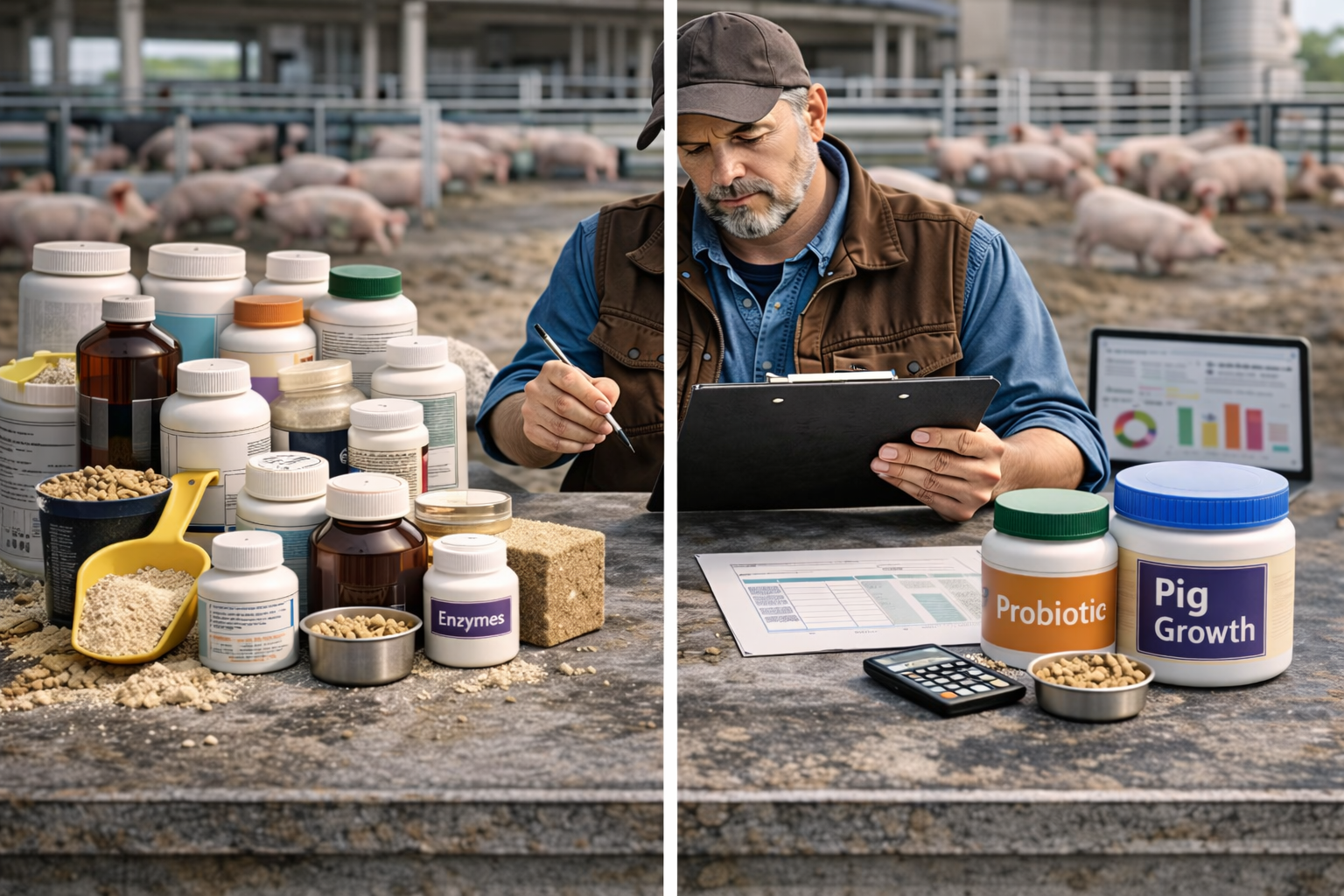
Pig feed supplements are most valuable when they solve a specific bottleneck in growth, gut function, or feed conversion rather than simply adding cost to the diet. The right supplement strategy can improve nutrient utilization, support pigs through stress periods such as weaning, and help phase feeding work more efficiently, while the wrong one often duplicates what the base formula already provides.
Introduction
Better pig growth does not come from feeding more feed alone; it comes from converting more of that feed into usable growth with fewer digestive setbacks and less variation across the group. That is why feed efficiency matters so directly to profitability in swine systems: when feed is the largest production cost, small improvements in conversion and average daily gain have an outsized financial effect.
This is where pig feed supplements earn their place. Used well, they help close nutritional and functional gaps in the ration, support gut health, improve digestibility, and steady performance during stressful periods such as weaning, feed transitions, or environmental pressure. Used poorly, they become expensive insurance products that do not address the real issue, which may actually be poor formulation, inconsistent raw materials, hygiene pressure, or management failures.
This guide is built around one practical question: Which pig feed supplements actually improve growth and feed efficiency, and how do you choose the right ones for each production stage without wasting money? The goal is not to sell a long list of ingredients, but to help producers, nutrition buyers, and advisors match supplement categories to stage, objective, and on-farm reality.
What are pig feed supplements?

- They are not complete feed; they are targeted additions used to correct gaps or improve how pigs use the diet.
- They can include probiotics, prebiotics, yeast products, organic acids, enzymes, vitamin-mineral premixes, amino acid support, betaine, L-carnitine, and phytogenic formulations.
- Producers use them to support average daily gain, feed conversion, gut stability, post-weaning resilience, and more consistent growth across the group.
- They are most useful when tied to a clear production goal and matched to the pig’s current phase, ingredient quality, and health pressure.
- The main categories differ in purpose: some improve digestion, some support microbiota, some help manage stress, and some tighten the nutrient profile of the ration itself.
What pig feed supplements actually are
Pig feed supplements are precision tools inside a broader swine feeding program. The complete diet still does the heavy lifting by supplying energy, protein, amino acids, minerals, and vitamins, but supplements are used when the base formula needs extra support for digestibility, gut function, phase-specific performance, or ingredient variability.
That distinction matters because supplementation is not about blindly layering products on top of a feed formula. It is about improving the way pigs respond to the diet they are already receiving, especially when the ration is challenged by lower-quality raw materials, high growth targets, post-weaning stress, or gut-health pressure.
In practical terms, supplements sit between formulation and outcomes. They help the producer move from “this ration meets paper specs” to “this ration performs in the barn,” which is why they are often most useful when a farm is trying to stabilize feed conversion, improve uniformity, or manage sensitive phases such as nursery feeding.
More is not always better. Overlapping additive categories, duplicating premixes, or chasing multiple performance claims at once can increase cost without creating a measurable response, especially if the real limit is poor feed quality, health pressure, stocking density, or water access.
Pig feed supplements vs. feed additives
In swine production, the terms supplements, additives, premixes, and functional support products often overlap, which is why buyers get confused. A useful practical distinction is this: supplements are the products you use to improve pig performance or nutrient balance, while additives is the broader category that can also include ingredients used to protect the feed itself or improve how it is manufactured.
A premix is typically a concentrated package of vitamins, minerals, and sometimes specialty ingredients designed for low-inclusion use in feed manufacturing. A functional support product usually focuses on a narrower outcome such as gut health, digestibility, or stress support through ingredients like probiotics, organic acids, enzymes, yeast derivatives, or phytogenic compounds.
For real-world buying decisions, producers do not need to get stuck in definitions. What matters is understanding whether a product changes the nutrient profile of the diet, improves digestion, supports microbiota, or simply adds a label claim without solving a specific production problem.
Why pig producers use supplements
Pig producers use supplements because modern swine performance is highly sensitive to feed conversion, gut stability, phase transitions, and ingredient efficiency. The common goals are practical and measurable.
- Improve average daily gain: Growth support matters most when pigs are expected to move efficiently through each phase without repeated setbacks.
- Improve feed conversion: Enzymes, gut-health-focused products, and better nutrient balancing are often used to extract more usable growth from the same feed input.
- Support gut health: Nursery and recently weaned pigs are especially sensitive to digestive instability, so microbial and gut-support products are commonly considered.
- Improve nutrient digestibility: Phytase, protease, and carbohydrase blends are used where ingredient structure limits nutrient release.
- Support pigs during weaning stress: Functional supplements are often used when feed intake dips and the intestinal environment becomes unstable.
- Enhance growth consistency: Better uniformity is commercially important because variable pigs create cost and flow problems throughout the system.
- Improve resilience: Certain categories are used to help pigs perform under heat, environmental, or feed-quality pressure.
- Support finishing performance: In grow-finish systems, supplements are often judged by whether they improve feed efficiency, carcass growth trajectory, or nutrient use rather than by broad “health” claims.
Main types of pig feed supplements
Probiotics / direct-fed microbials
These are live microorganisms added to the diet to support gut microbial balance and intestinal function. In swine systems, they are commonly considered for nursery and stressed pigs because stable gut ecology supports better nutrient use and more consistent intake. Their value is usually highest when the goal is to reduce digestive instability rather than to chase dramatic growth claims on already well-performing pigs.
Prebiotics
Prebiotics are substrates that selectively support beneficial gut microbes rather than directly supplying live organisms. They are most often used where the producer wants a gut-health-focused program without relying on a single live microbial strain. They are especially relevant in nursery feeding where microbial balance can shift quickly after weaning.
Yeast products
Yeast-based ingredients can include live yeast, yeast culture, or yeast-derived fractions used to support digestive function and gut resilience. They are commonly considered in performance programs aimed at nutrient utilization, stress support, or improved feed response under challenge. Their practical value depends on the form used and the feeding context, not just the word “yeast” on the label.
Acidifiers / organic acids
Organic acids and acidifier blends are used to influence gut environment, feed hygiene, and nutrient digestion, especially in younger pigs. They are most relevant in phases where gastric and intestinal stability is under pressure, such as weaning and nursery transitions. Producers usually evaluate them based on intake response, consistency, and whether they improve performance under real barn conditions rather than just in controlled trials.
Enzymes
Feed enzymes are used to break down feed components pigs cannot fully digest on their own. Their main role is to improve nutrient release and feed efficiency, particularly when the diet includes ingredients where phosphorus, protein, or carbohydrates are not fully accessible.
Phytase
Phytase helps release phosphorus tied up in phytate and can also improve access to other nutrients affected by phytate complexes. It is widely relevant in swine diets because it can improve nutrient utilization and reduce unnecessary reliance on inorganic phosphorus sources.
Protease
Protease is used where improving protein digestibility and amino acid release is a priority. It is typically most relevant when ingredient quality is variable or when the producer wants tighter protein efficiency.
Carbohydrases / multi-enzyme blends
Carbohydrases and multi-enzyme systems target structural carbohydrates and other anti-nutritional barriers in feed ingredients. They are mainly used to improve digestibility and help pigs extract more usable value from the same formula.
Vitamin and mineral premixes
These products supply core micronutrients in a concentrated and controllable way. They are foundational rather than optional because swine diets are built around accurate premix support across phases. The key buying issue is not whether to use them, but whether the premix is well designed for the production stage and compatible with the rest of the formula.
Amino acid support
Amino acid support is central to phase feeding because pigs respond strongly to amino acid balance, not just crude protein percentage. Supplemental amino acids are used to fine-tune growth efficiency, support lean gain, and avoid overfeeding crude protein when more precise formulation is possible.
Copper and zinc-related performance support
Copper- and zinc-related strategies have historically been used in pig nutrition in specific contexts linked to growth and gut performance, especially in younger pigs, but they must be handled carefully because efficacy, regulatory limits, environmental concerns, and phase suitability all matter. Producers should think about these as targeted tools with boundaries, not as generic growth shortcuts.
Betaine
Betaine is often considered where osmotic stress support, gut resilience, or methyl donor support is part of the nutritional objective. It is most often evaluated in situations involving environmental stress, formulation pressure, or specific performance goals rather than as a default ingredient for every phase.
L-carnitine
L-carnitine is used in some programs aimed at energy metabolism and performance support, particularly where formulation strategy is tightly managed. Its value tends to be more phase- and objective-specific than broad-spectrum, so buyers should judge it against a clear economic target.
Phytogenic / botanical additives
Phytogenic products include plant extracts, essential oils, and botanicals used to support gut health, nutrient utilization, and production performance. Reviews focused on swine nutrition describe their effects on growth performance, nutrient utilization, gut health, and meat quality, but responses vary by formulation, dose, and production context. That makes formulation quality and practical fit more important than attractive “natural growth” marketing.
Gut-health-focused formulations
These are multi-ingredient systems built around intestinal resilience rather than one nutrient claim. They may combine microbial support, acidifiers, yeast fractions, phytogenics, or functional carriers to help pigs stay on feed and use nutrients more consistently under pressure.
Piglet to finisher: what changes by stage?
Piglets / suckling pigs
Common goals: Early vitality, steady intake, and smoother transition toward creep feed or post-weaning feeding.
Common challenges: Immature digestion, dependence on sow support, and sensitivity to environmental or microbial stress.
Likely supplement categories: Milk-phase support products, highly digestible premix strategies, early microbial support, and selected gut-health-focused formulations.
Buying priorities: Safety, solubility if used in water, and proven fit for very young pigs rather than generic grow-finish claims.
Common mistakes: Using harsh or overly broad products meant for later phases, or expecting supplements to compensate for weak colostrum management or inconsistent piglet environment.
Weaned / nursery pigs
Common goals: Protect intake, minimize post-weaning growth checks, and improve feed conversion during the most fragile digestive stage.
Common challenges: Low intake after weaning, gut instability, ingredient sensitivity, and uneven performance across pens.
Likely supplement categories: Probiotics, prebiotics, yeast products, acidifiers, enzymes, selected zinc/copper strategies where appropriate, and targeted gut-health systems.
Buying priorities: Phase specificity, label clarity, low inclusion accuracy, and realistic economic payback in the nursery rather than generic claims about “lifetime performance.”
Common mistakes: Carrying the same supplement package across all nursery diets, or piling multiple gut-health products together without checking overlap or total cost.
Grower pigs
Common goals: Strong average daily gain, consistent feed intake, and efficient conversion as pigs move through a lower-risk but still performance-sensitive phase.
Common challenges: Ingredient variability, uneven pen growth, and hidden feed-efficiency losses that are less dramatic than nursery problems but more expensive in total.
Likely supplement categories: Enzymes, phase-specific premixes, amino acid refinement, selected phytogenics, and products aimed at nutrient utilization rather than “recovery.”
Buying priorities: Cost per ton versus measurable effect on gain and feed conversion.
Common mistakes: Treating grower pigs as if they no longer need precision, which often leads to sloppy phase transitions and unnecessary efficiency loss.
Finisher pigs
Common goals: Maintain efficient gain, control cost of gain, and support consistent finishing performance without overcomplicating the ration.
Common challenges: Marginal feed-efficiency drift, variation in carcass finish, and cost sensitivity because feed intake is high in this phase.
Likely supplement categories: Enzymes, amino acid balancing, phytogenic performance support where justified, and tightly managed premix strategies.
Buying priorities: Economic fit and whether the product improves conversion enough to matter at scale.
Common mistakes: Overusing specialty additives with low incremental return, or assuming finishers need the same gut-health support intensity as nursery pigs.
Breeding animals
Breeding animals can also justify targeted supplementation where reproductive condition, intake consistency, and phase-specific body management matter. These programs usually require more precise micronutrient, amino acid, and condition-management thinking than generic growth-focused supplements can provide.
Signs your pigs may need better supplementation
A supplement review is worth considering when performance suggests the ration is meeting paper specs but not delivering barn-level results.
- Slower-than-expected growth despite acceptable feed volume.
- Inconsistent feed intake during transitions or stress periods.
- Weak feed efficiency where pigs are eating but not converting well enough.
- Digestive inconsistency such as loose manure patterns or unstable intake response, especially around weaning.
- Post-weaning setbacks that persist longer than expected.
- Poor uniformity across pens or within groups.
- Weak body condition progression through grow-finish phases.
- Underperformance despite acceptable feed volume, which often points to digestibility, gut pressure, or formulation efficiency rather than simple intake shortage.
These are not diagnoses. They are decision signals that the producer should review formulation, ingredient quality, phase transitions, environment, and supplement strategy together rather than in isolation.
How to choose the right pig feed supplement
1. Start with production stage
Stage matters first because piglets, nursery pigs, growers, and finishers do not have the same digestive sensitivity or economic priorities. Nursery strategies are usually more gut-health-focused, while grow-finish strategies are often more about conversion economics and digestibility.
2. Define the target performance goal
Choose the category based on the job it must do: better post-weaning intake, stronger gut stability, improved nutrient digestibility, tighter feed conversion, or more consistent growth. Vague goals create vague purchases.
3. Review the current ration quality
Before buying a specialty product, check whether the current formula is already properly balanced and whether ingredient quality is stable enough to support the response you expect. Supplements work best when they sharpen a good ration, not when they are being asked to rescue a weak one.
4. Assess gut health pressure
The higher the microbial or digestive challenge, the more likely gut-support categories such as probiotics, acidifiers, yeast products, or functional blends will justify their cost. Where gut pressure is low and performance is already strong, the return may be smaller.
5. Check delivery method and mixing accuracy
Some products work best in premix systems, some in feed inclusion, and some in water or specialty applications. The right product on the wrong delivery system creates inconsistent dosing and weak results.
6. Evaluate formulation transparency
Look for clear active ingredients, concentrations, intended phase, and inclusion guidance rather than abstract claims about “supporting performance.” If a label hides the practical details, it is hard to judge value.
7. Check compatibility and overlap
Make sure the new product does not simply duplicate what is already present in the premix or current additive stack. Overlap is one of the fastest ways to increase feed cost without improving gain or conversion.
8. Consider storage, handling, and economics
A supplement that looks good on paper but is unstable in storage, hard to mix accurately, or too expensive per unit of performance gain is usually the wrong commercial choice. The right decision is the one that fits the barn, the mill, and the budget at the same time.
9. Judge supplier credibility
Reliable suppliers usually provide phase-specific guidance, technical support, and enough formulation clarity for the buyer to estimate value realistically. In swine production, that matters because small formulation shifts can have large cost effects when feed volume is high.
Premix vs powder vs liquid vs specialty additive
| Form | Best use case | Strengths | Limitations |
|---|---|---|---|
| Premix | Core vitamin-mineral and structured phase feeding programs. | Strong dosing consistency when manufacturing is controlled. | Less flexible for rapid short-term adjustments. |
| Powder additive | Feed inclusion where the farm or mill wants targeted support such as enzymes, microbial products, or specialty functional ingredients. | Practical for routine use and scalable across phases. | Depends heavily on mixing accuracy. |
| Liquid | Situations requiring fast application, specific delivery systems, or water-based support programs. | Useful when intake through feed is reduced or when fast flock-level delivery is needed. | Requires good handling, storage, and dosing equipment. |
| Specialty additive | Narrow objectives such as gut support, stress support, or targeted digestibility enhancement. | Can address specific bottlenecks precisely. | Easy to overbuy if the objective is not clearly defined. |
Common mistakes when buying pig supplements
- Buying based on claims instead of production need. Attractive language about growth or gut support does not guarantee a return in your phase and environment.
- Using the same supplement across all phases. Piglets, nursery pigs, growers, and finishers have different priorities, so a one-size-fits-all strategy often wastes money.
- Ignoring the base feed formulation. Supplements cannot compensate for a poorly designed formula or weak ingredient quality.
- Expecting supplements to fix management issues. Poor sanitation, stress, water problems, and stocking pressure can easily overwhelm any additive strategy.
- Overlapping too many categories. Multiple gut-health or performance products can stack cost faster than they stack results.
- Ignoring cost per performance gain. The right question is not whether a supplement has a plausible mechanism, but whether it pays in your system.
- Poor storage and handling. Stability matters for many functional ingredients.
- Not reading label details carefully. Inclusion rate, phase targeting, and actual actives matter more than front-label positioning.
How to read a pig supplement label
A pig supplement label should help the buyer answer five basic questions: what is in it, how much is in it, who it is for, how it should be used, and what practical result it is designed to support.
Check these elements carefully:
- Active ingredients: What the functional ingredients actually are.
- Concentration: How much of each active is delivered.
- Intended production phase: Piglet, nursery, grower, finisher, or breeding use.
- Directions for use: Inclusion rate and mixing guidance.
- Claims: Whether the performance language is specific or vague.
- Caution statements: Limits, restrictions, or compatibility concerns.
- Compatibility notes: Whether the product is designed to work alongside current premixes or other functional systems.
- Storage requirements: Stability depends on handling.
- Manufacturer transparency: Batch information, contact details, and technical support cues matter.
A strong label reduces buying friction because it allows comparison. A weak label forces the buyer to trust branding instead of measurable value.
Do pig feed supplements really improve growth and feed efficiency?
Yes, they can improve growth and feed efficiency significantly when they address a real nutritional or functional limit in the current program. Enzymes improve nutrient release, gut-focused categories can support performance under challenge, and stage-specific supplement strategies are often most effective when aligned with phase feeding and clear barn objectives.
Results vary when the supplement is poorly matched to the phase, duplicated unnecessarily, or asked to compensate for problems it was never designed to fix. A weak formula, inconsistent feed intake, poor environment, health pressure, or sloppy management can cap the response long before the supplement itself has a chance to work.
That is the honest commercial answer. Pig supplements are tools, not magic fixes, and the best returns usually come from targeted use inside a disciplined feeding program rather than from stacking trendy ingredients across every phase.
How to choose a reliable supplier or manufacturer
A reliable swine supplement supplier should make it easy to understand what the product is designed to do and where it fits in the feeding system. That means formulation transparency, phase-specific targeting, consistent quality, technical support, and practical instructions that make sense inside commercial pig production.
Look for suppliers that offer:
- Formulation transparency rather than vague proprietary positioning.
- Phase-specific targeting for piglets, nursery pigs, growers, and finishers.
- Consistency in ingredient quality and product performance.
- Technical support that helps connect product choice to actual diet and barn conditions.
- Practical feeding guidance on inclusion, overlap, storage, and expected use case.
- Reputation and trust signals strong enough for commercial-scale production decisions.
Comparison tables
Supplement type vs performance goal
Production stage vs supplement priority
| Production stage | Main priorities | Common supplement focus |
|---|---|---|
| Piglets / suckling pigs | Early support and smooth transition. | Gentle phase-specific support, early gut-focused tools, premix precision. |
| Nursery pigs | Post-weaning intake, gut stability, feed conversion. | Probiotics, prebiotics, acidifiers, yeast products, targeted enzyme and gut-support systems. |
| Grower pigs | Efficient gain and uniformity. | Enzymes, amino acid refinement, phase premix management, selected performance additives. |
| Finisher pigs | Cost of gain and stable finishing performance. | Enzymes, amino acid balance, tightly justified specialty additives. |
| Breeding animals | Condition, intake, and reproductive support. | Stage-specific micronutrient and condition-management support. |
Supplement form vs best use case
| Form | Best use case | Best fit |
|---|---|---|
| Premix | Built-in daily nutritional consistency. | Large-scale feed manufacturing and structured phase programs. |
| Powder | Routine feed inclusion of specialty ingredients. | Farms and mills needing scalable additive use. |
| Liquid | Rapid or water-based application where appropriate. | Stress periods or systems with controlled dosing equipment. |
| Specialty additive | Narrow problem-solving use. | Farms targeting a defined gut, digestibility, or conversion bottleneck. |
Pig production problem vs likely supplement direction
| Observed problem | Likely supplement direction |
|---|---|
| Slower-than-expected nursery growth | Gut-health support, acidifiers, microbial products, and phase-specific digestibility review. |
| Weak feed conversion in growers | Enzyme strategy, amino acid precision, and ingredient digestibility review. |
| Post-weaning instability | Nursery-focused microbial, acidifier, or gut-support formulation review. |
| Poor uniformity | Check intake consistency, phase transitions, and whether support products are matched to the stage. |
| Acceptable intake but weak gain | Review nutrient digestibility, additive overlap, and economic fit of current supplement stack. |
FAQ
What are pig feed supplements?
Pig feed supplements are concentrated nutritional or functional products added to feed or water to improve growth, feed efficiency, gut health, or nutrient use at specific production stages.
Do pig feed supplements improve feed efficiency?
They can improve feed efficiency when they address a real limiting factor such as poor nutrient release, unstable gut function, or stage-specific formulation gaps.
What helps piglets after weaning?
Recently weaned pigs are most often supported through strategies that protect intake, support gut stability, and reduce digestive disruption, including nursery-focused microbial products, acidifiers, and related functional support systems.
What supplements help grower pigs gain weight efficiently?
Grower pigs usually benefit most from digestibility and formulation-focused support such as enzymes, amino acid refinement, and well-designed phase premixes rather than high-cost “recovery” products.
Are enzymes worth using in pig feed?
They are often worth using when the goal is better nutrient digestibility and more efficient use of feed ingredients, especially with phytase and other enzyme systems matched to the formula.
Are probiotics helpful for pigs?
They can be helpful, particularly in younger or stressed pigs, where gut stability and intake consistency are under pressure.
What is the role of acidifiers in pig diets?
Acidifiers are mainly used to support the gut environment and help pigs through sensitive digestive phases, especially around weaning and nursery feeding.
Can the same supplement be used for piglets and finishers?
Sometimes a base premix philosophy carries across the system, but most specialty supplements should be judged by phase because piglets and finishers do not have the same needs or economics.
Do supplements replace a balanced pig feed formula?
No. Supplements are designed to refine or support a balanced formula, not replace the need for correct phase feeding and sound ingredient quality.
What should I check before buying a pig supplement?
Check the active ingredients, concentration, intended phase, inclusion rate, compatibility with the current formula, storage needs, and whether the expected response justifies the cost.
Are phytogenic additives useful in swine diets?
They can be useful for growth performance, nutrient utilization, gut health, and related outcomes, but their response depends strongly on formulation, dose, and production context.
What is the biggest buying mistake with pig supplements?
One of the biggest mistakes is paying for multiple overlapping products without first identifying the true production bottleneck.
Closing
The best pig supplement strategy is not the one with the longest ingredient list. It is the one that matches the right category to the right production stage, the right performance goal, and the real limit inside the current feeding program.
For some farms, that means tighter nursery gut support. For others, it means better enzyme use, sharper amino acid precision, or a cleaner premix strategy that improves feed conversion without unnecessary overlap. The commercial advantage comes from targeted decisions, not from supplement stacking.
A practical next step is to review the system phase by phase: identify where growth slows, where feed conversion slips, where gut pressure is highest, and where the current formula may be leaving value on the table. Once those pressure points are clear, comparing supplement categories becomes far easier and far more profitable.