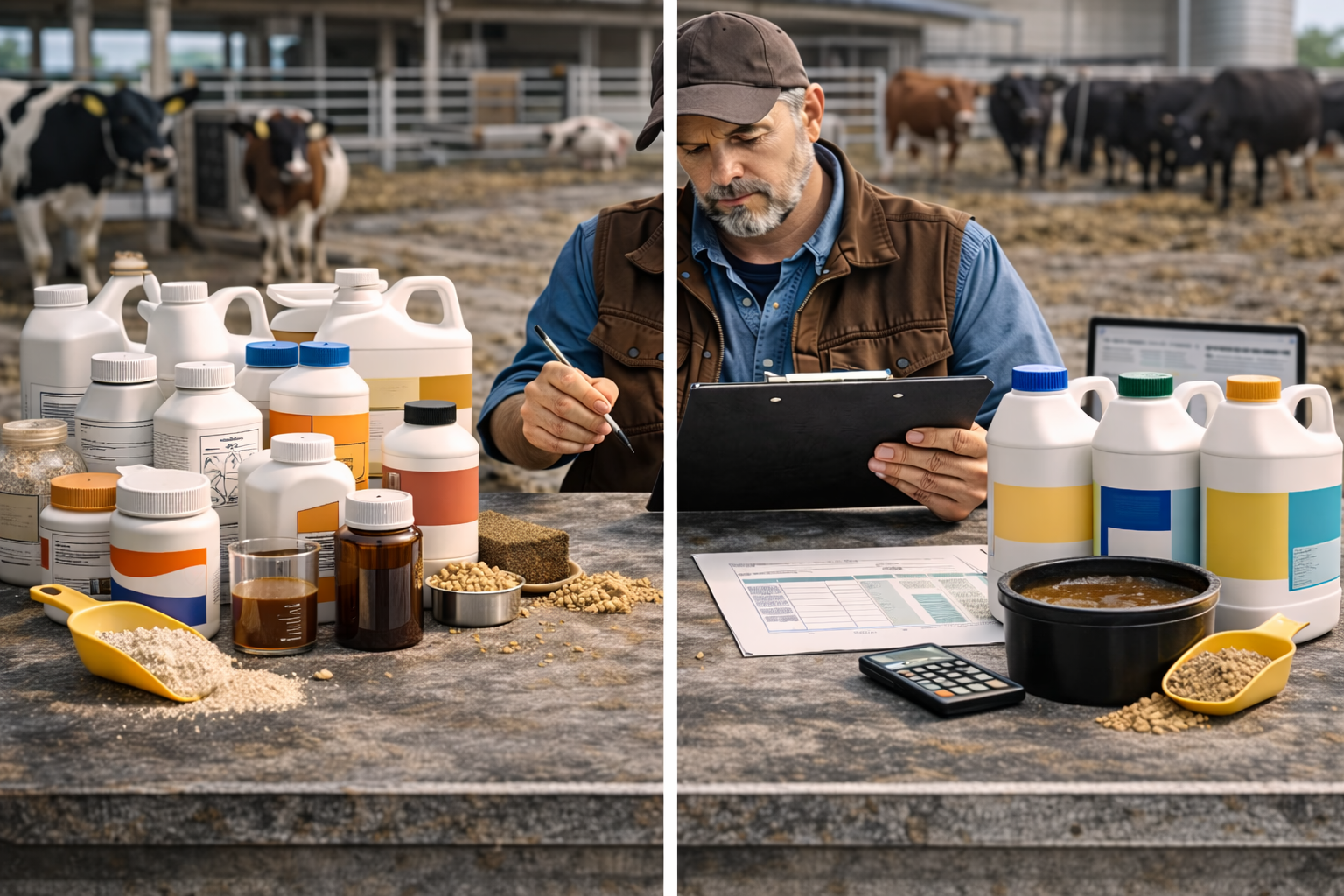
Liquid feed supplements have fundamentally changed how modern livestock operations deliver nutrients. The appeal is obvious: liquid systems reduce farm labor, eliminate dusty rations, and prevent cattle from sorting their feed. But buying a liquid feed supplement based purely on convenience is a fast way to waste money.
Dairy cows pushing for peak milk, pasture beef cattle wintering on dormant grass, and mixed-farm flocks of sheep or goats all require entirely different nutritional strategies. A liquid formulation that perfectly supplements a feedlot steer will not meet the calcium demands of a transition dairy cow—and it could literally prove fatal to a sheep.
This guide bridges the gap between animal nutrition science and practical farm management. Below, you will learn exactly when liquid feed supplements make sense, how they compare to dry alternatives, and how to choose the right liquid program for your specific animals without paying for water or unnecessary ingredients.
What are liquid feed supplements for cattle and farm animals?

Summary of Key Facts:
What Liquid Feed Supplements Actually Are
Liquid feed supplements are not complete feeds; they are highly concentrated nutritional tools. They fit into an animal feeding system as the ultimate “balancer,” filling the gaps left by your base forage and grain.
Common formulation types include clear liquids (where all nutrients are fully dissolved) and suspension liquids (where specialized clays or gums keep insoluble minerals and vitamins suspended evenly throughout the fluid).
It is critical to understand that “liquid” is a delivery method, not automatically a better nutritional solution. A liquid supplement is only as good as the nutrients suspended inside it. While the molasses base provides excellent quick-fermenting energy for rumen microbes, the true value of the product lies in how perfectly it delivers its protein and mineral payload to the animal.
Liquid Feed Supplements vs. Dry Supplements
The choice between liquid and dry supplementation comes down to your farm’s infrastructure, labor capacity, and feeding challenges.
- Convenience & Labor: Liquid systems (like lick tanks on pasture) require zero daily labor once filled by the supplier. Dry supplements often require daily bagging, hauling, and mixing.
- Palatability & Sorting: This is the liquid format’s greatest advantage. In a TMR, cattle easily sort out dry, bitter minerals and eat the grain. Liquid feed coats the entire ration, making it uniformly sweet and impossible to sort.
- Intake Consistency: In pasture settings, lick tanks self-regulate intake because the cow’s tongue tires after consuming her daily limit. Dry loose minerals are often over-consumed by dominant cows and ignored by timid ones.
- Mixing and Delivery: Dry supplements mix easily with standard farm equipment. Liquid supplements require specialized storage tanks, pumps, and liquid-ready mixer wagons.
- Storage & Limitations: Dry minerals stack easily in a barn but can clump or blow away in the wind. Liquid feeds won’t blow away, but improper formulations can settle or freeze solid in extreme winter temperatures.
The Verdict: Confinement dairy and feedlot systems favor liquid for TMR conditioning and sorting prevention. Extensive beef pastures favor liquid lick tanks for labor reduction. Dry supplements remain the standard where precise, low-volume micro-dosing is needed without investing in liquid infrastructure.
Why Producers Use Liquid Feed Supplements
Producers integrate liquid feed into their operations for several distinct, economically driven reasons:
- Improving Forage Utilization: The sugars in molasses provide instant energy to rumen microbes, stimulating them to break down tough, low-quality winter hay or mature pasture grass more efficiently.
- Delivering Safe Protein: Liquid feeds excel at delivering Non-Protein Nitrogen (NPN/urea). Because the urea is completely dissolved in the liquid, there are no “hot spots”—meaning a drastically reduced risk of urea toxicity compared to poorly mixed dry feed.
- Eliminating TMR Sorting: Coating a dairy or feedlot TMR with liquid feed binds the fine, expensive mineral particles to the long forage stems.
- Supporting Herd Intake During Stress: The high palatability of liquid molasses encourages animals to keep eating during heat stress, extreme cold, or weaning.
- Simplifying Delivery: For mixed-farm or expansive ranch operators, a supplier filling a 500-gallon lick tank every two weeks completely removes supplementation from the daily chore list.
What Liquid Feed Supplements Typically Contain
A modern liquid supplement is a complex piece of chemical engineering. Here is what you will typically find on the label:
- Molasses Base: Cane or beet molasses provides high-palatability sugar, quick rumen energy, and the physical stickiness needed to bind dusty rations.
- Protein Sources: Usually a mix of NPN (urea) to feed the rumen microbes, and sometimes suspended natural proteins.
- Energy Sources: Suspended animal fats or vegetable oils to increase the caloric density of the ration.
- Fermentation Co-Products: Corn steep liquor or condensed whey, which provide highly digestible peptides and organic acids.
- Minerals & Trace Minerals: Soluble phosphorus, calcium, zinc, copper, manganese, and selenium. (These require advanced suspension technology to prevent them from sinking to the bottom of the tank).
- Vitamins: Fat-soluble vitamins (A, D, E) suspended in the liquid matrix.
- Probiotics / Functional Additions: Live yeasts, ionophores, or fly-control compounds (like IGR) can be perfectly suspended for exact daily dosing.
Best Use Cases by Animal and Production System
Dairy Cattle
- Lactating Cows: The primary goal is maximizing dry matter intake (DMI) and preventing the sorting of TMRs. Liquid feeds deliver bypass fats and rumen-available sugars while ensuring every bite of feed contains the exact same mineral profile.
- Transition Cows: Liquid feeds can carry anionic salts (which are notoriously bitter) and mask their taste with molasses, keeping pre-fresh cows eating while preventing milk fever.
- Youngstock: Used to stimulate early rumen development and improve the palatability of starter grain.
Beef Cattle
- Pasture & Cow-Calf: The goal is maintaining body condition on dormant winter grass. Liquid lick tanks provide the NPN and energy required for rumen bugs to digest tough, mature forage, requiring no daily labor from the rancher.
- Feedlot / Stockers: Used heavily in starter/receiving rations to get highly stressed, newly weaned calves to eat. In finishing rations, liquid feed controls dust, binds the ration, and delivers ionophores safely.
Other Farm Animals (Sheep & Goats)
- Sheep: Critical Warning: Sheep are highly susceptible to copper toxicity. You cannot feed a generic cattle liquid supplement to sheep. You must buy a sheep-specific formulation with zero added copper. When formulated correctly, liquid feed provides excellent late-gestation energy to prevent twin-lamb disease (pregnancy toxemia).
- Goats: Goats are notorious feed sorters. Top-dressing or mixing a targeted liquid supplement into their ration prevents them from picking through their feed and leaving the minerals behind.
Delivery Methods and How Liquid Supplements Are Used
- Free-Choice Lick Tanks: Large plastic tanks with rotating wheels. The animal licks the wheel, which brings up a thin layer of supplement. Best for: Extensive beef pastures. Limitations: Intake can vary by weather and forage quality.
- TMR Inclusion: Pumped directly into the mixer wagon alongside silage and grain. Best for: Commercial dairies and feedlots. Limitations: Requires onboard liquid pumps and heated tanks in cold climates.
- Top-Dressing: Poured directly over a bunk of dry hay or silage. Best for: Small dairies or tie-stall operations. Limitations: Highly labor-intensive if done manually by the bucket.
- Waterline Supplementation: Injecting highly soluble liquid nutrients directly into drinking water. Best for: Swine, poultry, or acutely stressed incoming feedlot calves. Limitations: Requires daily line flushing to prevent biofilm buildup.
Signs Liquid Supplementation May Be Worth Considering
Consider transitioning to a liquid feed system if you observe any of the following on your farm:
- Sorting behavior: Your cows are tossing long forage stems aside to eat the grain, leaving expensive dry minerals sitting at the bottom of the bunk.
- Excessive feed dust: Your TMR is dry and blows away in the wind, irritating cattle respiratory tracts.
- Low-quality winter forage: Your pasture has gone dormant, and cattle are losing body condition because they cannot digest the tough fiber.
- Labor constraints: You no longer have the manpower to haul, open, and mix 50-pound bags of dry mineral every single day.
- Inconsistent intake: Your herd’s mineral consumption spikes and drops wildly from week to week using loose dry mineral.
How to Choose the Right Liquid Feed Supplement
Do not buy liquid feed based on price-per-ton alone. Use this decision framework:
- Animal Type & Stage: Ensure the formulation is legally and biologically cleared for your specific animals (e.g., lactating dairy vs. dry beef cows vs. sheep).
- Feeding System: Do you have a TMR mixer, or do you need a standalone lick tank? The viscosity of the product must match your delivery method.
- Forage Quality: If your hay is low in protein, choose a high-NPN liquid. If your hay is high in protein but low in energy, choose a high-fat/high-sugar liquid.
- Dry Matter Content (Economics): Liquid feed contains water. Compare products based on their dry matter nutrient density, not their as-fed liquid weight.
- Suspension Stability: Ask the supplier if their product is a “solution” or a “suspension.” If it is a suspension, ask for guarantees that the minerals will not settle as sludge at the bottom of your tank.
- Palatability vs. Control: In lick tanks, the liquid must be formulated to naturally limit intake (often via phosphoric acid or thickness) so cattle don’t drink it all in one day.
Pros and Cons of Liquid Feed Supplements
Where Liquid Feed Excels:
- Eliminates feed sorting and reduces dust.
- Highly palatable, driving intake during stress.
- Delivers NPN (urea) with maximum safety and uniformity.
- Massively reduces daily feeding labor in pasture systems.
Where Liquid Feed May Not Fit:
- Farms lacking the capital to invest in storage tanks and pumps.
- Extremely cold climates where poorly formulated liquids can freeze or turn into unpumpable sludge.
- Operations that only need micro-dosing of specific trace minerals without added energy or protein.
Common Mistakes When Buying Liquid Feed Supplements
- Assuming all dark liquids are the same: Molasses is just a carrier. Buying cheap molasses without suspended minerals or protein does not supplement your herd; it just gives them expensive candy.
- Ignoring species differences: Feeding cattle liquid to sheep, resulting in fatal copper toxicity.
- Buying “As-Fed” without doing the math: A liquid that is 50% water might look cheap per ton, but it is incredibly expensive per pound of actual nutrition.
- Using liquid to cover up garbage forage: Pouring sweet liquid over moldy, spoiled hay will make the cows eat it, but it will still destroy their rumen and cause health issues.
- Overlooking storage logistics: Buying a bulk semi-load of liquid feed without realizing your farm tank isn’t agitated or insulated for winter.
How to Read a Liquid Feed Supplement Label
The label is your legal guarantee of quality. Evaluate these specific elements:
- Moisture / Dry Matter: This tells you how much water you are paying for.
- Crude Protein & NPN: It will list “Crude Protein,” followed by “Includes not more than X% equivalent crude protein from non-protein nitrogen.” This tells you how much of the protein is from urea vs. natural sources.
- Intended Animal Type: Look for strict phrasing (e.g., “For Beef Cattle on Pasture Only”).
- Feeding Directions & Intake Limits: It will state target consumption (e.g., “Target 1.5 to 2.5 lbs per head per day”). If your cattle eat 5 lbs a day, the formulation is wrong for your setup.
- Caution Statements: Look for warnings regarding ionophores (which kill horses) or copper (which kills sheep).
Do Liquid Feed Supplements Really Improve Performance?
Yes, they do—when matched correctly to the farm’s nutritional bottleneck.
If your dairy cows are losing butterfat because they are sorting their TMR, adding a liquid supplement will physically bind the ration, stabilize rumen pH, and measurably improve milk components. If your pasture beef herd is losing weight on winter grass, a liquid protein tank will feed the rumen bacteria, unlocking the energy in the grass and maintaining body condition scores.
However, liquid feed is a tool, not magic. If your base ration is fundamentally short on effective fiber, or your cattle are overcrowded and stressed, no amount of liquid supplement will yield a profitable return. Performance outcomes always depend on the total feeding program.
How to Choose a Reliable Supplier or Manufacturer
Liquid feed requires advanced chemistry and manufacturing to keep heavy minerals suspended in fluid. Choose a supplier based on:
- Formulation Transparency: They should eagerly provide the dry-matter breakdown of their product.
- System-Specific Targeting: They offer distinct products for TMR pumps vs. pasture lick tanks.
- Consistency & Agitation: They guarantee their product will not separate, settle, or sludge out in your farm tank.
- Delivery Infrastructure: They have a reliable fleet of pump-trucks and a reputation for showing up before your tanks run dry.
- Technical Support: They employ ruminant nutritionists who will evaluate your forage before recommending a liquid formulation.
Comparison Tables
Liquid Supplement Type vs. Use Case
| Liquid Formulation | Primary Nutrients | Best Farm Use Case |
|---|---|---|
| High NPN / Urea | High protein, rumen sugars | Beef cattle grazing mature, dormant winter grass. |
| Fat-Added Suspensions | Energy, bypass fats, minerals | Lactating dairy TMRs requiring dense energy without starch. |
| High-Phosphorus | Macro-minerals, vitamins | Herds grazing lush spring/summer grass that is protein-rich but mineral-poor. |
| Anionic Liquid | Chlorides, sulfates, molasses | Dairy transition cows 21 days pre-calving to prevent milk fever. |
Dairy vs. Beef vs. Mixed-Farm Priorities
| Animal System | Primary Liquid Supplement Priority | Biggest Risk / Limitation |
|---|---|---|
| Dairy TMR | Sorting prevention, high energy, precise mineral distribution. | Freezing in lines; over-wetting the TMR. |
| Beef Pasture | Labor reduction, forage utilization, maintaining body condition. | Over-consumption of lick tanks; running tanks empty. |
| Sheep / Mixed Flocks | Late gestation energy, strict copper avoidance. | Cross-contamination with cattle feed causing toxicity. |
Delivery Method vs. Best Fit
| Delivery System | Convenience | Control | Best Farm Fit |
|---|---|---|---|
| Mixer Wagon (TMR) | Medium | Very High | Confinement Dairies & Feedlots |
| Lick Wheel Tanks | Very High | Low to Medium | Extensive Cow-Calf & Stocker Pastures |
| Manual Top-Dress | Low | High | Small Tie-Stall Dairies, Show Cattle |
Common Farm Problem vs. Likely Liquid Supplement Direction
| Farm Problem | Nutritional Gap | Recommended Liquid Strategy |
|---|---|---|
| Cattle sorting out dry minerals | Poor ration physical consistency | Molasses-based TMR conditioner to bind the ration. |
| Weight loss on winter pasture | Rumen nitrogen deficiency | High-NPN (urea) lick tank to digest tough fiber. |
| Poor intake during heat stress | Palatability & Hydration | Sweet, high-potassium liquid top-dress. |
| Labor shortage for daily feeding | Time/Manpower | Supplier-filled, free-choice 500-gallon lick tanks. |
Liquid vs. Dry Supplement Comparison
| Feature | Liquid Supplements | Dry Supplements |
|---|---|---|
| TMR Sorting | Prevents sorting entirely | Cattle easily sort and leave behind |
| Labor Required | Minimal (pumped or supplier-filled) | High (daily bagging/mixing) |
| Dust Control | Excellent | Poor to None |
| Storage Needs | Tanks, pumps, winterizing | Dry barn, pallets |
| NPN (Urea) Safety | Exceptionally safe (fully dissolved) | Risk of toxic “hot spots” if poorly mixed |
FAQ: Common Questions About Liquid Feed Supplements
What are liquid feed supplements?
They are fluid nutritional products, typically based on molasses, used to deliver proteins, fats, vitamins, and minerals directly into a feed ration or via free-choice lick tanks.
Are liquid supplements better than dry supplements for cattle?
They are superior for preventing feed sorting, reducing dust, and minimizing labor. However, dry supplements are often more cost-effective if you only need to deliver micro-doses of trace minerals without added energy.
What do liquid feed supplements usually contain?
A base of molasses or whey, combined with non-protein nitrogen (urea), soluble phosphorus, suspended fats, vitamins (A, D, E), and trace minerals.
Do liquid supplements help dairy cows?
Yes. By physically binding the TMR, they ensure the cow eats her forage and grain together, which stabilizes rumen pH, improves butterfat, and maximizes milk production.
Are liquid feed supplements useful in pasture cattle?
Highly useful. Free-choice lick tanks provide the essential nitrogen and energy pasture cattle need to digest tough, dormant winter grasses, all without requiring daily feeding labor.
Can the same liquid supplement be used across all farm animals?
No. Liquid supplements formulated for cattle often contain high levels of copper and non-protein nitrogen, which can be instantly fatal to sheep or horses.
What is the role of molasses in liquid feed?
Molasses acts as the fluid carrier, binds dust in the feed, masks the bitter taste of minerals, and provides rapidly fermentable sugars to feed the rumen microbes.
How are liquid supplements delivered on farm?
They are pumped directly into TMR mixer wagons, poured over feed in bunks (top-dressing), or offered free-choice in pasture lick tanks.
What should I check before buying a liquid supplement?
Check the dry matter content (to ensure you aren’t overpaying for water), the source of protein (NPN vs. natural), suspension stability guarantees, and formulation legality for your specific animals.
Do liquid feed supplements replace a balanced ration?
Never. They are designed to correct the deficiencies in your forage and grain, not to replace the fundamental calories and effective fiber your animals require to survive.
The Next Step in Your Feeding Strategy
Choosing the right supplementation strategy is about matching the nutritional tool to the specific limits of your farm.
If your dairy cows are leaving expensive minerals in the bunk, or your beef herd is losing ground on dormant winter pasture, a liquid feed supplement offers unparalleled advantages in palatability, intake consistency, and labor reduction. However, buying based purely on convenience or cheap “as-fed” prices will only mask poor management and drain your feed budget.
Your next step: Assess your current feeding system. Are you losing money to feed sorting, wasted dry mineral, or poor forage utilization? If the answer is yes, evaluate your forage quality and reach out to a reputable liquid feed manufacturer. Request a dry-matter comparison against your current dry program, and build a liquid strategy that drives measurable intake and performance on your farm.