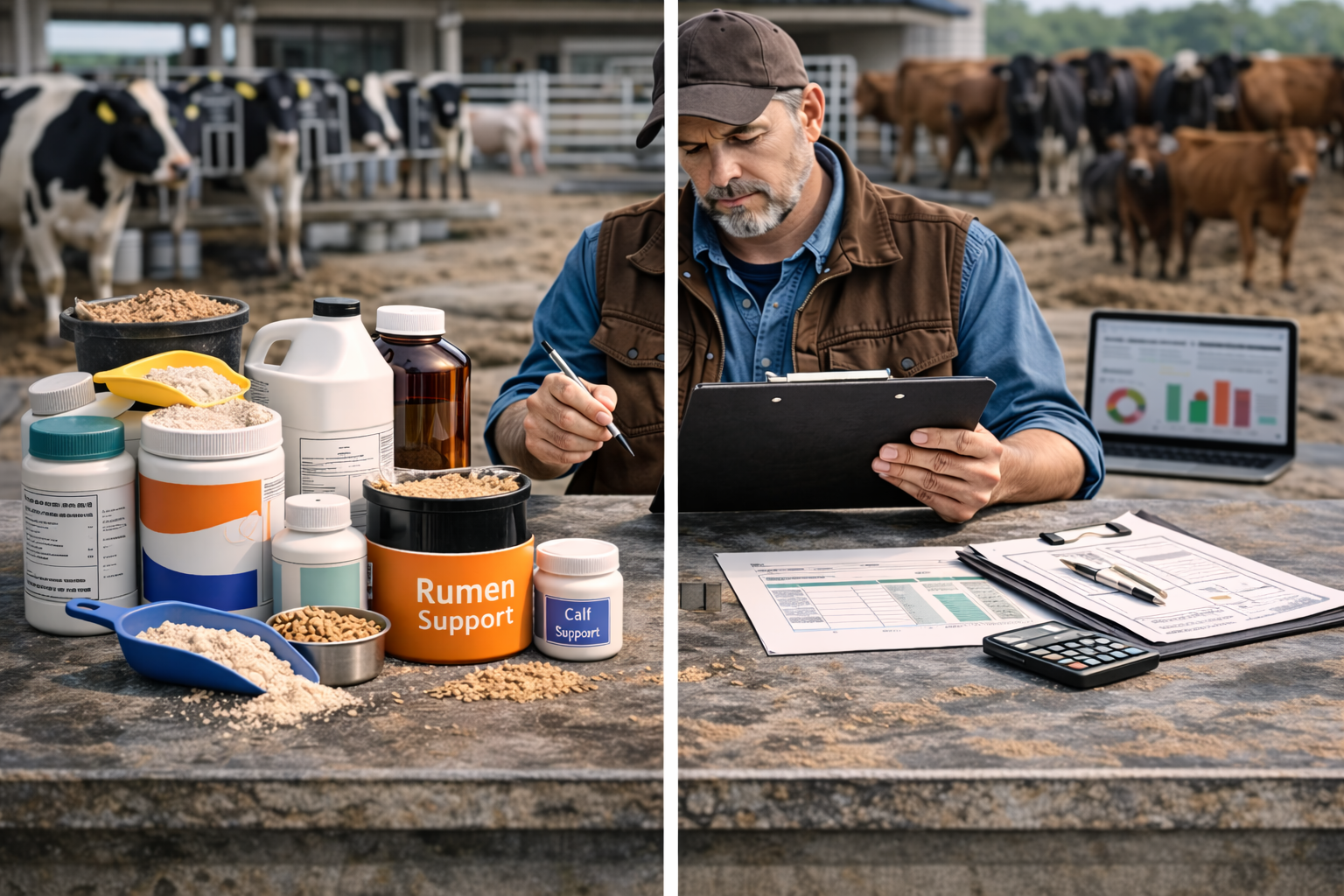
Cattle performance depends on more than simply feeding more volume. Whether you are managing a high-producing dairy herd or running a pasture-based cow-calf operation, profitability is determined by how efficiently your cattle convert feed into milk, muscle, and healthy calves.
When a base ration falls short—due to variable forage quality, seasonal weather, or the intense metabolic demands of lactation and growth—the right cattle feed supplements can close the gap. However, dairy and beef herds have fundamentally different supplementation priorities. Choosing the wrong product, or overlapping supplements unnecessarily, wastes money and fails to solve the real bottlenecks holding your herd back.
This guide answers the most critical question producers and nutrition buyers face: Which cattle feed supplements does my dairy or beef herd actually need, and how do I choose the right ones without wasting money? Read on to learn how to match supplement categories to your production goals, evaluate labels, and build a targeted, commercially intelligent cattle nutrition strategy.
What are cattle feed supplements?

Summary of Key Facts:
What Cattle Feed Supplements Actually Are
To use supplements profitably, you must understand their specific role in cattle nutrition.
Cattle feed supplements are highly targeted tools designed to address specific physiological and digestive demands. They differ from the complete feed or base ration, which provides the bulk macronutrients (carbohydrates and crude fiber). Because ruminants rely on a complex stomach to ferment forage, a base ration is rarely perfect. Forage quality changes by the season, field, and cutting.
Supplements fit into a cattle feeding program as the balancing mechanism. They correct deficiencies and optimize the rumen environment. Effective supplementation is about precision—correcting a specific trace mineral deficiency, buffering a high-starch diet, or feeding the rumen microbes so they can digest low-quality hay. It is never about blindly adding more ingredients to the bunk.
Cattle Feed Supplements vs. Feed Additives
While often grouped together, there is a practical difference between supplements and additives on the farm.
- Feed Additives: These are typically technological or sensory ingredients used to manage the feed itself. Mold inhibitors, silage inoculants, flavorings, and pellet binders are additives. Their primary job is feed preservation and handling.
- Feed Supplements: These are nutritional and functional products designed to interact with the cow’s biology. Mineral programs, bypass proteins, and vitamin packs are supplements.
- Performance Support Categories / Functional Nutrition: Products like live yeast, probiotics, and ionophores often straddle the line (classified regulatorily as additives but used practically as supplements). In a cattle operation, these are used to actively modify rumen fermentation or support the immune system.
The practical distinction: an additive protects your feed; a supplement improves your cattle.
Why Cattle Herds Use Supplements
Successful herd managers use supplements to achieve specific, measurable outcomes. Common goals include:
- Better milk production: Driving higher peak milk and sustaining lactation persistency in dairy cows.
- Stronger milk components: Improving milk fat and true protein percentages through rumen buffering and specific fatty acids.
- Improved fertility: Boosting conception rates and reducing days open through targeted trace mineral and vitamin E/selenium status.
- Better growth and weight gain: Accelerating Average Daily Gain (ADG) in stockers and feedlot cattle.
- Better feed efficiency: Helping the rumen microbes extract more energy from every pound of dry matter consumed.
- Stronger rumen function: Stabilizing rumen pH to prevent subacute ruminal acidosis (SARA) on high-grain diets.
- Correcting mineral gaps: Preventing grass tetany (magnesium deficit) or milk fever (calcium imbalance).
- Supporting calves and youngstock: Accelerating rumen development and strengthening immunity in replacement heifers and beef calves.
- Helping during stress periods: Maintaining dry matter intake (DMI) during extreme heat, extreme cold, or weaning.
- Supporting herd condition and resilience: Maintaining optimal Body Condition Score (BCS) on dormant winter pastures.
Main Types of Cattle Feed Supplements
Mineral Supplements
- What it is: Macro-minerals (calcium, phosphorus, magnesium, potassium, sodium, sulfur).
- What it does: Builds the skeleton, supports muscle contraction, and balances cellular fluids.
- When it is useful: Year-round, but specifically adjusted for lush spring grass (magnesium) or lactation (calcium/phosphorus).
- Which cattle benefit: All cattle, particularly lactating cows and growing calves.
- Outcome supported: Prevention of metabolic crashes (e.g., milk fever, grass tetany).
Trace Mineral Supplements
- What it is: Micro-minerals like zinc, copper, manganese, selenium, iodine, and cobalt.
- What it does: Acts as catalysts for enzymes, reproductive hormones, and immune cell function.
- When it is useful: Continually. Essential prior to breeding and calving.
- Which cattle benefit: Breeding stock (dairy and beef) and newborn calves.
- Outcome supported: High conception rates, healthy hooves, and strong immune response.
Vitamin Supplements
- What it is: Fat-soluble (A, D, E) and sometimes B-complex vitamins (though rumen microbes synthesize most B vitamins).
- What it does: Drives tissue repair, calcium absorption, and antioxidant defense.
- When it is useful: When feeding stored, aged forages, or during periods of high oxidative stress.
- Which cattle benefit: Confined dairy herds, feedlot cattle, and wintering beef cows.
- Outcome supported: Vision, bone growth, and mastitis resistance.
Protein Supplements
- What it is: Rumen-degradable protein (urea/NPN) or rumen-undegradable “bypass” protein (treated soybean or blood meal).
- What it does: Feeds the rumen microbes (degradable) or directly feeds the cow’s lower gut (bypass).
- When it is useful: When grazing mature, low-quality winter forage, or during early lactation.
- Which cattle benefit: Wintering beef cows, early-lactation dairy cows, and growing stockers.
- Outcome supported: Sustained milk yield and maintaining BCS on poor forage.
Energy Supplements
- What it is: High-density calories from bypass fats, tallow, or molasses.
- What it does: Increases energy intake without taking up excess physical space in the rumen.
- When it is useful: When cows cannot eat enough dry matter to meet their caloric needs.
- Which cattle benefit: Fresh dairy cows and finishing feedlot steers.
- Outcome supported: Prevention of severe weight loss (negative energy balance) and improved carcass finish.
Rumen Support Supplements
- What it is: Rumen buffers like sodium bicarbonate.
- What it does: Neutralizes excess acid produced by fermenting grains.
- When it is useful: When feeding “hot,” high-starch rations.
- Which cattle benefit: High-producing dairy cows and feedlot cattle.
- Outcome supported: Prevention of acidosis and butterfat depression.
Yeast, Probiotics, and Prebiotics
- What it is: Live Saccharomyces cerevisiae yeast, bacterial strains, and microbial feed sources.
- What it does: Scavenges oxygen in the rumen, stimulates fiber-digesting bacteria, and stabilizes gut health.
- When it is useful: During ration changes, heat stress, or weaning.
- Which cattle benefit: Transition dairy cows, receiving feedlot cattle, and young calves.
- Outcome supported: Higher DMI, better fiber digestion, and scours prevention.
Electrolyte Support
- What it is: Salts (sodium, potassium, chloride) formulated for water or feed inclusion.
- What it does: Restores cellular hydration.
- When it is useful: During severe heat stress, transport, or calf diarrhea.
- Which cattle benefit: Transported calves, scouring calves, and heat-stressed dairy herds.
- Outcome supported: Survival and rapid recovery.
Liquid Feed Supplements
- What it is: Molasses-based suspensions carrying urea, vitamins, and minerals.
- What it does: Provides highly palatable nutrients while reducing dust in mixed feeds.
- When it is useful: To improve the palatability of poor-quality hay or dry TMRs.
- Which cattle benefit: Feedlot cattle, dairy heifers, and pasture-based beef herds.
- Outcome supported: Consistent intake and improved forage utilization.
Lick Tubs and Blocks
- What it is: Solidified molasses, protein, and mineral blocks.
- What it does: Allows cattle to self-supplement in remote locations.
- When it is useful: Extensive grazing where daily feeding is impossible.
- Which cattle benefit: Cow-calf pairs and stockers on large pastures.
- Outcome supported: Labor-efficient baseline supplementation.
Transition Support Supplements
- What it is: Anionic salts (DCAD diets), calcium boluses, and liver support (choline/betaine).
- What it does: Prepares the cow’s metabolism for the massive calcium and energy draw of calving and milking.
- When it is useful: 21 days pre-calving to 21 days post-calving.
- Which cattle benefit: Dairy cows.
- Outcome supported: Prevention of milk fever, retained placentas, and ketosis.
Calf Support Supplements
- What it is: Colostrum replacers, targeted probiotics, and essential oil blends.
- What it does: Builds initial immunity and establishes a healthy gut microbiome.
- When it is useful: From birth through weaning.
- Which cattle benefit: Dairy replacement heifers and high-risk beef calves.
- Outcome supported: Zero mortality and explosive early growth.
Amino Acid Support
- What it is: Rumen-protected Lysine and Methionine.
- What it does: Balances the specific amino acid profile required for milk protein synthesis.
- When it is useful: When maximizing milk component payouts.
- Which cattle benefit: Lactating dairy cows.
- Outcome supported: Higher milk true protein without overfeeding expensive crude protein.
Dairy vs. Beef: What Changes?
Cattle are cattle, but a dairy cow producing 100 pounds of milk a day and a beef cow raising a calf on native grass live in different metabolic universes.
Dairy Cattle Priorities
- Lactating Cows: The goal is maximum intake and milk component output. They require perfectly balanced macro-minerals, rumen buffers, protected amino acids, and bypass energy. A common mistake is feeding high starch without adequate rumen buffering, destroying butterfat.
- Dry Cows: The goal is rumen rehabilitation and fetal growth. Supplements shift toward moderate trace minerals and strictly controlled energy to prevent fat cows.
- Transition Cows (Pre/Post Calving): This is the highest-risk period. The goal is metabolic survival. They require anionic salts to manipulate blood pH (DCAD diets) to mobilize calcium and prevent milk fever, alongside liver support to prevent ketosis.
- Heifers: The goal is steady frame growth without fattening the mammary gland. Supplements focus on basic vitamin/mineral premixes and ionophores for feed efficiency.
- Calves: The goal is immune survival and rumen development. Priority goes to high-quality milk replacers, probiotics, and targeted respiratory/gut support.
Beef Cattle Priorities
- Cow-Calf Herds: The goal is one live calf per cow per year, fueled by cheap forage. The biggest nutritional gap is usually winter protein and year-round trace minerals. A common mistake is buying cheap oxide-based minerals that pass through the cow unabsorbed, leading to poor conception rates.
- Stockers / Growers: The goal is cheap frame growth on grass. They require ionophores, trace minerals, and targeted protein to maximize forage digestion.
- Feedlot Cattle: The goal is explosive, efficient daily gain and carcass marbling. They require heavy rumen buffers, Vitamin A, and targeted trace minerals to survive the stress of a high-grain, high-energy diet.
- Replacement Heifers: The goal is reaching target breeding weight (65% of mature weight) by 14 months. They require excellent trace mineral status and energy support to trigger puberty.
- Calves: Beef calves mostly rely on the cow’s milk, but may require creep feed supplements (minerals, yeast) to reduce weaning stress.
Signs Your Herd May Need Better Supplementation
Cattle signal their nutritional gaps long before a blood test confirms them. Watch for these practical indicators:
- Poor milk output: Dairy herds failing to peak, or dropping off too sharply after 90 days in milk.
- Poor body condition: Cows showing ribs and spine (low BCS) despite adequate forage availability.
- Weak fertility or reproduction performance: High rates of open cows, cystic ovaries, retained placentas, or silent heats.
- Inconsistent growth: Stockers or feedlot steers falling short of targeted Average Daily Gain (ADG).
- Poor feed conversion: Cattle eating heavily but not gaining or milking efficiently, indicating poor rumen fermentation.
- Weak calf performance: High rates of scours, dull coats, or a “pot-bellied” appearance in youngstock.
- Poor forage utilization: Cattle leaving too much low-quality hay behind, or undigested grain/long fiber visible in the manure.
- Stress-related performance decline: Severe drops in intake during heat waves or abrupt weather changes.
- Low mineral status indicators: Rough, dull hair coats (often a copper/zinc issue), hoof lesions, or dirt-eating (pica).
- General underperformance: A herd that looks “okay” but consistently misses industry-standard profitability benchmarks.
How to Choose the Right Cattle Feed Supplement
Building a profitable supplementation strategy requires a disciplined decision framework. Before buying a product, evaluate:
- Herd Type & Life Stage: A dry dairy cow and a feedlot steer will both die if fed the other’s targeted supplement. Match the product precisely to the animal’s current physiological state.
- Production Goal: Are you trying to fix a problem (e.g., poor conception) or push an outcome (e.g., higher butterfat)?
- Forage or Silage Quality: Test your forage. A supplement’s only job is to fill the gap left by your forage. If your hay is 18% protein, buying a protein tub is a total waste of money.
- Grazing vs. Confinement: Confined cattle get their supplements precisely mixed into a TMR. Grazing cattle require weather-resistant, free-choice delivery methods.
- Stress and Seasonal Factors: Summer heat requires electrolytes and yeast; winter grazing requires protein to fuel fiber digestion.
- Delivery Method & Consistency of Intake: If you buy a loose mineral that is bitter, cattle won’t eat it. If intake is inconsistent, the supplement fails.
- Formulation Quality & Ingredient Transparency: Look at the chemical form. Copper sulfate or organic copper is highly available; copper oxide is essentially rock dust.
- Compatibility with the Base Ration: Ensure a new supplement does not bind with or antagonize an existing ingredient (e.g., high sulfur/molybdenum in water tying up copper).
- Storage and Handling: Do not buy liquid supplements if you lack tanks, and do not buy bulk yeast products if your feed shed is hot and humid.
- Supplier Credibility: Buy from companies that offer on-farm nutrition consulting, not just slick brochures.
Liquid vs. Powder vs. Mineral Mix vs. Block vs. Top-Dress
| Supplement Form | Best Use Cases | Strengths & Limitations | Fit for Dairy vs. Beef |
|---|---|---|---|
| Liquid Feed | TMR conditioning, lick tanks on pasture. | Strengths: Palatable, reduces dust, carries urea well. Limitations: Requires specialized tanks/pumps. | High fit for feedlot and large dairy TMRs; good for beef pasture tanks. |
| Powder / Micro-Premix | Precision feeding in total mixed rations. | Strengths: Highly accurate dosing. Limitations: Must be mechanically mixed; prone to wind loss. | Essential for dairy and feedlot; rare in grazing beef. |
| Loose Mineral Mix | Free-choice stations or TMR inclusion. | Strengths: Cost-effective, adjustable. Limitations: Intake can vary wildly by individual cow. | Standard for dairy TMRs and actively managed beef pastures. |
| Blocks / Tubs | Extensive grazing and remote pastures. | Strengths: Weatherproof, zero daily labor. Limitations: Expensive per unit of nutrient; dominant cows may over-consume. | Excellent for beef cow-calf and stockers; poor for milking dairy cows. |
| Top-Dress / Pellets | Individual cow management, robotic milkers. | Strengths: Highly targeted to the specific animal. Limitations: Labor intensive unless automated. | High fit for dairy (robots/parlors) and show/seedstock beef. |
Common Mistakes When Buying Cattle Supplements
- Choosing based on marketing instead of herd need: Buying a “magic rumen booster” without fixing a fundamentally broken, high-acid base ration.
- Ignoring forage quality: Guessing what the herd needs without pulling forage and silage samples first.
- Not separating dairy and beef priorities: Feeding high-calcium dairy minerals to dry beef cows, risking metabolic imbalances.
- Underestimating mineral imbalances: Buying cheap oxide-form minerals and wondering why hoof health and conception rates remain terrible.
- Overlapping too many products: Feeding a complete commercial pellet, plus a mineral pack, plus a vitamin tub, leading to expensive and dangerous toxicities (e.g., selenium).
- Ignoring intake consistency: Putting out a mineral feeder but letting it sit empty for three days a week.
- Not checking label concentration: Buying the cheapest bag, only to realize you have to feed four times as much to get the required active ingredients.
- Poor storage: Leaving probiotics or enzymes in direct sunlight, killing the active biology.
- Expecting supplements to fix management failures: Supplements cannot cure overcrowded pens, filthy water troughs, or poor bunk management.
How to Read a Cattle Supplement Label
A cattle supplement label is a legal document that tells you exactly what you are paying for. Here is what to evaluate:
- Active Ingredients: Look at the source. Is the zinc coming from zinc sulfate (good) or zinc oxide (poor)?
- Concentration: Check the guaranteed analysis. Is the active ingredient present in trace amounts (ppm) or robust percentages (%)?
- Intended Cattle Type: Ensure it explicitly states “Lactating Dairy Cows,” “Beef Cows on Pasture,” or “Feedlot Steers.”
- Directions for Use: Does it require mixing into a TMR, or can it be fed free-choice?
- Claims: Are the claims specific (e.g., “Aids in the prevention of grass tetany”) or vague (e.g., “Supports cow wellness”)?
- Dosage or Intake Guidance: Check the targeted daily intake (e.g., 4 oz per head per day). If your cows eat 8 oz, it is costing you double.
- Caution Statements: Look for strict warnings, such as “Do not feed to sheep” (due to copper) or withdrawal times for medicated feeds.
- Storage Requirements: Does it need to be kept cool and dry to keep yeasts alive?
- Manufacturer Transparency & Quality Signals: Look for lot numbers, clear contact info, and industry quality certifications (e.g., Safe Feed/Safe Food).
Do Cattle Feed Supplements Really Improve Performance?
Yes, absolutely—when they fill a verified nutritional void.
When they help significantly: Supplements yield massive ROI when they target specific, limiting factors. For example, adding an ionophore to a stocker steer’s diet will demonstrably improve feed efficiency. Feeding anionic salts to a pre-fresh dairy cow will drastically reduce the incidence of clinical milk fever. Providing a high-quality trace mineral to a beef herd 60 days before breeding will noticeably tighten the calving window.
When results are limited: If your dairy cows are locked in a poorly ventilated barn with limited bunk space, no amount of yeast or bypass protein will force them to milk better. If your beef cows are standing in knee-deep mud, an expensive energy tub will not fix their body condition.
Supplements are precision tools, not magic fixes. The results you get are entirely dependent on forage quality, intake consistency, herd management, and stress load.
How to Choose a Reliable Supplier or Manufacturer
To ensure you aren’t paying premium prices for limestone dust and molasses, evaluate suppliers on these traits:
- Formulation Transparency: They clearly list their ingredient sources and guarantee their analysis without hiding behind secretive “proprietary blends.”
- Cattle-Specific Targeting: They offer distinct, scientifically backed product lines for dairy transition, dairy lactation, beef pasture, and feedlot—not just one “all-stock” bag.
- Technical Support: They provide access to ruminant nutritionists who will analyze your forage tests and recommend a tailored program.
- Consistency: Every batch looks, smells, and flows identically through your mixing equipment.
- Practical Feeding Guidance: They provide realistic expectations regarding free-choice intake management and palatability.
- Reputation and Trust Signals: They have a proven track record, zero recall history for cross-contamination, and strict quality control measures suitable for commercial dairy or beef operations.
Quick-Reference Comparison Tables
Supplement Type vs. Herd Goal
| Supplement Category | Primary Herd Goal |
|---|---|
| Bypass Protein | Sustaining milk yield / avoiding muscle loss on poor forage |
| Rumen Buffers (Bicarb) | Stabilizing rumen pH on high-starch / high-grain diets |
| Live Yeasts / Probiotics | Boosting fiber digestion and maintaining DMI during heat stress |
| Trace Minerals (Cu, Zn, Mn) | Maximizing conception rates and building strong hooves |
| Anionic Salts (DCAD) | Preventing milk fever in transition dairy cows |
Dairy vs. Beef Supplement Priorities
| Production Phase | Dairy Cattle Priority | Beef Cattle Priority |
|---|---|---|
| Lactation / Cow-Calf | Maximum DMI, bypass fats, rumen buffers, protected amino acids | Cheap forage utilization, protein tubs, pasture mineral blocks |
| Dry / Gestation | Controlled energy, DCAD management, liver support | BCS maintenance, winter protein, vitamin A & E |
| Growing / Stockers | Rumen development, balanced frame growth | Ionophores, trace minerals, cheap ADG on grass |
| Finishing | N/A (Cull cows) | Heavy rumen buffers, high energy, carcass marbling support |
Herd Problem vs. Likely Supplement Direction
| Observed Herd Problem | Likely Nutritional Gap | Suggested Supplement Direction |
|---|---|---|
| High rates of open cows | Trace mineral deficiency (Cu, Zn, Se) | Bioavailable (chelated/hydroxy) trace mineral pack |
| Butterfat depression | Rumen acidosis (low pH) | Rumen buffers, yeast, adjust effective fiber |
| Cows losing extreme weight | Negative energy balance | Bypass fats, high-quality bypass protein |
| Grass tetany on spring grass | Magnesium deficiency | High-magnesium mineral mix fed 30 days prior |
FAQ: Common Questions About Cattle Supplementation
What are cattle feed supplements?
They are concentrated nutritional products—like minerals, vitamins, proteins, and rumen modifiers—added to a base diet to correct deficiencies and optimize herd performance.
Do dairy and beef cattle need different supplements?
Yes. High-producing dairy cows require precision supplementation for extreme milk and component output, while beef cattle generally require supplements designed to maximize the digestion of variable pasture forages.
What are the best mineral supplements for cattle?
The best mineral supplements use highly bioavailable sources (like hydroxy or organic/chelated trace minerals) and are custom-balanced to offset the specific mineral deficiencies of your local forage and water.
What helps cattle gain weight efficiently?
Ionophores, targeted protein to stimulate rumen microbes, feed enzymes, and a properly balanced macro-mineral profile all improve Average Daily Gain and feed efficiency.
What supplements support milk production?
Rumen buffers to maintain digestion, bypass fats for dense energy, protected amino acids for milk protein synthesis, and yeast to drive higher dry matter intake.
Are liquid cattle supplements better than powder?
Liquid supplements are excellent for reducing dust in a TMR and ensuring cattle cannot sort their feed. Powders (micro-premixes) are better for highly precise, low-inclusion nutrient delivery.
How do I know if my herd needs more mineral support?
Look for dull hair coats, poor hoof health, low conception rates, and retained placentas. Always confirm with forage testing and, if necessary, blood or liver biopsies.
Can the same supplement be used across all cattle?
No. Feeding a high-calcium lactating dairy mineral to a dry beef cow can cause metabolic issues, and feeding feedlot rations to a replacement heifer will ruin her udder development.
Do supplements replace a balanced ration?
Never. Supplements are designed to optimize a balanced ration, not to replace the fundamental energy and effective fiber required for a healthy ruminant.
What should I check before buying a cattle supplement?
Verify the targeted cattle class, the concentration of active ingredients, the chemical form of the minerals (bioavailability), the daily required intake, and the cost per head per day.
The Next Step in Herd Performance
Profitable cattle nutrition is not a guessing game. The most successful dairy managers and beef producers do not buy generic supplements based on colorful bags; they buy precise nutritional tools to solve specific operational bottlenecks.
Whether your goal is to push milk components higher, tighten your calving window, or maximize the daily gain of your feedlot steers, the path forward is the same: test your forage, identify your primary performance gap, and select the exact cattle feed supplement engineered to close it.
Your Next Step: Review your herd’s current performance data and pull fresh forage samples. Once you know exactly what your base ration is lacking, reach out to a transparent, cattle-focused manufacturer or ruminant nutritionist. Compare labels, insist on bioavailable ingredients, and build a targeted supplementation strategy that drives measurable returns for your operation.