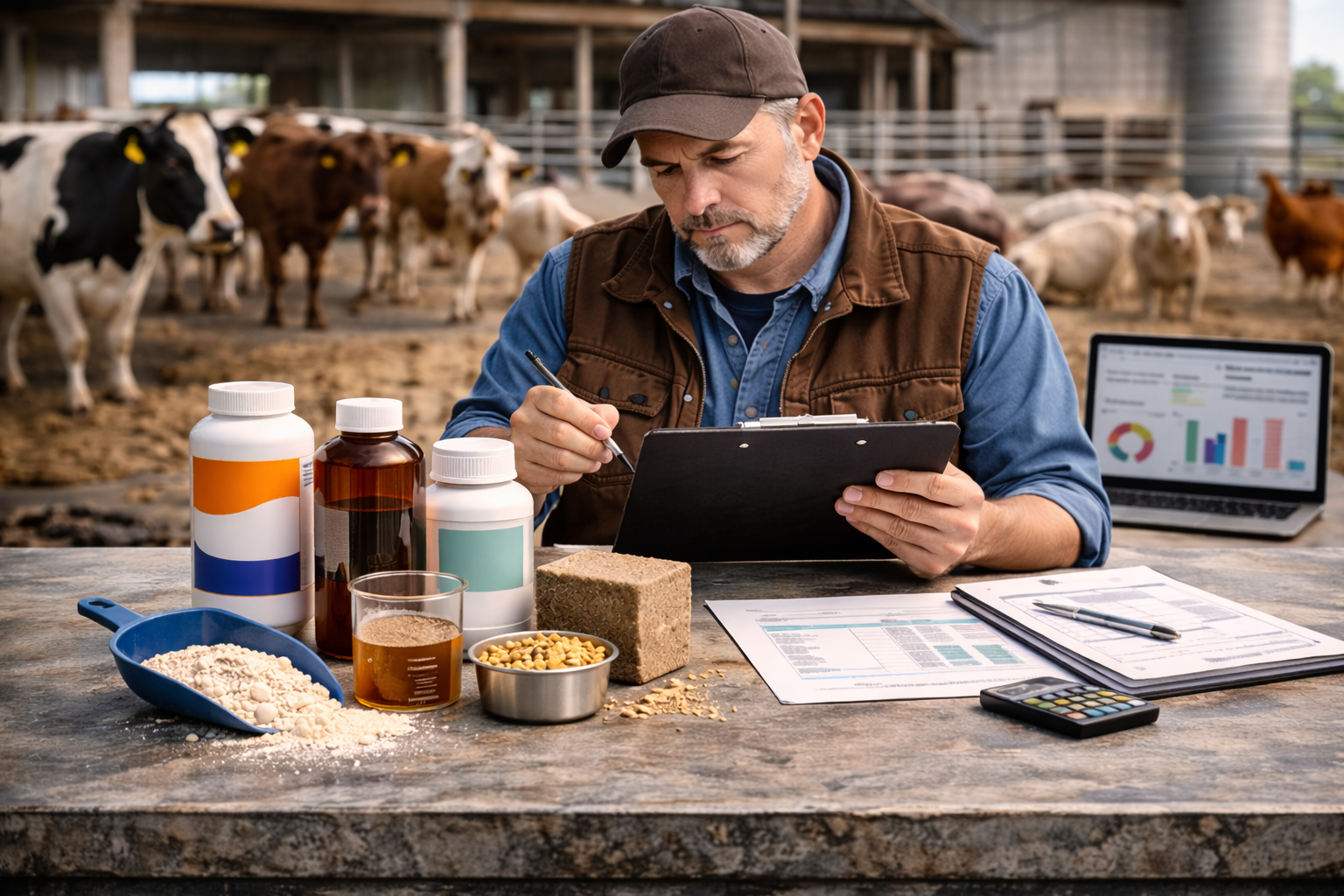
Better livestock performance does not come from simply feeding animals more volume. It comes from feeding them more precisely. Maximizing health, growth, and productivity requires identifying exactly where your base ration is strong, where it falls short, and which specific inputs will effectively bridge that gap.
This is why livestock supplementation matters. When chosen correctly, the right product improves feed conversion, strengthens immunity, and supports high-yield reproduction. When chosen poorly, it duplicates nutrients you are already paying for, inflates your overhead, and delivers zero measurable return.
This guide answers the most critical question producers and farm managers face: Which livestock feed supplement do I actually need, and how do I choose one that improves farm outcomes without wasting money? Below, you will learn how to evaluate your herd’s nutritional gaps, select the exact category of support required, and bypass marketing hype to make commercially intelligent buying decisions.
What are livestock feed supplements?

Summary of Key Facts:
What Livestock Feed Supplements Are
Feed supplements act as the precision layer of your feeding program. While your base ration—composed of forage, grains, and roughage—supplies the bulk of the required calories and crude protein, it is rarely perfectly balanced. Soils deplete, forage quality fluctuates, and high-producing animals demand more than basic commodities can reliably deliver.
This is where supplements fit into the feeding strategy. They are not designed to replace your base livestock feed; they are engineered to complete it. By adding micro-doses of specific nutrients or digestive aids, these products ensure that the animal’s metabolism operates at peak efficiency, turning standard animal feed into a high-performance diet.
Feed Supplements vs. Feed Additives
While often used interchangeably, there is a practical distinction between supplements and additives.
- Feed Additives: This is a broad, regulatory term that includes technological and sensory ingredients. Preservatives, mold inhibitors, pellet binders, and flavorings are all additives. Their primary job is often to protect the feed itself or improve its physical handling.
- Feed Supplements: This refers to nutritional and performance-enhancing support categories. Vitamins, trace minerals, and bypass proteins are supplements. Their primary job is to directly impact the animal’s physiology, correcting deficiencies and driving health and productivity.
In practical terms, an additive manages the feed; a supplement manages the animal.
Why Livestock Producers Use Feed Supplements
Serious producers do not buy supplements as a luxury; they buy them as an investment with a required return. Common operational goals include:
- Better Growth: Accelerating daily weight gain in young stock and finishing animals to reduce days on feed.
- Improved Feed Efficiency: Helping the animal extract more usable energy and protein from every pound of feed consumed (lowering the Feed Conversion Ratio).
- Stronger Immunity: Equipping the animal’s immune system to fight off pathogens, reducing veterinary costs and mortality rates.
- Better Reproduction: Improving conception rates, embryo survival, and reducing calving/farrowing intervals through optimized mineral and vitamin status.
- Improved Milk or Meat Production: Driving higher peak lactation in dairy cows or better carcass yield and marbling in beef and swine.
- Improved Mineral Status: Preventing costly metabolic disorders like milk fever or grass tetany caused by calcium or magnesium imbalances.
- Better Stress Tolerance: Maintaining intake and reducing weight loss during heat waves, transport, or weaning.
- Gut Health Support: Stabilizing the microbiome to prevent scours and improve nutrient absorption.
- Correcting Nutrient Gaps: Balancing out poor-quality seasonal forage or inconsistent grain harvests.
Main Types of Livestock Feed Supplements
Understanding how to classify these products is the first step in avoiding redundant purchases.
Vitamin Supplements
- What it is: Concentrated fat-soluble (A, D, E, K) and water-soluble (B-complex) vitamins.
- What it does: Supports bone development, vision, blood clotting, and metabolic processes.
- When it is useful: During winter feeding, prolonged stress, or when feeding stored, older forages.
- Which livestock benefit: All classes, especially indoor-housed swine and high-producing dairy cows.
- Goal supported: Immunity, reproduction, and overall vitality.
Mineral Supplements
- What it is: Macro-minerals like calcium, phosphorus, magnesium, and sodium.
- What it does: Builds skeletal structure and regulates muscle and nerve function.
- When it is useful: Continually, but critical during late gestation, lactation, and rapid skeletal growth.
- Which livestock benefit: Dairy cows, laying hens, and growing calves.
- Goal supported: Milk production, bone health, and preventing metabolic crashes.
Trace Minerals
- What it is: Micro-minerals like zinc, copper, selenium, manganese, and iodine.
- What it does: Acts as catalysts for enzymes, hormones, and immune responses.
- When it is useful: In areas with known soil deficiencies or to boost reproductive success.
- Which livestock benefit: Breeding stock, grazing beef cattle, and sheep.
- Goal supported: Fertility, hoof health, and disease resistance.
Amino Acid Supplements
- What it is: Synthetic, essential building blocks of protein (e.g., lysine, methionine, threonine).
- What it does: Balances the protein profile without overfeeding crude protein.
- When it is useful: When trying to maximize lean muscle growth or milk protein while minimizing nitrogen waste.
- Which livestock benefit: Swine, poultry, and high-yield dairy cows (as rumen-protected forms).
- Goal supported: Lean tissue growth and feed efficiency.
Protein Supplements
- What it is: Concentrated nitrogen sources, such as soybean meal, bypass proteins, or non-protein nitrogen (urea).
- What it does: Feeds the rumen microbes or provides direct absorbable protein to the intestine.
- When it is useful: When grazing low-quality, mature pastures or feeding poor-quality hay.
- Which livestock benefit: Beef cattle on winter pasture, dairy cows in early lactation.
- Goal supported: Maintaining body condition and sustaining milk output.
Energy Supplements
- What it is: High-calorie additions like bypass fats, tallow, or molasses.
- What it does: Drastically increases the energy density of a ration without adding excessive grain bulk.
- When it is useful: When animals cannot physically eat enough volume to meet their caloric demands.
- Which livestock benefit: Early lactation dairy cattle and finishing beef steers.
- Goal supported: Preventing severe weight loss and driving milk/meat volume.
Probiotics and Prebiotics
- What it is: Live beneficial bacteria (probiotics) and the fibers that feed them (prebiotics).
- What it does: Competitively excludes bad bacteria and stabilizes the gut pH.
- When it is useful: Following antibiotic treatments, during weaning, or during feed transitions.
- Which livestock benefit: Calves, piglets, and transition cows.
- Goal supported: Gut health, scours prevention, and nutrient absorption.
Enzymes
- What it is: Biological catalysts like phytase or xylanase.
- What it does: Breaks down complex, indigestible plant materials to release locked nutrients.
- When it is useful: When feeding high-grain diets or rations heavy in alternative by-products.
- Which livestock benefit: Swine and poultry.
- Goal supported: Feed efficiency and lowering total feed costs.
Toxin Binders
- What it is: Clays, yeast cell walls, or polymers.
- What it does: Binds to mycotoxins in moldy grains, allowing them to pass harmlessly through the digestive tract.
- When it is useful: When feeding weather-damaged grain or silage.
- Which livestock benefit: Swine, dairy cows, and poultry.
- Goal supported: Liver protection, preserving feed intake, and preventing abortion.
Electrolyte Support
- What it is: Salts and minerals (sodium, potassium, chloride) often mixed with simple sugars.
- What it does: Restores cellular fluid balance and encourages water intake.
- When it is useful: During severe heat stress, transport, or bouts of diarrhea.
- Which livestock benefit: Transported beef calves, scouring piglets, and heat-stressed dairy cows.
- Goal supported: Survival, hydration, and rapid recovery.
Stress Support Formulations
- What it is: Blends of antioxidants (Vitamin E, Selenium), electrolytes, and energy.
- What it does: Mitigates the physiological damage caused by cortisol and oxidative stress.
- When it is useful: Processing, weaning, or extreme weather shifts.
- Which livestock benefit: All highly managed livestock.
- Goal supported: Minimizing weight shrink and immune suppression.
Liquid Supplements
- What it is: Molasses-based suspensions carrying proteins, vitamins, and minerals.
- What it does: Provides highly palatable, easily mixed, dust-reducing nutrition.
- When it is useful: In TMR (Total Mixed Rations) or lick tanks on pasture.
- Which livestock benefit: Feedlot cattle and grazing herds.
- Goal supported: Ration palatability and consistent nutrient intake.
Premixes
- What it is: Micro-dosed blends of vitamins and minerals carried in a grain base.
- What it does: Ensures an even distribution of micro-ingredients in large batches of feed.
- When it is useful: When milling your own feed or ordering custom bulk rations.
- Which livestock benefit: All commercial livestock operations.
- Goal supported: Comprehensive baseline nutrition.
Mineral Blocks or Licks
- What it is: Solid, weather-resistant blocks of salt, minerals, and sometimes protein.
- What it does: Allows animals to self-regulate their mineral intake on pasture.
- When it is useful: In extensive grazing setups where daily feeding is impossible.
- Which livestock benefit: Pastured beef, sheep, and goats.
- Goal supported: Preventing pasture-based deficiencies with minimal labor.
Species-Specific Guide
Dairy Cattle
- Common nutritional gaps: Energy deficits in early lactation, calcium crashes at calving.
- Common production goals: Maximizing peak milk yield, maintaining butterfat, and ensuring prompt re-breeding.
- Useful supplement categories: Bypass fats, anionic salts (transition phase), rumen-protected amino acids, and live yeasts.
- Practical buying priorities: Proven bioavailability and formulations that will not disrupt rumen pH.
- Common mistakes: Feeding dry-cow minerals to lactating cows, or overfeeding unprotected fats which coat rumen fibers and depress digestion.
Beef Cattle
- Common nutritional gaps: Vitamin A and protein deficits during winter or drought grazing.
- Common production goals: Cost-effective daily gain, strong weaning weights, and high conception rates in the cow herd.
- Useful supplement categories: Protein tubs, trace mineral loose mixes, and ionophores for feed efficiency.
- Practical buying priorities: Weather-resistant formulas for pasture, and targeted formulas for the feedlot.
- Common mistakes: Buying the cheapest trace mineral mix without checking if the metals are in bioavailable (e.g., chelated or hydroxy) forms.
Calves
- Common nutritional gaps: Inadequate initial immune transfer, lack of rumen development.
- Common production goals: Zero mortality, rapid frame growth, and smooth weaning.
- Useful supplement categories: Probiotics, electrolytes, and targeted vitamin E/Selenium shots or pastes.
- Practical buying priorities: High palatability and easy water solubility.
- Common mistakes: Using poor-quality milk replacers and trying to “fix” the resulting scours with expensive supplements rather than fixing the base diet.
Sheep and Goats
- Common nutritional gaps: Energy shortages in late gestation (causing pregnancy toxemia), selenium/vitamin E deficiency.
- Common production goals: Multiple healthy births, heavy weaning weights, and strong fleece/mohair quality.
- Useful supplement categories: Energy-dense molasses blocks, specific sheep/goat mineral premixes.
- Practical buying priorities: Formulations explicitly labeled for sheep to ensure correct copper levels.
- Common mistakes: Feeding generic “all-stock” minerals to sheep, which can lead to fatal copper toxicity.
Swine
- Common nutritional gaps: Precise amino acid imbalances, gut instability at weaning.
- Common production goals: Rapid lean gain, tight feed conversion ratios, and large, uniform litters.
- Useful supplement categories: Synthetic amino acids, phytase enzymes, toxin binders, and pre/probiotics.
- Practical buying priorities: Strict dosage accuracy and high-quality mixing properties.
- Common mistakes: Ignoring mycotoxin risks in grain and suffering reproductive failure that no vitamin can fix.
Signs Better Supplementation May Be Needed
Animals communicate their nutritional status through performance and behavior. Look for these practical indicators:
- Poor growth: Animals failing to hit standard weight benchmarks for their age.
- Low feed efficiency: Animals consuming vast amounts of feed but lacking the finish or condition to show for it.
- Weak body condition: Ribs and spine showing despite adequate pasture or bunk feed.
- Poor fertility: High rates of open cows, small litters, or retained placentas.
- Stress-related performance decline: Severe milk drops or respiratory issues following minor weather changes.
- Low productivity: Depressed milk butterfat or low fleece weights.
- Recovery challenges: Animals taking too long to bounce back from mastitis or lameness.
- Poor coat or general condition: Rough, dull hair coats or delayed shedding (often a trace mineral or parasite issue).
- Inconsistent weight gain: Some animals thriving while others stall on the exact same ration.
Note: These signs indicate a management or nutritional gap, not a specific disease. Always consult with a veterinarian or nutritionist to rule out illness.
How to Choose the Right Livestock Feed Supplement
This is the commercial core of animal nutrition. To stop wasting money, filter your purchasing decisions through this framework:
- Species and Life Stage: Never buy a generic product. A lactating dairy cow requires a vastly different calcium-to-phosphorus ratio than a growing steer.
- Production Goal: Are you buying to fix a problem (like scours) or to push an outcome (like marbling)? Name the goal before you buy the product.
- Current Ration Quality: Test your forage. If your hay is already 18% protein, buying an expensive protein tub is a waste of capital.
- Environment and Stress Load: A herd facing a brutal summer drought requires different electrolyte and vitamin support than a herd in a climate-controlled barn.
- Ease of Administration: If a powder requires daily top-dressing but you only visit the pasture once a week, the product will fail. Match the form to your labor capacity.
- Dosage Consistency: Can you guarantee every animal gets the right amount?
- Formulation Quality and Bioavailability: Oxide forms of minerals are cheap but poorly absorbed. Sulfates, hydroxy, and chelated forms cost more but actually enter the bloodstream.
- Compatibility: Ensure the new supplement does not bind with or cancel out an additive already in your base feed.
- Storage and Shelf Life: Do not buy a six-month supply of a liquid that degrades in sunlight if you lack proper storage tanks.
- Supplier Credibility: Buy from manufacturers with in-house nutritionists and rigorous quality control standards, not just good marketing.
Liquid vs. Powder vs. Premix vs. Blocks
Choosing the right delivery mechanism reduces labor and ensures accurate dosing.
- Liquid Supplements:
- Pros: Highly palatable, suppresses dust in TMR, prevents animals from sorting their feed.
- Cons: Requires specialized tanks and pumps; can freeze in extreme cold.
- Best for: Feedlots and dairy TMRs.
- Powder (Top-Dress):
- Pros: Great for individualized dosing of sick or high-value animals.
- Cons: Labor-intensive; can be blown away by wind or sorted out by picky eaters.
- Best for: Show animals, small herds, or specific medical interventions.
- Premix:
- Pros: Highly accurate, homogeneous distribution of micro-ingredients.
- Cons: Must be mechanically mixed into a larger batch of feed; not for direct feeding.
- Best for: Commercial operations mixing their own bulk rations.
- Mineral Blocks or Licks:
- Pros: Ultimate convenience; weather-resistant; zero daily labor.
- Cons: Intake is highly variable—boss animals may eat too much, timid animals too little.
- Best for: Extensive grazing operations.
Common Mistakes When Buying Livestock Feed Supplements
Avoid these common pitfalls that drain farm budgets:
- Choosing by marketing claims only: Buying a “magic growth booster” without reading the ingredient tag to see how it actually functions.
- Ignoring base ration quality: Trying to out-supplement a diet composed of moldy grain and rotten hay.
- Using the wrong product for the species: Feeding cattle mineral to sheep, or poultry vitamins to swine.
- Confusing general products with targeted ones: Using a generic “all-stock” block when a specific reproductive trace-mineral blend is required.
- Overlooking dosage concentration: Buying a cheaper bucket that requires feeding three times as much product to reach the same active nutrient level as the premium brand.
- Poor storage: Leaving vitamin packs open in a hot, humid barn, effectively destroying their biological value.
- Overusing supplements: Stacking three different products that all contain high levels of selenium, risking fatal toxicity.
- Expecting supplements to fix poor management: No supplement cures overcrowded pens, dirty water troughs, or poor ventilation.
How to Read a Supplement Label
A label is a legal document, not a billboard. Here is what to evaluate:
- Active Ingredients: Look past the brand name. What is actually driving the result? (e.g., Zinc Methionine vs. Zinc Oxide).
- Concentration: Check the guaranteed analysis. Is the active ingredient present in trace parts-per-million (ppm) or robust percentages (%)?
- Inclusion Rate: How much must be fed per head, per day to achieve the guaranteed analysis?
- Target Species: Ensure it explicitly lists the animals you are feeding.
- Use Instructions: Does it require mixing, or can it be fed free-choice?
- Caution Statements: Look for warnings, such as withdrawal times prior to slaughter or restrictions for certain species.
- Storage Guidance: Does it require temperature control to keep enzymes or probiotics alive?
- Quality Signals: Look for lot numbers, manufacturer contact info, and certifications like Safe Feed/Safe Food.
Do Feed Supplements Really Improve Health, Growth, and Productivity?
Yes, but only when applied logically.
When they work well: Supplements yield massive returns when they precisely fill a diagnosed void. For example, adding an ionophore and bypass protein to a backgrounding steer’s diet will demonstrably increase daily gain and improve feed conversion. Adding a probiotic to a stressed weaned piglet’s diet will measurably reduce mortality.
When results are limited: If your cattle are already grazing lush, nutrient-dense spring pasture, adding a high-end protein tub will result in zero extra growth—the animal simply excretes the excess nitrogen.
Productivity gains depend entirely on the overall feeding and management system. Supplements are force-multipliers for good management, not band-aids for bad management.
How to Choose a Reliable Supplier or Manufacturer
Your supplier should act as a partner in your farm’s profitability. Evaluate them on:
- Transparency: They openly share their ingredient sources, mineral forms, and guaranteed analyses without hiding behind “proprietary blends.”
- Consistency: Every batch looks, smells, and performs exactly the same.
- Technical Support: They employ actual agronomists or nutritionists who will review your forage tests and recommend a product, rather than just sending a salesman.
- Product Specialization: They understand the nuanced differences between dairy, beef, and swine—not just repackaging the same formula with a different label.
- Reputation and Trust Signals: They have a track record of safety, zero recall history for cross-contamination, and strict batch reliability.
Comparison Tables
Table 1: Supplement Type vs. Purpose
| Supplement Type | Primary Farm Purpose | Best Used For |
|---|---|---|
| Trace Minerals | Enzymatic and immune support | Improving herd fertility and hoof health |
| Bypass Protein | Direct amino acid delivery | High-producing dairy cows; growing steers |
| Probiotics | Gut microbiome stabilization | Weaning stress, post-antibiotic recovery |
| Electrolytes | Cellular hydration | Heat stress, transport shrink, scours |
| Enzymes | Breaking down complex feeds | Lowering total feed costs in swine/poultry |
Table 2: Livestock Type vs. Likely Supplement Category
| Livestock Type | Common Goal | Most Likely Supplement Category |
|---|---|---|
| Dairy Cattle | High milk yield & component quality | Bypass fats, rumen buffers, yeast |
| Beef Cattle | Cost-effective frame growth | Protein blocks, ionophores, trace minerals |
| Swine | Lean muscle gain & feed efficiency | Synthetic amino acids, phytase enzymes |
| Sheep / Goats | Multiple births & fleece quality | Sheep-safe (no-copper) mineral mixes |
| Calves | Survival & rapid rumen development | Probiotics, targeted vitamins, electrolytes |
Table 3: Delivery Form vs. Best Use Case
| Delivery Form | Convenience Level | Dosing Control | Best Farm Use Case |
|---|---|---|---|
| Liquid | High | High (if mixed in TMR) | Dust control in large feedlot rations |
| Powder | Low | High (individualized) | Sick pens, show animals, custom top-dress |
| Premix | Medium | Very High | Commercial operations milling their own feed |
| Blocks / Tubs | Very High | Low (free-choice) | Extensive remote pasture grazing |
Table 4: Symptom / Problem vs. Supplement Direction
| Observed Symptom | Likely Nutritional Gap | Suggested Supplement Direction |
|---|---|---|
| Retained Placentas / Open Cows | Selenium / Vitamin E deficiency | Chelated trace mineral mix |
| Poor Feed Conversion | Indigestible complex carbohydrates | Feed enzymes (e.g., xylanase) |
| Severe Heat Stress Panting | Potassium / Sodium depletion | Water-soluble electrolytes |
| Milk Fat Depression | Rumen acidosis (low pH) | Rumen buffers (sodium bicarbonate) |
FAQ Section
What are livestock feed supplements?
They are concentrated additions to a base animal diet designed to fill nutritional gaps, improve digestion, and optimize health and productivity.
Are feed supplements and feed additives the same?
No. Additives often manage the feed itself (like preservatives or flavorings), while supplements directly manage the animal’s nutritional and physiological needs.
What supplements help livestock grow faster?
Bypass proteins, synthetic amino acids, ionophores, and enzyme supplements directly influence daily gain and feed conversion.
Do supplements improve feed efficiency?
Yes. Products like enzymes, yeasts, and probiotics help the animal extract more calories and nutrients from the same volume of feed.
Are liquid feed supplements better than powder?
It depends on the workflow. Liquids are excellent for TMR mixing and dust reduction, while powders offer highly precise dosing for individual animals or custom milled batches.
What are the best mineral supplements for cattle?
The best mineral supplement uses bioavailable forms (like chelated or hydroxy trace minerals) and is specifically formulated to balance the exact deficiencies of your local seasonal forage.
Can the same supplement be used across species?
Rarely. Formulations are species-specific. Feeding a cattle mineral to sheep can cause lethal copper toxicity. Always buy species-targeted products.
How do I know if my livestock need extra supplementation?
Look for stalled growth, poor reproductive rates, rough hair coats, or excessive weight loss during lactation. Always confirm with forage testing and veterinary consultation.
Do supplements replace balanced livestock feed?
Never. Supplements are force-multipliers for good rations; they cannot undo the damage of starving animals or feeding rotten, nutrient-void forage.
What should I check before buying a supplement?
Verify the target species, check the concentration of active ingredients, understand the required daily dosage, and ensure the delivery method fits your farm’s labor setup.
Can I overfeed vitamins and minerals?
Yes. Overfeeding trace minerals like selenium or copper, or fat-soluble vitamins (A, D, E, K), can lead to severe toxicity, organ damage, and death.
When should I use electrolyte supplements?
Deploy electrolytes during periods of heavy fluid loss: severe heat waves, long-distance transport, weaning stress, or outbreaks of scours.
What is a bypass protein?
It is a protein source that resists breakdown in the rumen, passing directly into the lower intestine where it is absorbed highly efficiently by the animal.
How long do feed supplements last in storage?
It varies by ingredient. Minerals are highly stable, but vitamins, probiotics, and enzymes degrade rapidly if exposed to heat, light, and moisture. Check the expiration date.
Strong Closing Section
Achieving top-tier health, growth, and productivity is not a guessing game—it is an exercise in precision. The most profitable producers do not throw money at generic bags of powder hoping for a miracle. They test their forage, identify their exact nutritional bottlenecks, and select the specific livestock feed supplements engineered to break those bottlenecks.
You now possess the framework to evaluate your herd’s needs, decode supplement labels, choose the correct delivery method, and avoid the costly mistakes of redundant supplementation.
Your Next Step: Stop paying for marketing hype and start paying for performance. Review your current ration, identify your primary production goal—whether that is tighter feed conversion, higher weaning weights, or eliminating transition cow crashes—and reach out to a specialized, transparent manufacturer to find the exact formulation your farm needs. Focus on the science, match the product to the species, and watch your operational profitability grow.